Jack Tramiel Got A Good Deal, And Ruined Everything

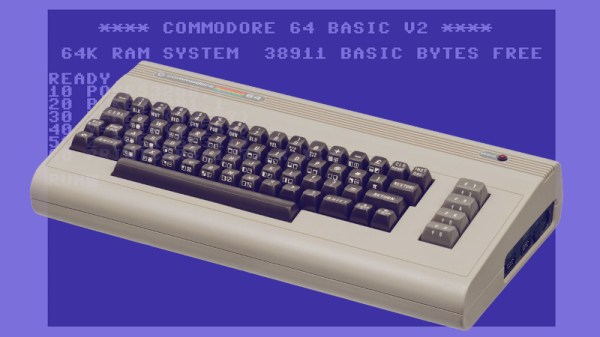
A sideshow in the playground wars of the early 1980s over who had the best home computer lay in the quality of their onboard BASIC interpreters. Where this is being written the cream of the crop was Acorn’s BBC Basic, while Sinclair owners could hold their own, and the Commodore 64 was regarded as powerful, but not easy to program. It’s a teenage memory brought to mind by [Liam Proven], who argues in a blog post that Commodore’s BASIC left a problematic legacy that can still be felt today.

It’s an interesting proposition, and one with its roots in Commodore founder Jack Tramiel’s 1977 deal with Bill Gates to acquire a version of Microsoft BASIC for his machines, in which he paid a one-off fee for unlimited uses of the language rather than a per-sale levy. The argument in the post is that this led to later Commodore machines being hamstrung by an outdated BASIC interpreter as a cost saving measure. It fits well with those 1980s memories from school computer labs, because by comparison its competitors six years after the deal had the benefit of language extensions missing in Commodore’s 64.

Where [Liam]’s analysis becomes interesting is in how he perceives the effect of this long-in-the-tooth BASIC; he postulates that the sheer number of Commodore 8-bit machines sold ensured it had a dominant position in the market place and thus coloured the perception of BASIC as a programming language in the years that followed. We’re not so sure about his view that this led eventually to some of the shortcomings in computing today, but we agree wholeheartedly with him that Commodore were less than competent in marketing their hardware.

We look forward to hearing your take on the matter in the comments, and meanwhile for some perspectives on the Commodore of the day who better to relate them than somebody who had a ringside seat. Our colleague [Bil Herd] has shared with us some of his Commodore recollections over the years, including the Commodore 128 story, an account of the 1985 CES show, and a two-parter on the TED chip and its speech capabilities.

Header image: Commodore BASIC / Public Domain, and Evan-Amos / Public domain.
FPGA Raises Component Video From A Sinclair ZX Spectrum

An abiding memory of the early-80s heyday of 8-bit computing for many is operating their computer from the carpet in front of the family TV. While the kids in the computer adverts had parents who bought them a portable colour telly on which to play Jet Set Willy, the average kid had used up all the Christmas present money on the computer itself. The cable would have been an RF connection to the TV antenna socket, and the picture quality? At the time we thought it was amazing because we didn’t know any different, but with the benefit of nearly 40 years’ hindsight, it was awful.

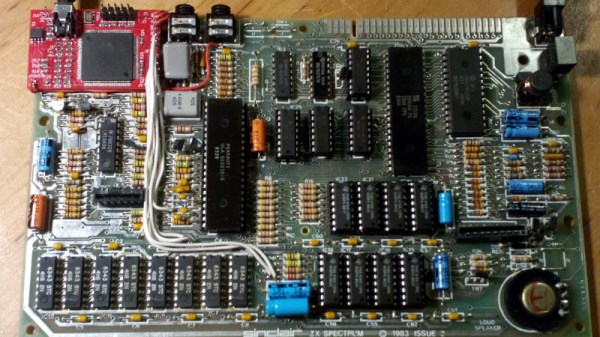
For ZX Spectrum owners in 2020 a standard modification is to bring out a composite video signal, but [c0pperdragon] has gone a step or two beyond that with a component video interface. And this isn’t a mod in which the signals are lifted from the Spectrum’s colour encoder circuitry, instead it uses an FPGA hooked directly to the ULA chip to generate the component video itself.

The Altera chip sits on a little PCB designed to occupy the footprint of the original Astec modulator, and sports a neat bundle of wires hooked up to the various Spectrum signals it needs. There are a couple of jumpers to select the output type and resolution, it supports YPbPr or RGsB outputs and both 288p and 576p. If you think perhaps it looks a little familiar, that’s because it’s the sister project of an earlier board for the Commodore 64. So if you have a Spectrum and are annoyed by UHF and PAL, perhaps it’s worth a look.

Microsoft Releases The Source Code You Wanted Almost 30 Years Ago

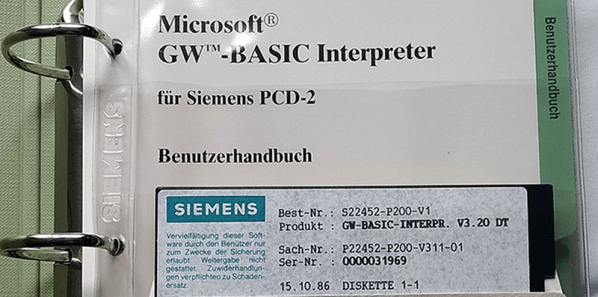
In the late 1970s and early 1980s, if you had a personal computer there was a fair chance it either booted into some version of Microsoft Basic or you could load and run Basic. There were other versions, of course, especially for very small computers, but the gold standard for home computer Basic was Microsoft’s version, known then as GW-Basic. Now you can get the once-coveted Microsoft Basic source code for the 8086/8088 directly from Microsoft in the state you would have found it in 1983. They put up a read only GW-BASIC repository, presumably to stop a flood of feature requests for GPU acceleration.

You might wonder why they would do this? It is certainly educational, especially if you are interested in assembly language. For historical reasons, you might want to get a copy you could modify, too, for your latest retrocomputer project.

There are a few tidbits of interest. Some of the source is marked that it was translated. Apparently, Microsoft had a master implementation for some processor — real or imagined — and could translate from that code to 8088, Z-80, 6502, or any other processor they wanted to target.

From what we understand, GW-Basic was identical to IBM’s BASICA, but didn’t require certain IBM PC ROMs to operate. Of course, BASICA, itself, came from MBASIC, Microsoft’s CP/M language that originated with Altair Basic. A long lineage that influenced personal computers for many years. On a side note, there’s debate on what the GW stands for. Gee-Whiz is a popular vote, but it could stand for ‘Gates, William’, Greg Whitten (an early Microsoft employee), or Gates-Whitten. The source code doesn’t appear to answer that question.

We did enjoy the 1975 copyright message, though:

ORIGINALLY WRITTEN ON THE PDP-10 FROM
FEBRUARY 9 TO APRIL 9 1975

BILL GATES WROTE A LOT OF STUFF.
PAUL ALLEN WROTE A LOT OF OTHER STUFF AND FAST CODE.
MONTE DAVIDOFF WROTE THE MATH PACKAGE (F4I.MAC).

It wasn’t long ago that Microsoft released some old versions of MSDOS. If you have the urge to write some Basic, you might pass on GW-Basic and try QB64, instead.

GW-Basic Disk and Manual photo by [Palatinatian] CC-SA-4.0.

Looking For Pi In The 8087 Math Coprocessor Chip

Even with ten fingers to work with, math can be hard. Microprocessors, with the silicon equivalent of just two fingers, can have an even harder time with calculations, often taking multiple machine cycles to figure out something as simple as pi. And so 40 years ago, Intel decided to give its fledgling microprocessors a break by introducing the 8087 floating-point coprocessor.

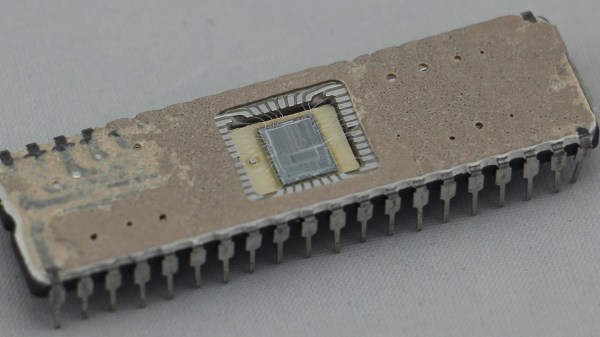
If you’ve ever wondered what was going on inside the 8087, wonder no more. [Ken Shirriff] has decapped an 8087 to reveal its inner structure, which turns out to be closely related to its function. After a quick tour of the general layout of the die, including locating the microcode engine and ROM, and a quick review of the NMOS architecture of the four-decade-old technology, [Ken] dug into the meat of the coprocessor and the reason it could speed up certain floating-point calculations by up to 100-fold. A generous portion of the complex die is devoted to a ROM that does nothing but store constants needed for its calculation algorithms. By carefully examining the pattern of NMOS transistors in the ROM area and making some educated guesses, he was able to see the binary representation of constants such as pi and the square root of two. There’s also an extensive series of arctangent and log2 constants, used for the CORDIC algorithm, which reduces otherwise complex transcendental calculations to a few quick and easy bitwise shifts and adds.

[Ken] has popped the hood on a lot of chips before, finding butterflies in an op-amp and reverse-engineering a Sinclair scientific calculator. But there’s something about seeing constants hard-coded in silicon that really fascinates us.

60’s Natural Gas Pipeline Computer Retires To Play Games

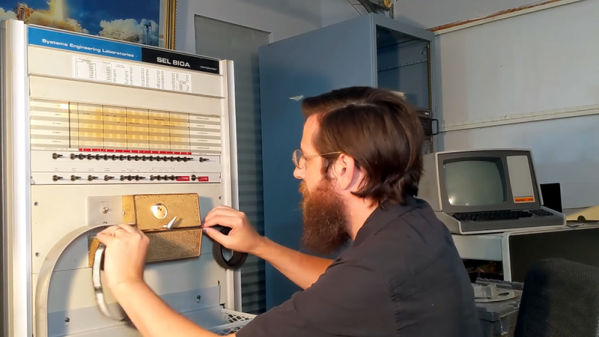
Computer gaming has come a very long way since the 1960s. While computers of that era may not run Doom or anything even close to it, many of us had our first exposure to computers playing Hunt the Wumpus, Adventure, or Star Trek over a clackety old TeleType machine. If you missed those days, or if you simply miss them, you might enjoy the video from [somecomputerguy] who fires up an old retired gas pipeline computer and loads enough paper tape into it to play Lunar Lander. (Video embedded below.)

We don’t miss the days of toggling in a bootloader so you could load the paper tape for a second bootloader before you could enter the actual program you wanted to run.

Continue reading “60’s Natural Gas Pipeline Computer Retires To Play Games”

EDSAC Lives In MiSTer

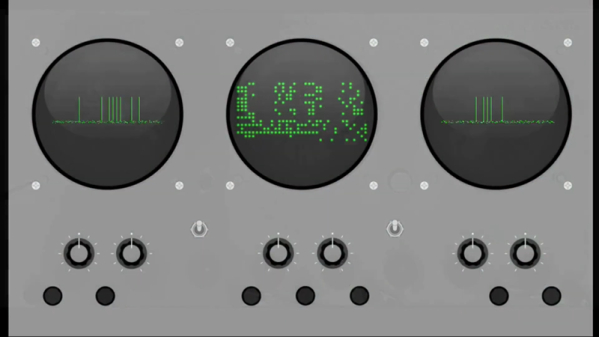
There’s a lot of argument over which was the first modern computer to be built. There’s room for debate, but EDSAC — the work of Dr. Maurice Wilkes — certainly was among the first. While we’ve seen simulators before, [hrvach’s] FPGA-based simulator for the MiSTer platform has a lot going for it. Check out the video, below.

So much of what we take for granted today was first developed on the EDSAC. For example, the “Wheeler jump” (named after graduate student David Wheeler) was the origin of the idea of a subroutine.

Continue reading “EDSAC Lives In MiSTer”

Original Zork MDL Source Code Has Been Released

Though mostly known for its releases on countless 8-bit personal computers from the 1970s and 1980s, the game of Zork began its life on a PDP-10 mainframe. Recently, MIT released the original source code for this version of Zork. As we covered a while ago, the history of Zork is a long and lustrous one, a history that is based on this initial version written in MDL.

To recap, MDL is a LISP-derived language that excels at natural language processing. It was developed and used at MIT’s AI and LCS (now CSAIL) departments for a number of projects, and of course to develop games with. The use of MDL gave Zork as a text-based adventure a level of interaction that was far ahead of its time.

What MIT has made available is the source code from Zork as it existed around 1977, at a time when it was being distributed to universities around the US. For purely educational purposes, obviously. This means that it’s a version of Zork before it was commercialized (~1979), showing a rare glimpse of the game as it was still busily being expanded.

Running the game will take a bit of effort, however. These files were retrieved from an original MIT backup tape that was used with their PDP-10 machines. Ideally one would use a 1970s-era PDP-10 mainframe with an MDL compiler, but in a pinch one could run a PDP-10 emulator as well.

Let us know whether you got it to run. Screenshots (ASCII or not) are highly encouraged.