Apollo Guidance Computer Saved From The Scrap Yard

NASA needed a small and lightweight computer to send humans on their journey to the Moon and back, but computers of the day were made out of discrete components that were heavy, large, complicated, and unreliable. None of which are good qualities for spaceflight. The agency’s decision to ultimately trust the success of the Apollo program on the newly developed integrated circuit was an important milestone in computer history.

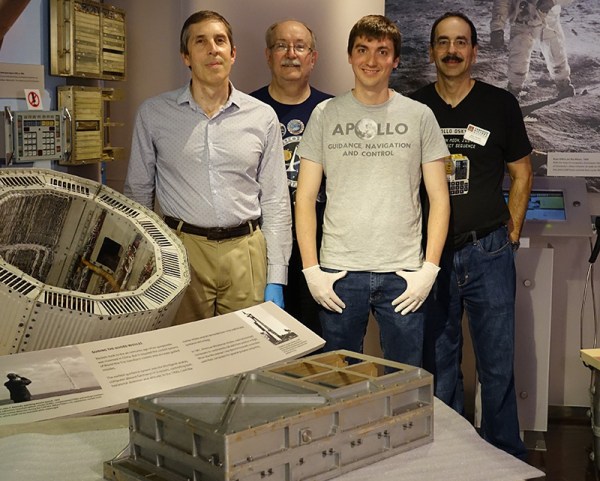
Given the enormity of the task at hand and the monumental effort it took, it’s surprising to learn that there aren’t very many left in existence. But perhaps not as surprising as the fact that somebody apparently threw one of them in the trash. A former NASA contractor happened to notice one of these historic Apollo Guidance Computers (AGC) at an electronics recycling facility, and thankfully was able to save it from getting scrapped.

The AGC was actually discovered in 1976, but it was decided to get the computer working again in time for the recent 50th anniversary of the Moon landing. A group of computer scientists in California were able to not only get the computer up and running, but integrate it into a realistic simulator that gives players an authentic look at what it took to land on the Moon in 1969.

Restoring a computer of this age and rarity is no easy feat. There aren’t exactly spare parts floating around for it, and the team had to go to great effort to repair some faults on the device. Since we covered the beginning stages of the restoration last year, the entire process has been extensively documented in a series of videos on YouTube. So while it’s unlikely you’ll find an AGC in your local recycling center, at least you’ll know what to do with it if you do.

Continue reading “Apollo Guidance Computer Saved From The Scrap Yard”
Reverse Engineering An Ancient SBC With An Apple ][

We spend a lot of time in our community discussing the many home computers from the 8-bit era, while almost completely ignoring their industrial equivalents. While today a designer of a machine is more likely than not to reach for a microcontroller, four decades ago they would have used a single-board computer which might have shared a lot of silicon with the one you used to play Pac Man.

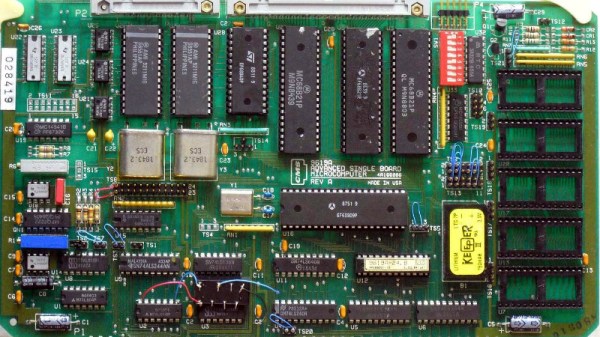
[Epooch] recently came into possession of a CMS 9619A Advanced Single Board Microcomputer, a rather unique Programmable Logic Controller intended for industrial applications. It’s powered by a Motorola 6809 CPU and features the usual array of peripheral chips. To unlock its secrets he reached not for an array of tools from 2019 but for a venerable Apple ][e microcomputer.

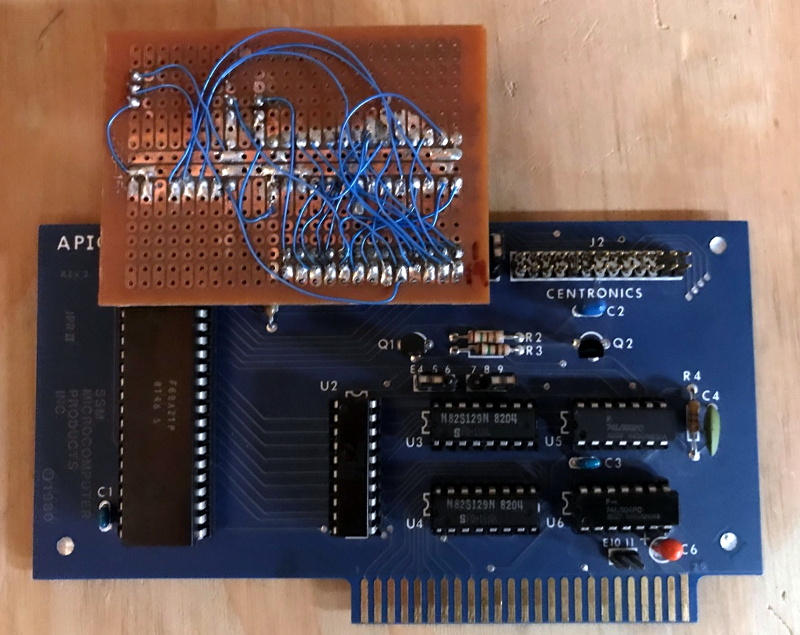
In this type of 8-bit machine the various peripherals are enabled through address decoding logic that toggles their chip select line when a particular I/O address is called. Sometimes this task is performed by a set of 74 or similar logic chips, but in the case of the CMS 9619A it falls upon a Programmable Array Logic (PAL). These chips, which could be thought of as a simple precursor to today’s FPGAs, were ideal for creating custom decoding logic.

As you might expect though, a PAL is an opaque device, so to deduce the address map it was necessary to reverse engineer it using the Apple ][‘s printer card and a bit of BASIC code. It then remained to do some ROM disassembly work and wire up the serial ports, before some ROM patching with the Apple ][ as an EPROM programmer to finally access the machine’s debugger.

The 6809 is famous as the brains of Radio Shack’s CoCo and the Dragon computers, but this isn’t the first time we’ve seen it in an SBC.

Raspberry Pi Helps Vintage Psion Find Its Voice

Ask a hacker to imagine computing in the 1980s, and they might think of the classic 8-bit all-in-one machines from the likes of Commodore and Atari, or perhaps the early PCs and Macs. No matter the flavor, they’ll likely have one thing in common: a lack of mobility thanks to being anchored down by a bulky CRT screen in the form of either a television or a dedicated monitor. Mobile computing at the time was something of an expensive rarity, consisting of various quirky handhelds that today have been all but forgotten.

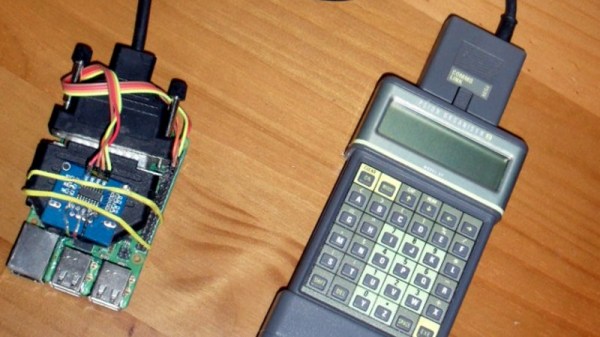
Looking to see if one of these so-called “pocket computers” could still be of use in 2019, [James Fossey] set out to get his circa 1986 Psion Organiser II connected to the Internet. With a Hitachi CPU, two-line text-only LCD and ABCD keyboard it’s a world away from the modern smartphone, yet as an early stab at a PDA as well as general purpose computer it’s visibly an ancestor of the devices we carry today. Of course, as the Psion was produced before the advent of affordable mobile data and before even the invention of the Web, it needed a bit of help connecting to a modern network.

Psion sold an RS-232 cable accessory which came with both serial terminal and file transfer in ROM, so with one of these sourced and a little bit of hackery involving an RS-232 to TTL converter and a DB-25 connector, he was able to hook it up to a Raspberry Pi. That means it’s reduced to being a dumb terminal for a more powerful machine that can do the heavy lifting, but those with long memories will tell you that’s exactly what would have been done with the help of a modem to connect to a BBS back in 1986. So far he’s got a terminal on the Pi and a Twitter client, but he’s declined to show us the Hackaday Retro Edition.

Psion has rarely featured directly on these pages, but despite being forgotten by many today they were a groundbreaking company whose influence on portable computing stretched beyond their own line of devices. One we have shown you is an effort to put more recent hardware into a Psion Series 5 clamshell.

Maybe The Oldest Computer, Probably The Oddest

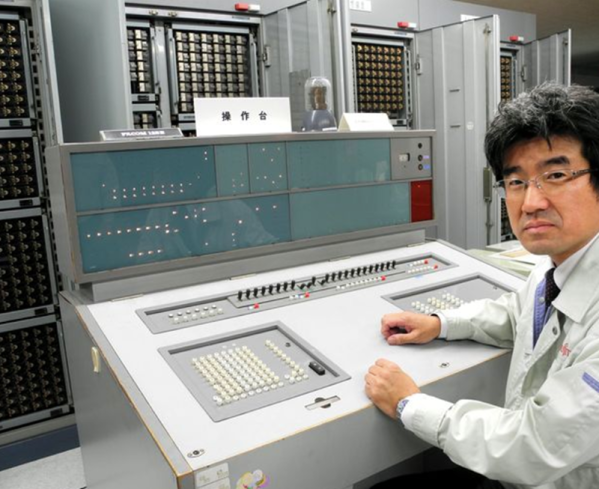
[Tadao Hamada] works for Fujitsu Tokki, a subsidiary of the more famous Fujitsu. In 1956, Fujitsu decided to compete with IBM and built a relay-based computer, the FACOM128. The computer takes up 70 square meters and weighs about 3 tons. By 1959, they’d learned enough to make a FACOM128B model that was improved. [Hamada’s] job is to keep one of these beasts operational at Fujitsu’s Numazu plant. According to the Japanese Computer Museum, it may be the oldest working computer.

Continue reading “Maybe The Oldest Computer, Probably The Oddest”

Creative Limitation And The Super Nintendo Sound Chips

The Super Nintendo recently experienced a surge in popularity, either from a combination of nostalgic 30-somethings recreating their childhoods, or because Nintendo released a “classic” version of this nearly-perfect video game system. Or a combination of both. But what made the system worthy of being remembered at all? With only 16 bits and graphics that look ancient by modern standards, gameplay is similarly limited. This video from [Nerdwriter1] goes into depth on a single part of the console – the sound chips – and uses them to illustrate a small part of what makes this console still worth playing even now.

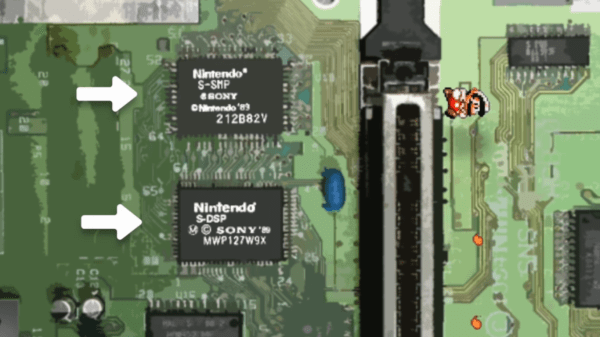
The SNES processed sound with two chips, a processing core and a DSP. They only had a capacity of 64 kb, meaning that all of a game’s sounds and music had to fit in this tiny space. This might seem impossible if you’ve ever played enduring classics like Donkey Kong Country, a game known for its impressive musical score. This is where the concept of creative limitation comes in. The theory says that creativity can flourish if given a set of boundaries. In this case it was a small amount of memory, and within that tiny space the composer at Rare who made this game a work of art was able to develop a musical masterpiece within strict limitations.

Even though this video only discusses the sound abilities of the SNES, which are still being put to good use, it’s a good illustration of what made this system so much fun. Even though it was limited, game developers (and composers) were able to work within its limitations to create some amazingly fun games that seem to have withstood the test of time fairly well. Not all of the games were winners, but the ones that were still get some playtime from us even now.

Continue reading “Creative Limitation And The Super Nintendo Sound Chips”

Run Your Own Phone To Bring The Dreamcast Back Online

Playing a video game online is almost second nature now. So much so that almost all multiplayer video games have ditched their split-screen multiplayer modes because they assume you’d rather just be alone at your house than hanging out with your friends. This wasn’t always the case though. In the early days of online multiplayer, systems had to rely on dial-up internet before broadband was readily available (and still had split screen if you didn’t even have that). Almost no one uses dial up anymore though, so if you still like playing your old Dreamcast you’re going to have to do some work to get it online again.

Luckily for all of us there’s a Raspberry Pi image to do almost anything now. This project from [Kazade] uses one to mimic a dial-up connection for a Dreamcast so you can connect with other people still playing Quake 20 years later. It’s essentially a network bridge, but you will need some extra hardware because phone lines use a high voltage line that you’ll have to make (or buy) a solution for. Once all the hardware is set up and working, you’ll need to make a few software configuration changes, but it’s a very straightforward project.

Granted, there have been ways of playing Dreamcast games online before, but this new method really streamlines the process and makes it as simple as possible. The Dreamcast was a great system, and there’s an argument to be made that the only reason it wasn’t more popular was that it was just slightly too far ahead of its time.

Thanks to [Rusty] for the tip!

Vintage Computer Festival West Is Almost Here

If you’ve got an interest in technology, a penchant forĀ that particular shade of yellowed plastic, and happen to be located in the California area, then we’ve got the event for you. The Vintage Computer Festival West is happening this weekend, August 3rd and 4th, at the Computer History Museum in Mountain View, California.

The Vintage Computer Festival offers a truly unique experience for anyone with a passion for all the silicon that’s come before. Where else could you sit in on a roundtable of early Apple employees discussing the bevy of authentic ultra-rare Apple I computers that will be on display, or get up close and personal with a restored Apollo Guidance Computer? If you really want to dive in on the deep end, Hackaday’s own Bill Herd will be in attendance giving his lecture about the effects of heat and time on the internal components of decades-old pieces of hardware.

Still skeptical? Perhaps you’ll get a kick out of the exhibit that celebrates more than two decades of Quake by hosting a LAN game where the classic game is running on less common platforms like the RS/6000 series or the Sun Ulta. If you’re interested in seeing modern reconstructions of classic technology, there will be plenty of that on display as well. Eric Schlaepfer will be showing off his transistor-scale replica of the iconic 6502 microprocessor, and you won’t want to miss the Cactus in all its rainbow colored toggle switch and blinkenlight glory.

Of course, if you’re in the market for your very own piece of computing history, there’s no better place to be. The consignment area gives showgoers a chance to buy and sell all manners of vintage and unique hardware, harking back to the days where the best way to get your hands on a computer (or the parts to build one) was by attending a dedicated event. Plus, no shipping fees!

Put simply, there really is something for everyone at the Vintage Computer Festival. Even if you weren’t around to experience Apple II or Commodore 64 in their prime, these events are a rare opportunity to learn about the early days of a technology that today we all take for granted. Have you ever wondered how programs were entered into those early computers with nothing more than a bank of toggle switches and an array of LEDs? One of the passionate exhibitors at VCF will be more than happy to walk you through the process.

At the end of the day, preserving this technology and sharing it with future generations is really what it’s all about. Just as in previous years, Hackaday is proud to sponsor the Vintage Computer Festival and further their goal of ensuring this incredible shared heritage isn’t lost.