In hacker circles, the “Internet of Things” is often the object of derision. Do we really need the IoT toaster? But there’s one phrase that — while not new — is really starting to annoy me in its current incarnation: AI or Artificial Intelligence.
The problem isn’t the phrase itself. It used to mean a collection of techniques used to make a computer look like it was smart enough to, say, play a game or hold a simulated conversation. Of course, in the movies it means HAL9000. Lately, though, companies have been overselling the concept and otherwise normal people are taking the bait.
The Alexa Effect
Not to pick on Amazon, but all of the home assistants like Alexa and Google Now tout themselves as AI. By the most classic definition, that’s true. AI techniques include matching natural language to predefined templates. That’s really all these devices are doing today. Granted the neural nets that allow for great speech recognition and reproduction are impressive. But they aren’t true intelligence nor are they even necessarily direct analogs of a human brain.
There are a series of stages to coming down from a festival. After the hectic rush of travel there are the several days of catching up on lost sleep and picking up the threads of your life again, then once a semblance of order has been regained there’s that few weeks of emptiness. Your life will never be the same again, it’s all so mundane.
I’m pleased to say the Hackaday and Tindie stickers were very popular.
It’s now a couple of weeks since the SHACamp 2017 hacker festival in the Netherlands was in full swing, and the write-up below has slowly taken shape over that time amid the other work of being a Hackaday scribe and editor. It’s early morning here in Southern England as I write this, so on the equivalent day while I was at SHACamp at this time I would have been carrying a large pack of stickers for distribution on the swapping table through the rising sunlight of a camp still largely asleep after the previous night’s revelry. Past our German and Dutch immediate neighbours, down the ramp from the dyke, the cardboard tent depot on my left and the food court on my right, to the information tent. Greet the bleary-eyed volunteer at the end of their graveyard shift, and spread plenty of Hackaday and Tindie stickers on the table for the masses. And then? Find a coffee, and sally forth into the field for another day among one of the most stimulating communities on Earth. My community. Your community.
The sticker table is a good place to start if you wish to get a handle on a large hacker camp. On it you will find the logos of a cross-section of the diverse organisations and groups present. There are a few commercial ones like my Jolly Wrenchers and Tindie the puppy, there are some from voluntary organisations or interest groups, but mostly they are the logos of a continent’s — even the wider world’s in some cases — hackspaces and makerspaces. Here you see the breadth of the attendees, as the logos of spaces from thousands of miles away you’ve never encountered before mingle. This isn’t quite a global gathering, but there is a sense of global community around it.
How Do You Describe a Hacker Camp?
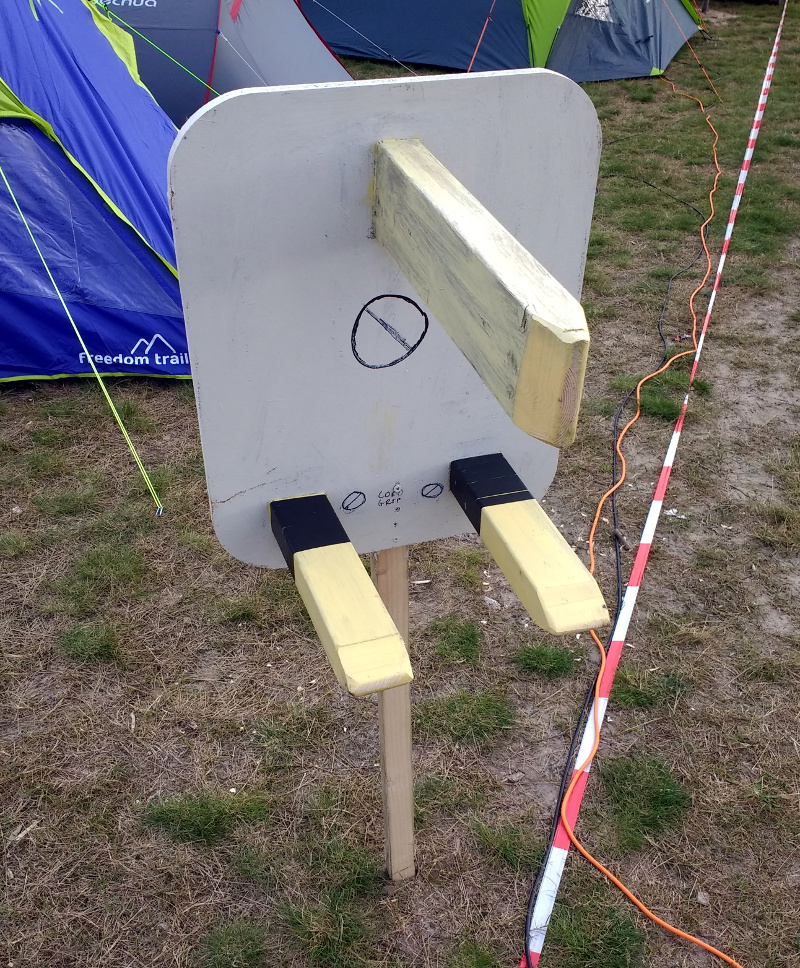
You shall find us by our clearly superior yet dangerous to barefoot pedestrians fused right-angled mains connector.
So before I take you through my experience of SHA, it’s best to start by describing a hacker camp in more general terms. When I’m describing a camp like SHA to the kind of people who don’t read Hackaday, I put it as similar to the music festivals they are used to but without the bands. Instead the audience provides the entertainment through the work they bring to the event or do at the event, and through a comprehensive program of talks and lectures. Oh — and this is the bit that makes their eyes open wide — every structure on site from the smallest one-man tent to the largest marquee has mains power and high-speed Internet. Sometimes people grasp what SHA is from this description, sometimes they don’t.
Different groups, be they individual hackspaces, people from a particular country, or other special interest groups, congregate in villages, collections of tents, marquees, and gazebos in which they set up whatever cool stuff they’ve brought along. My tent with its Hackaday flag was in a village composed of a mix of British hackspaces up on the dyke, which [Michael] from MK Makerspace had marked with a sign consisting of a huge BS1363A mains plug. More than one person pointed out it would have been better lying flat on the ground with pins in the air, ready to catch an unwary Monty Python foot.
Location, location, location — what’s critical to real estate is also critical to eclipse watching, and without sounding too boastful, those of us atop South Menan Butte, an extinct volcano in southeast Idaho, absolutely nailed it. Not only did we have perfect weather, we had an excellent camping experience, great food, a magnificent natural setting, and a perch 800 feet above a vast plain stretching endlessly to the east and west. Everything was set up for a perfect eclipse experience, and we were not disappointed.
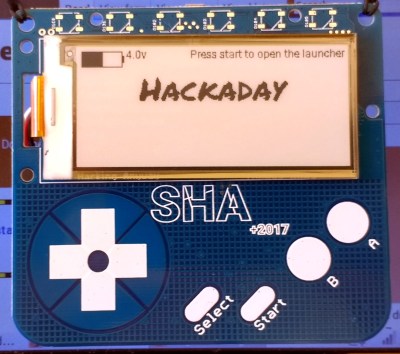
The badge has become one of the defining features of a modern hacker camp, a wearable electronic device that serves as both event computer and platform for some mild software and hardware hacking. Some events have had astoundingly sophisticated badges while others are more simple affairs, and the phenomenon has even spawned an ecosystem of unofficial badges which have nothing to do with the event in question.
The SHACamp 2017 badge is the latest to come the way of a Hackaday writer, and certainly contains enough to be taken as representative of the state of hacker camp badges in 2017. It doesn’t have a star turn like CCCCamp 2015’s software defined radio, instead it’s an extremely handy little computer in its own right.
PASTOR LAPHROAIG ANNOUNCES THE PUBLICATION OF WHAT WILL TORMENT THE ACOLYTES OF THE CHURCH OF ROBOTRON! NO MAN SHALL BE SPARED AND THE INQUISITION WILL BEGIN PROMPTLY!
For the last few years, Pastor Manul Laphroaig and friends have been publishing the International Journal of PoC || GTFO. This is a collection of papers and exploits, submitted to the Tract Association of PoC || GTFO, each of which demonstrates an interesting exploit, technique, or software toy in the field of electronics. Imagine, if 2600 or Dr. Dobb’s Journal were a professional academic publication. Add some whiskey and you have PoC || GTFO.
This is something we’ve been waiting a while for. The International Journal of PoC || GTFO is now a real book bible published by No Starch Press. What’s the buy-in for this indulgence? $30 USD, or a bit less if you just want the Ebook version. The draw of the dead tree version of PoC includes a leatherette cover, gilt edges, and the ability to fit inside bible covers available through other fine retailers. There are no rumors of a children’s version with vegetable-based characters.
PoC || GTFO, in reality, is an almost tri-annual journal of reverse engineering, computer science, and other random electronic computational wizardry, with papers (the Proof of Concept) by Dan Kaminsky, Colin O’Flynn, Joe FitzPatrick, Micah Elisabeth Scott, Joe Grand, and other heroes of the hacker world. What does PoC || GTFO present itself as? Applied electrons in a religious tract publication. The tongue is planted firmly in the cheek here, and it’s awesome.
On August 21, 2017, the Moon will cast its shadow across the entire breadth of the United States for the first time in almost a century. It is estimated that 12 million people live within the path in which the sun will be blotted out, and many millions more are expected to pour into the area to experience the wonders of totality.
We’d really love it if you would tell us where you’ll be during the eclipse by creating your own event page, but that’s not what this article’s about. With millions gathered in a narrow swath from Oregon to South Carolina, and with the eclipse falling on a Monday so that the prior two weekend days will be filled with campouts at prime viewing locations, I expect that Eclipse 2017 will be one big coast-to-coast party. This is an event that will attract people of all stripes, from those with no interest in astronomy that have only the faintest idea of what’s actually happening celestially, to those so steeped in the science that they’ll be calling out the exact beginning of totality and when to expect Baily’s Beads to appear.
I suspect our readership leans closer to the latter than the former, and some may want to add to the eclipse experience by participating in a little citizen science. Here’s how you can get involved.
Infrastructure seems so permanent and mundane that most of us never give it a second thought. Maintenance doesn’t make for a flashy news story, but you will frequently find a nagging story on the inside pages of the news cycle discussing the slowly degrading, crumbling infrastructure in the United States.
If not given proper attention, it’s easy for these structures to fall into a state of disrepair until one suddenly, and often catastrophically, fails. We’ve already looked at a precarious dam situation currently playing out in California, and although engineers have that situation under control for now, other times we haven’t been so lucky. Today we’ll delve into a couple of notable catastrophic failures and how they might be avoided in future designs.
Gaining Weight While Delaying Repairs
Most of us take infrastructure for granted every day. Power lines, roads, pipelines, and everything else have a sense of permanence and banality that can’t be easily shaken. Sadly, this reality shattered for most people in Minneapolis, Minnesota in August 2007.






 The badge has become one of the defining features of a modern hacker camp, a wearable electronic device that serves as both event computer and platform for some mild software and hardware hacking. Some events have had astoundingly sophisticated badges while others are more simple affairs, and the phenomenon has even spawned an ecosystem of unofficial badges which have nothing to do with the event in question.