The Components Are INSIDE The Circuit Board

Through-hole assembly means bending leads on components and putting the leads through holes in the circuit board, then soldering them in place, and trimming the wires. That took up too much space and assembly time and labor, so the next step was surface mount, in which components are placed on top of the circuit board and then solder paste melts and solders the parts together. This made assembly much faster and cheaper and smaller.

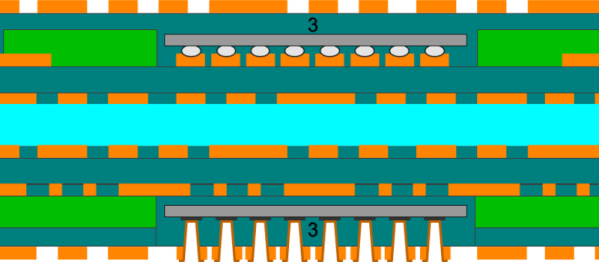
Now we have embedded components, where in order to save even more, the components are embedded inside the circuit board itself. While this is not yet a technology that is available (or probably even desirable) for the Hackaday community, reading about it made my “holy cow!” hairs tingle, so here’s more on a new technology that has recently reached an availability level that more and more companies are finding acceptable, and a bit on some usable design techniques for saving space and components.

Continue reading “The Components Are INSIDE The Circuit Board”

Hack Space Debris At Your Peril

Who has dibs on space debris? If getting to it were a solved problem, it sure would be fun to use dead orbital hardware as something of a hacker’s junk bin. Turns out there is some precedent for this, and regulations already in place in the international community.

To get you into the right frame of mind: it’s once again 2100 AD and hackers are living in mile-long space habitats in the Earth-Moon system. But from where do those hackers get their raw material, their hardware? The system abounds with space debris, defunct satellites from a century of technological progress. According to Earth maritime law, if space is to be treated like international waters then the right of salvage would permit them to take parts from any derelict. But is space like international waters? Or would hacking space debris result in doing hard time in the ice mines of Ceres?

Continue reading “Hack Space Debris At Your Peril”

I’ve Seen The Future And It’s Full Of Freakin’ Huge Bricks

“Did you know you can 3D-print LEGO bricks that can actually be used as regular LEGO?”–me, in 2009

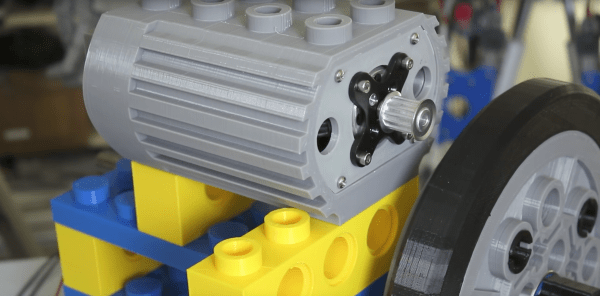
Those magical words made real to me the wonder that was 3D printing. It was a magical time! Everyone was 3D printing everything, though most of it wasn’t very good because the technology wasn’t there. But just as every technology goes through an evolution, the goalposts of coolness move on past what used to be remarkable to the new thing everyone’s talking about.

These days, no one is going to be more than mildly curious about your 3D-printed LEGO brick. Still, when you look at that uneven lump of plastic as being just one step in an evolution, it’s pretty momentous. What I’m saying is that we’re looking at a future that can be described in three words: Freakin’ Huge Bricks.

Continue reading “I’ve Seen The Future And It’s Full Of Freakin’ Huge Bricks”

Knowing What’s Below: Buried Utility Location

We humans have put an awful lot of effort into our infrastructure for the last few centuries, and even more effort into burying most of it. And with good reason — not only are above ground cables and pipes unsightly, they’re also vulnerable to damage from exposure to the elements. Some utilities, like natural gas and sanitary sewer lines, are also dangerous, or at least perceived to be so, and so end up buried. Out of sight, out of mind.

But humans love to dig, too, and it seems like no sooner is a paving project completed than some joker with a jackhammer is out there wrecking the pristine roadway. Before the construction starts, though, cryptic markings will appear on the pavement courtesy of your local buried utility locating service, who apply their rainbow markings to the ground so that nothing bad happens to the often fragile infrastructure below our feet.

Continue reading “Knowing What’s Below: Buried Utility Location”

Hacker Heroism: Building Your Way Out Of AV Hell

Many years ago, in a rainy concrete jungle on the west coast of Australia, I worked for a medium-sized enterprise doing a variety of office-based tasks. Somehow, I found myself caught up in planning a product launch event outside the official remit of my position. We got through it, but not before the audiovisual (AV) setup of the event turned into one giant hack.

The initial planning stages went remarkably smoothly until less than a month out from the big day when three weeks of frantic changes and revisions to the presentation rained down. These were some of the hardest days of my working life to date, as it seemed that we would lock in a new arrangement, only to tear it up days later as some new vital criteria came to light, throwing everything back into disarray.

Things came to a head on the night before the event. Working with two different AV teams we had planned for four projection screens and five flat screen televisions spread throughout the venue and controlled from the central AV desk. But somewhere in all those changes the televisions were set up to all display a still image, or nothing at all. I needed to show different videos on each and have the ability to black them all out.

It was at this point I realized we were screwed. The production team simply didn’t have the hardware to drive another five screens, but they could source it — for the sum of $5000. Management were furious, and were under the impression, like myself that this was what we had asked and paid for already. I was at an impasse, and beginning to wonder if I’d have a job come Monday. I wandered off to a corner to curse, and more importantly, think. After all, I’m a hacker — I can get through this.

Continue reading “Hacker Heroism: Building Your Way Out Of AV Hell”

In-Band Signaling: Dual-Tone Multifrequency Dialing

One late night many decades ago, I chanced upon a technical description of the Touch-Tone system. The book I was reading had an explanation of how each key on a telephone sends a combination of two tones down the wire, and what’s more, it listed the seven audio frequencies needed for the standard 12-key dial pad. I gazed over at my Commodore 64, and inspiration hit — if I can use two of the C64’s three audio channels to generate the dual tones, I bet I can dial the phone! I sprang out of bed and started pecking out a Basic program, and in the wee hours I finally had it generating the recognizable Touch-Tones of my girlfriend’s phone number. I held the mouthpiece of my phone handset up to the speaker of my monitor, started the program, and put the receiver to my ear to hear her phone ringing! Her parents were none too impressed with my accomplishment since it came at 4:00 AM, but I was pretty jazzed about it.

Since that fateful night I’ve always wondered about how the Touch-Tone system worked, and in delving into the topic I discovered that it’s part of a much broader field of control technology called in-band signaling, or the use of audible or sub-audible signals to control an audio or video transmission. It’s pretty interesting stuff, even when it’s not used to inadvertently prank call someone in the middle of the night. Continue reading “In-Band Signaling: Dual-Tone Multifrequency Dialing”

Building Set Limitations Make For Z-Height Follies

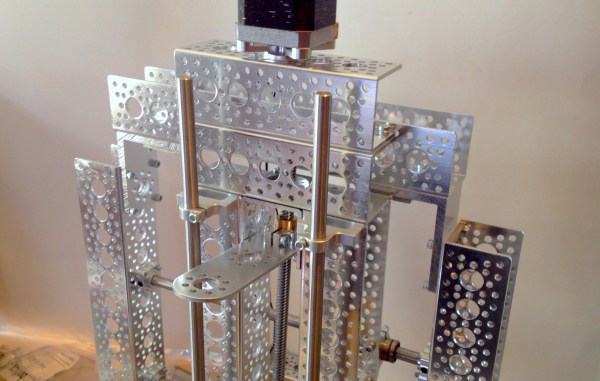
I’m working on a small CNC mill that uses a robotics building set as a starting point. I don’t know what to expect from the process. Maybe the connections will be too wobbly for the machine to be anything but a curiosity. Maybe I’ll be able to do pen plotting and balsa carving but nothing tougher than that. My goal is to have it carve PCBs, but what ultimately is important is that I have a tool whose awesomeness justifies the expense I’ve put into the project.

So far the process has been fun and interesting. But recently the Z-axis build has been especially so. It raises a really interesting question: where does the balance between unknown finished design and known material parameters fall?

Continue reading “Building Set Limitations Make For Z-Height Follies”