Analog Discovery 2 As A Vector Network Analyzer

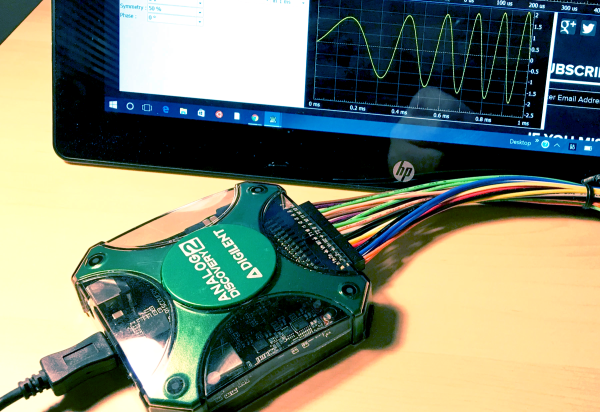
A while back, I posted a review of the Analog Discovery 2, which is one of those USB “do everything” instruments. You might recall I generally liked it, although I wasn’t crazy about the price and the fact that the BNC connectors were an extra item. However, in that same post, I mentioned I’d look at the device’s capabilities as a network analyzer (NA) sometime in the future. The future, as they say, is now.

What’s an NA?

In its simplest form, there’s not much to an NA. You sweep a frequency generator across some range of frequencies. You feed that into some component or network of components and then you measure the power you get out compared to the power you put in. Fancy instruments can do some other measurements, but that’s really the heart of it.

The output is usually in two parts. You see a scope-like graph that has the frequency as the X-axis and some sort of magnitude as the Y-axis. Often the magnitude will be the ratio of the output power to the input power as a decibel. In addition, another scope-like output will show the phase shift through the network (Y-axis) vs frequency (X-axis). The Discovery 2 has these outputs and you can add custom displays, too.

Why do you care? An NA can help you understand tuned circuits, antennas, or anything else that has a frequency response, even an active filter or the feedback network of an oscillator. Could you do the same measurements manually? Of course you could. But taking hundreds of measurements per octave would be tedious and error-prone.

Continue reading “Analog Discovery 2 As A Vector Network Analyzer”

Friday Hack Chat: Ladyada On Creative And Interactive Robotics

Somewhere at the intersection of microcontrollers, open source toolchains, the Maker Movement, and the march of technology, there’s a fuzzy concept that can best be described as robotics or physical computing. Instead of a computer in a box or a dumb microcontroller, these projects interact with the outside world. Whether that’s through the Internet, tapping a bunch of sensors, or just waving the arm of a servo around, there’s a need for a platform that actually does all of this stuff. For this week’s Hack Chat, we’re going to be talking all about creative and interactive robots, and you’re invited.

Our guest for this week’s Hack Chat will be Limor “Ladyada” Fried, the founder of Adafruit, and someone who needs no introduction but we’re going to do it anyway. Adafruit began as a weird side project selling exact reproductions of the Roland TB-303, building cell phone jammers, and making guides to build your own USB power bank before USB power banks were a thing. This has grown into Adafruit, a company with over 100 employees in the heart of New York City, one of the best places for learning and making electronics, and a place that does everything Open Source with zero loans or VC money. By any objective measure, Adafruit has become the most successful business story to come out of the Maker Movement, however nebulously that can be defined.



This week the Hack Chat will be focused on the CRICKIT, the Creative Robotics and Interactive Construction Kit. The CRICKIT is an add-on to Adafruit’s Circuit Playground that allows you to build your own robot with CircuitPython, MakeCode, or just Arduino. There’s support for arts, crafts, sensors, audio, animatronics, physical computing, kinetic sculptures, science experiments, and just about anything else you can think of. Need an example? Here’s Blue Öyster Cult. Here’s that robot that came with the NES. It’s all great fun.

You are, of course, encouraged to add your own questions to the discussion. You can do that by leaving a comment on the Hack Chat Event Page and we’ll put that in the queue for the Hack Chat discussion.join-hack-chat

Our Hack Chats are live community events on the Hackaday.io Hack Chat group messaging. This week is just like any other, and we’ll be gathering ’round our video terminals at noon, Pacific, on Friday, June 22nd.  Here’s a clock counting down the time until the Hack Chat starts.

Click that speech bubble to the right, and you’ll be taken directly to the Hack Chat group on Hackaday.io.

You don’t have to wait until Friday; join whenever you want and you can see what the community is talking about.

What Is Our Martian Quarantine Protocol?

If you somehow haven’t read or watched War of the Worlds, here’s a spoiler alert. The Martians are brought down by the common cold. You can argue if alien biology would be susceptible to human pathogens, but if they were, it wouldn’t be surprising if aliens had little defense against our bugs. The worrisome part of that is the reverse. Could an astronaut or a space probe bring back something that would ravage the Earth with some disease? This is not science fiction, it is both a historically serious question and one we’ll face in the near future. If we send people to Mars are they going to come back with something harmful?

A Bit of News: Methane Gas Fluctuations on Mars

What got me thinking about this was the mounting evidence that there could be life on Mars. Not a little green man with a death ray, but perhaps microbe-like life forms. In a recent press release, NASA revealed that they not only found old organic material in rocks, but they also found that methane gas is present on Mars and the amount varies based on the season with more methane occurring in the summer months. There’s some dispute about possible inorganic reasons for this, but it is at least possible that the variation is due to increased biological activity during the summer.

Continue reading “What Is Our Martian Quarantine Protocol?”

Hackaday Links Column Banner

Hackaday Links: June 17, 2018

Do you like badges? Of course you like badges. It’s conference season, and that means it’s also badge season. Well good news, Tindie now has a ‘badge’ category. Right now, it’s loaded up with creepy Krustys, hypnotoads, and fat Pikas. There’s also an amazing @Spacehuhn chicken from [Dave]. Which reminds me: we need to talk about a thing, Spacehuhn.

On the list of ‘weird emails we get in the tip line’ comes Rat Grease. Rat Grease is the solution to rodents chewing up cabling and wires. From what we can gather, it’s a mineral oil-based gel loaded up with capsaicin; it’s not a poison, and not a glue. Rats are our friends, though, which makes me want to suggest this as a marinade, or at the very least a condiment. The flash point is sufficiently high that you might be able to use this in a fryer.

[Matthias Wandel] is the guy who can build anything with a table saw, including table saws. He posts his stuff online and does YouTube videos. A while back, he was approached by DeWalt to feature their tools in a few videos. He got a few hand tools, a battery-powered table saw, and made some videos. The Internet then went insane and [Matthias] lost money on the entire deal. Part of the reason for this is that his viewers stopped buying plans simply because he featured yellow power tools in his videos. This is dumpster elitism, and possibly the worst aspect of the DIY/engineering/maker community.

Elon Musk is the greatest inventor ever. No scratch that. The greatest person ever. Need more proof? The CEO of Tesla, SpaceX, and our hearts has been given the green light to build a high-speed underground train from Chicago O’Hare to downtown. Here’s the kicker: he’s going to do it for only $1 Billion, or $55 Million per mile, making it the least expensive subway project by an order of magnitude. Yes, Subways usually cost anywhere between $500 to $900 Million per mile. How is he doing it? Luck, skill, and concentrated power of will. Elon is the greatest human ever, and we’re not just saying that to align ourselves with an audience that is easy to manipulate; we’re also saying this because Elon has a foggy idea for a ‘media vetting wiki’.

There are rumors Qualcomm will acquire NXP for $44 Billion. This deal has been years in the making, with reports of an acquisition dating back to 2016. Of course, that time, the deal was set to go through but was apparently put on hold by Chinese regulators. Now it’s the same story again; there were recent rumors of Qualcomm buying NXP, and the story was later changed to rumors. We’re waiting for an actual press release on this one. It’s just another long chapter in the continuing story of, ‘where the hell are all the Motorola app notes and data sheets?’

Retrotechtacular: Car Navigation Like It’s 1971

Anyone old enough to have driven before the GPS era probably wonders, as we do, how anyone ever found anything. Navigation back then meant outdated paper maps, long detours because of missed turns, and the far too frequent stops at dingy gas stations for the humiliation of asking for directions. It took forever sometimes, and though we got where we were going, it always seemed like there had to be a better way.

Indeed there was, but instead of waiting for the future and a constellation of satellites to guide the way, some clever folks in the early 1970s had a go at dead reckoning systems for car navigation. The video below shows one, called Cassette Navigation, in action. It consisted of a controller mounted under the dash and a modified cassette player. Special tapes, with spoken turn-by-turn instructions recorded for a specific route, were used. Each step was separated from the next by a tone, the length of which encoded the distance the car would cover before the next step needed to be played. The controller was hooked to the speedometer cable, and when the distance traveled corresponded to the tone length, the next instruction was played. There’s a long list of problems with this method, not least of which is no choice in road tunes while using it, but given the limitations at the time, it was pretty ingenious.

Dead reckoning is better than nothing, but it’s a far cry from GPS navigation. If you’re still baffled by how that cloud of satellites points you to the nearest Waffle House at 3:00 AM, check out our GPS primer for the details.

Continue reading “Retrotechtacular: Car Navigation Like It’s 1971”

Retrotechtacular: Voice Controlled Robot From 1961

We like to think that all these new voice-controlled gadgets like our cell phones, Google Home, Amazon Echo, and all that is the pinnacle of new technology. Enabled by the latest deep learning algorithms, voice-controlled hardware was the stuff of science fiction back in the 1961s, right? Not really. Turns out in around 1960, Ideal sold Robot Commando, a kid’s toy robot that featured voice control.

Well, sort of. If you look at the ad in the video below, you’ll see that a kid is causing the robot to move and fire missiles by issuing commands into a microphone. How did some toy company pull this off in 1961?

Continue reading “Retrotechtacular: Voice Controlled Robot From 1961”

Field Trip! Hackaday Visits Pimoroni

If you have a Raspberry Pi and have any interest in its peripherals, you may be familiar with the grinning pirate logo of the British company, Pimoroni. The Sheffield, UK based outfit first established a niche for itself as one of the go-to places for much of the essentials of Pi ownership, and has extended its portfolio beyond the Pi into parts, boards, and components across the spectrum of electronic experimentation. Their products are notable for their distinctive and colourful design language as well as their  constant exploration of new ideas, and they have rapidly become one of those companies to watch in our sphere. On our way up to Newcastle for Maker Faire UK, we passed close enough to the Pimoroni HQ to be able to ask nicely if we could drop in and have a tour.

[Paul] showing off some of the Pimoroni attention to design detail. This artwork is hidden behind a display panel on the finished product.
Paul showing off some of the Pimoroni attention to design detail. This artwork is hidden behind a display panel on the finished product.
The Pimoroni HQ can be found in a nondescript unit with a discreetly placed sign on an industrial estate after a short drive through the city from the motorway. Inside it’s the same as thousands of other units, a set of offices at the front and a cavernous warehouse behind, except this one is filled with the kinds of goodies that get our blood pumping! And we’re told this toybox warehouse is soon to be joined by another nearby unit, as the Pimoroni business is expanding.

Our guide was the company co-founder Paul Beech, whose work you will be familiar with even if this is the first time you’ve heard his name;  Paul was the designer of the Raspberry Pi logo! The company is not exclusive to that platform but it’s fair to say they have a strong connection with the Pi, starting in 2012 with as their website puts it: “One laser cutter and a kettle” on which they produced the first of their iconic PiBow laser-cut sandwich Raspberry Pi cases.

Continue reading “Field Trip! Hackaday Visits Pimoroni”