Remoticon 2021 // Voja Antonic Makes You A Digital Designer

[Voja Antonic] has been building digital computers since before many of us were born. He designed with the Z80 when it was new, and has decades of freelance embedded experience, so when he takes the time to present a talk for us, it’s worth paying attention.

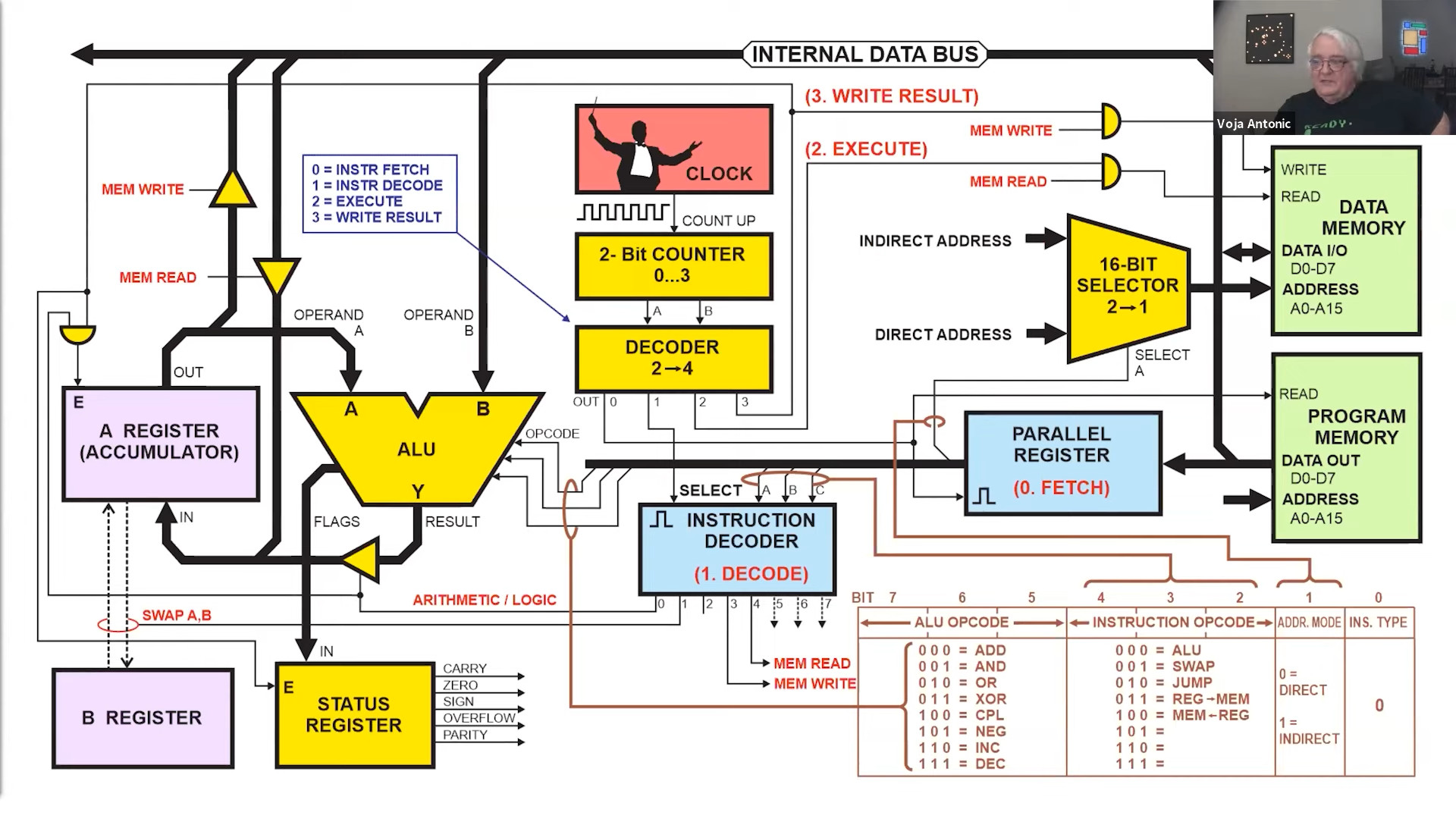
For his Remoticon 2022 presentation, he will attempt to teach us how to become a hardware expert in under forty minutes. Well, mostly the digital stuff, but that’s enough for one session if you ask us. [Voja] takes us from the very basics of logic gates, through combinatorial circuits, sequential circuits, finally culminating in the description of a general-purpose microprocessor.

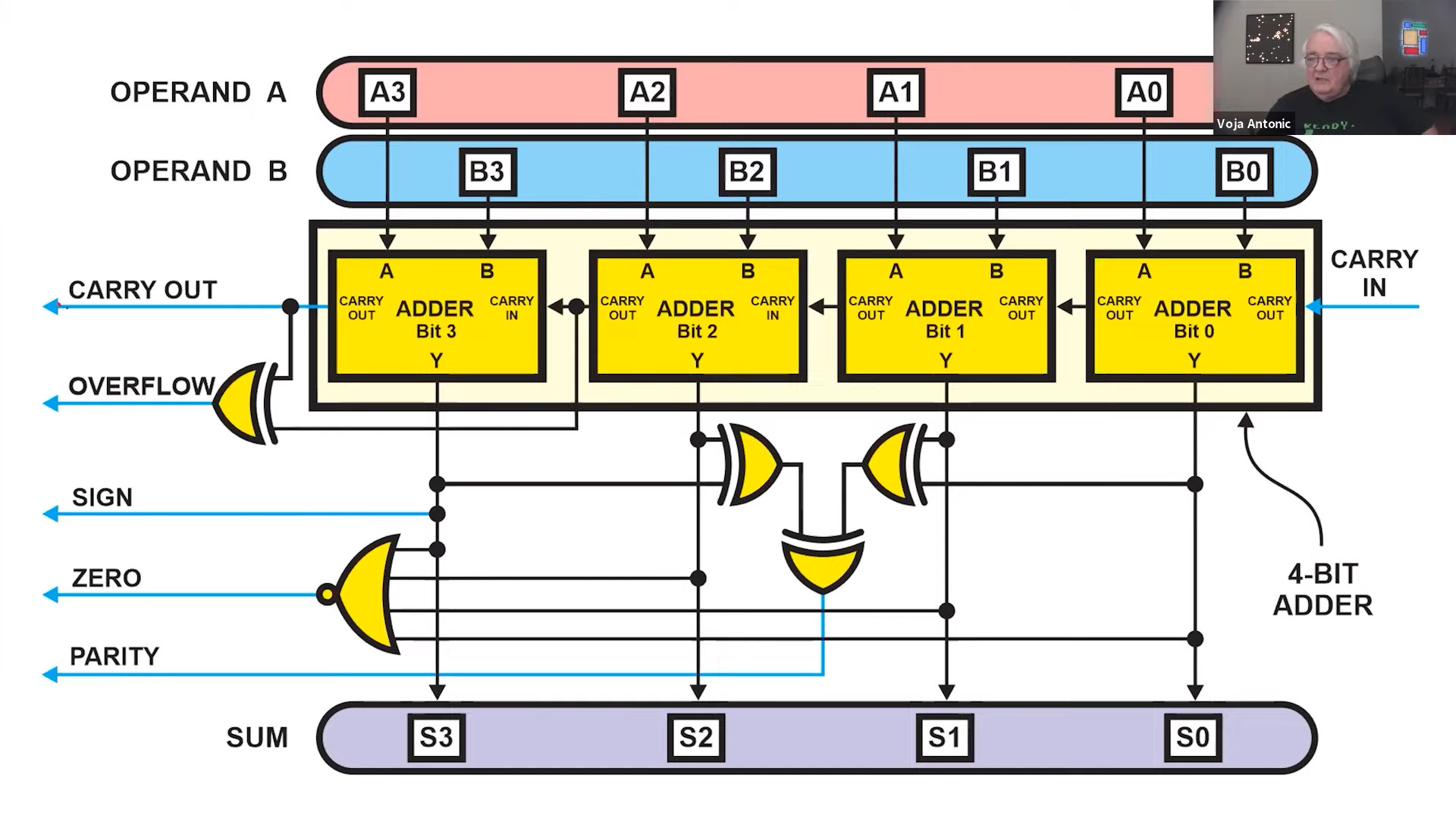
A 4-bit ripple-carry adder with additional CPU flag outputs

As he demonstrates, complex digital electronics systems really are just built up in a series of steps of increasing complexity. starting with individual active elements (transistors operating as switches) forming logic elements capable of performing simple operations.

From there, higher level functions such as adders can be formed, and from those an ALU and so on. Conceptually, memory elements can be formed from logic gates, but it’s not the most efficient way to do it, and those tend to be made with a smaller and faster circuit. But anyway, that model is fine for descriptive purposes.

Once you have combinatorial logic circuits and memory elements, you have all you need to make the necessary decoders, sequencers and memory circuits to build processors and other kinds of higher complexity circuits.

Obviously forty minutes isn’t anywhere nearly enough time time to learn all of the intricacies of building a real microprocessor like the pesky details of interfacing with it and programming it, but for getting up the learning curve from just a knowledge of binary numbers to an understanding of how a CPU is built, it’s a pretty good starting point.

Now, If you can only tear your eyes away from his slick game-of-life wall mounted LED display, you might pick up a thing or two.

Continue reading “Remoticon 2021 // Voja Antonic Makes You A Digital Designer”

555 Timer On Its Own In Electronic Dice

One of the most common clichés around here is that a piece of equipment chosen for a project is always too advanced. If a Raspberry Pi was used, someone will say they should have used an Arduino. If they use an Arduino, it should have been an ATtiny. And of course, if an ATtiny was used, there should have simply been a 555 timer. This time, however, [Tim] decided to actually show how this can be done by removing some of the integrated circuits from an electronic dice and relying entirely on the 555 timer for his build.

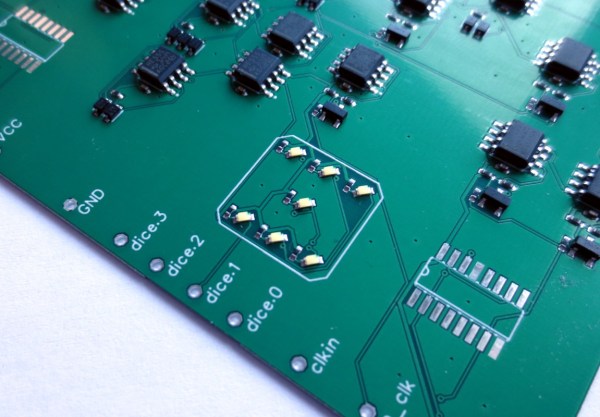
The electronic dice that [Tim] has on hand makes use of two main ICs: a NE555 and a CD4017 which is a decade counter/divider used for cycling through states. In order to bring the 555 to the forefront of this build, he scraps the CD4017 and adds an array of 555 timers. These are used to generate the clock signals necessary for this build but can also be arranged to form logic circuits. This comes at a great cost, however. The 555 chips take up an unnecessarily large area on the PCB (even though these are small surface-mount chips), consume an incredible amount of power, and are very slow. That’s fine for an electronic dice-rolling machine like this one, but that’s probably where [Tim] will leave this idea.

The 555 timer is a surprisingly versatile chip, and this project shows that there is some element of truth to the folks claiming that projects need naught but a few 555s. We’ve seen entire CPUs built using nothing but 555s, and even a classic project that uses a 555 timer to balance a robot.

Apollo DSKY Display Glows Again

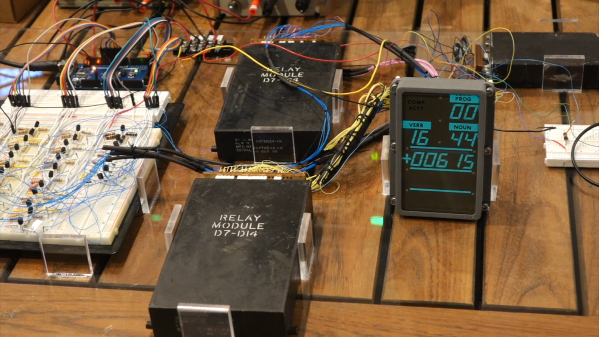
We love seeing old technology brought back to life, especially when it’s done in the context of how the device was originally intended to be used. And double points when it’s space gear, like what [Curious Marc] and his usual merry band of cohorts did when they managed to light up a couple of real Apollo DSKY displays.

The “Display and Keyboard” formed the human interface to the Apollo Guidance Computer, the purpose-built machine that allowed Apollo missions to fly to the Moon, land safely, and return to Earth. Complete DSKYs are hard to come by, but a lucky collector named [Marcel] was able to score a pair of the electroluminescent panels, one a prototype and one a flight-qualified spare. He turned them over to AGC guru [Carl Claunch], who worked out all the details of getting the display working again —  a non-trivial task with a device that needs 250 volts at 800 Hertz.

The first third of the video below mostly concerns the backstory of the DSKY displays and the historical aspects of the artifacts; skip to around the 12:30 mark to get into the technical details, including the surprising use of relays to drive the segments of the display. It makes sense once you realize that mid-60s transistors weren’t up to the task, and it must have made the Apollo spacecraft a wonderfully clicky place. We were also intrigued by the clever way the total relay count was kept to a minimum, by realizing that not every combination of segments was valid for each seven-segment display.

The video has a couple of cameos, like [Ben Krasnow], no slouch himself when it comes to electroluminescent displays and DSKY replicas. We also get a glimpse of well-known component slicer and MOnSter 6502-tamer [TubeTime] too. Continue reading “Apollo DSKY Display Glows Again”

Control An IRL Home From Minecraft

Minecraft seems to be a game in which anything is possible, both in the virtual world and in the real one. As a sandbox-style game, we’ve seen all kinds of things implemented in it including arithmetic logic units and microcontroller emulators. On the other end of reality we’ve also seen a lot of projects in which real-world interfaces impact the virtual world in some way. As a game, the lines between these two worlds often seem to blur, and that’s no different for this project that allows for control of a smart home from within the game itself.

The project is called HomeAssistantMC and is built with Forge. The mod interfaces directly with a Minecraft game. From within the game, players can create a model of their home complete with light switches and other control interfaces. A WebSocket API listens to the game for changes to these devices, and interfaces with real-world controllers which control the home in real life. The game uses special state blocks to handle the control, and the entire control system can be configured in-game once all of the appropriate software has been installed.

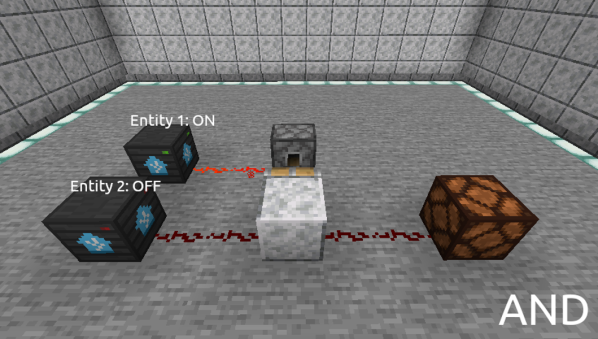
For anyone willing to experiment with this software, all of the code for this project is available on its GitHub page. One of the other interesting things about this project is the ability to use other creations within Minecraft for home automation. For example, building logic gates allows for nuanced control of the home automation setup with creations we’ve already seen in Minecraft before. And, if you really want to go deep into the weeds, you could even build a complete 6502 processor from within the game as well.

Thousands Of Discrete MOSFETs Make Up This Compact CPU-Less Computer

How long has it been since a computer could boast about the fact that it contained 2,500 transistors? Probably close to half a century now, at a guess. So in a world with a couple of billion transistors per chip, is a 2,500-transistor computer really something to brag about? Yes. Yes, it is.

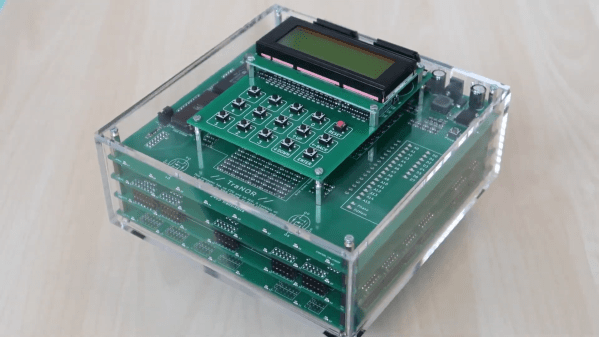
The CPU-less computer, called the TraNOR by its creator [Dennis Kuschel], is an elaboration on his previous MyNOR, another CPU-less machine that used a single NOR-gate made of discrete transistors as the core of its arithmetic-logic unit (ALU). Despite its architectural simplicity, MyNOR was capable of some pretty respectable performance, and even managed to play a decent game of Tetris. TraNOR, on the other hand, is much more complicated, mainly due to the fact that instead of relying on 74HC-series chips, [Dennis] built every single gate on the machine from discrete MOSFETs. The only chips on the four stacked PCBs are a trio of memory chips; we don’t fault him at all for the decision not to build the memory — he may be dedicated, but even art has its limits. And TraNOR is indeed a work of art — the video below shows the beautiful board layouts, with seemingly endless arrays of SMD transistors all neatly arranged and carefully soldered. And extra points for using Wintergatan’s marble machine melody as the soundtrack, too.

As much as we loved the original, TraNOR is really something special. Not only is it beautiful, but it’s functional — it’s even backward-compatible with MyNOR’s custom software. Hats off to [Dennis] for pulling off another wonderful build, and for sharing it with us.

Continue reading “Thousands Of Discrete MOSFETs Make Up This Compact CPU-Less Computer”

8-Bit Computer Addresses LEDs

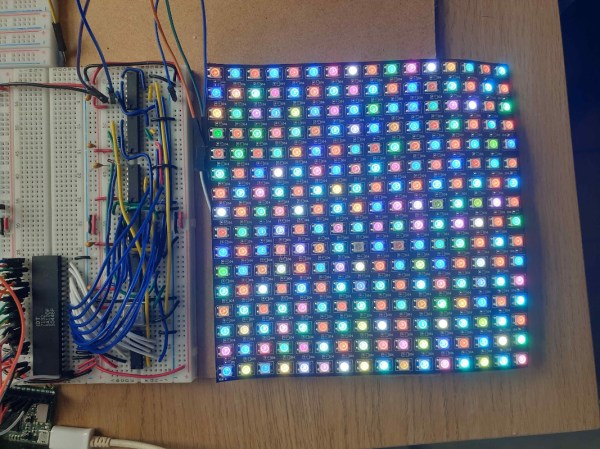
Homebrew 8-bit computers tend to have fairly limited displays, often one or more seven-segment displays and an array of LEDs to show the values of RAM or perhaps some other states of the computer. [Duncan] is in the process of building just such an computer, but wondered if there was a way to create a more visually appealing display while still keeping the computer true to its 8-bit roots. With some interesting TTL logic he was able to create this addressable RGB LED display to some remarkable results.

The array works by controlling the WS2812B LED strips with a specific timing cycle which was pioneered by [Tim] for a different project. [Tim] was able to perform this timing cycle with some simple Assembly code, which means that [Duncan] could convert that code into TTL gate logic relatively easily. Using 74LS02 NOR chips gets the job done as far as timing goes, and the pulses are then fed into a shift register and support logic which then creates the signal for the LED strips.

When everything is said and done, [Duncan] has a fully addressable 16×16 RGB LED array as a display for his 8-bit computer without violating any of his design principles and keeping everything to discrete TTL logic chips and a stick of RAM. It’s a unique method of display that might go along really well with any other homebrew computer like this one that’s also built with 74LS chips.

Hackaday Links Column Banner

Hackaday Links: February 28, 2021

In an announcement that came as a surprise to few, NASA now says that landing humans on the Moon by 2024 is no longer likely. Acting administrator Steve Jurczyk lays the blame at the feet of Congress, for failing to provide the funds needed for Human Landing Systems development, a critical step needed to meet the aggressive overall timeline. The announcement doesn’t mark the end of the Artemis program; in fact, NASA is continuing to work on a realistic timeline for getting boots back on the lunar surface, and a decision on which of the three submitted proposals for a lunar lander will be further developed should be coming in the next few months. As far as we can see, this is simply an adjustment to the original timeline for a landing, but given the stunning recent success of Perseverance showing just what robots can do, we’d expect pushback from some quarters on the need for human exploration.

The entry-level 3D design market was thrown into considerable turmoil last year when Autodesk changed the licensing terms for its flagship Fusion 360 package. Hobbyists who had been enjoying relatively unfettered access to the powerful suite chafed at the new restrictions, leaving many to threaten to jump ship, apparently without much thought given to the dearth of alternative products. That may be changing now that Dassault Systèmes has announced two new versions of SolidWorks aimed at the maker and student segments. The Makers offer is intended for hobbyists who want to design for benchtop manufacturing methods like 3D-printing. The Students offer is aimed at engineering and design students looking to gain experience with the tools they’ll be expected to have mastered by the time they enter the job market. It looks like the Makers offer will be at least partly contingent on the interest expressed by the community, so you might want to make your feeling know on the subject. If the Makers edition comes to pass in the second half of this year, it will likely target a $99/year price point.

We stumbled upon an interesting YouTube series the other day that stirred the creative juices. We all probably remember the first time we learned about the Mandelbrot set, the fractal number set that looks something like a lumpy kidney bean and continues to do so no matter how far you zoom into it. The image may be complex but the math behind it is simple enough to implement in software that it’s often done as an exercise for CS students and other unfortunates. But implementing a Mandelbrot set generator in logic is possible too, which WildEngineering did in this video series. Rather than implement this as discrete logic gates, he used a neat logic simulator called Digital, which looks like a handy tool to learn all by itself. The Mandelbrot generator concepts are really instructive too, and it sure seems like the next logical step would be to gather the needed 74xx-series chips and start breadboarding. We’d love to give it a whirl ourselves, but won’t be heartbroken if someone beats us to it.

If it sometimes appears that we at Hackaday get a little frustrated with the comments section of the articles we write, rest assured that we know that we have the best readers on the planet, hands down. Where the toxicity of other corners of the Internet is often unbearable, our readers truly do make this a fabulously collaborative environment, on the whole.

In fact, some commenters even go so far as to basically write their own articles in response to one of ours, and when that happens we like to point it out. The article that spawned the effort was Kristina Panos’ excellent “What If I Never Make Version Two?”, a recent piece that dips a toe into the psychology of hacking. Peter Walsh picks up on the theme with his Hackaday.io page entitled “The Psychology of Version Two”, which we really enjoyed. After a brief look at the neurochemistry of happiness, Peter dives into some “brain hacks” to assess the need for a version 2. There are some great tips, and we really enjoyed both the original article and Peter’s response.