3D Printed Brushed Motor Is Easy To Visualize

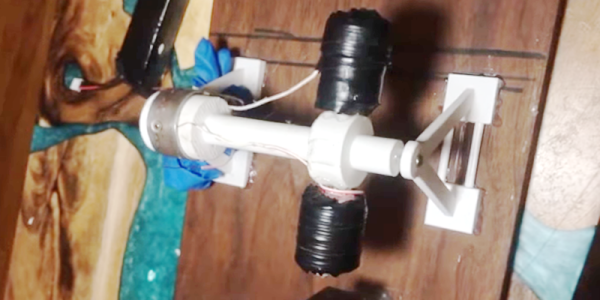
A motor — or a generator — requires some normal magnets and some electromagnets. The usual arrangement is to have a brushed commutator that both powers the electromagnets and switches their polarity as the motor spins. Permanent magnets don’t rotate and attract or repel the electromagnets as they swing by. That can be a little hard to visualize, but if you 3D Print [Miller’s Planet’s] working model — or just watch the video below — you can see how it all works.

We imagine the hardest part of this is winding the large electromagnets. Getting the axle — a nail — centered is hard too, but from the video, it looks like it isn’t that critical. There was a problem with the link to the 3D model files, but it looks like this one works.

Continue reading “3D Printed Brushed Motor Is Easy To Visualize”
Smooth Moves From Cheap Motors

Building an electric motor isn’t hard or technically challenging, but these motors have very little in the way of control. A stepper motor is usually employed in applications that need precision, but adding this feature to a motor adds complexity and therefore cost. There is a small $3 stepper motor available, but the downside to this motor is that it’s not exactly the Cadillac of motors, nor was it intended to be. With some coaxing, though, [T-Kuhn] was able to get a lot out of this small, cheap motor.

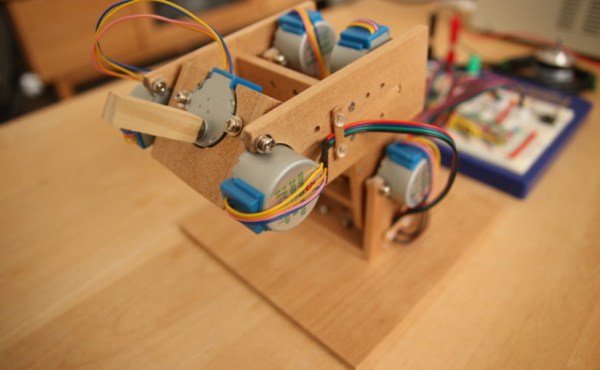
To test out the motors, [T-Kuhn] built a small robotic arm. He began by programming his own pulse generating algorithm that mimics a sine wave in order to smooth out the movement of the motor. An Arduino isn’t fast enough to do these computations, though, so he upgraded to using the ESP32. He also was able to implement the inverse kinematics on his own. The result of all this work for a specific platform and motor type is a robotic arm that has a very low cost but delivers performance of much more expensive hardware.

The robot arm was built by [T-Kuhn] too, and all of the details on that build, as well as all the schematics and code, are available on the project site if you need a low-cost robot arm or a good stepper motor controller for a low cost. There are many other ways of getting the most out of other types of low-cost motors as well.

Continue reading “Smooth Moves From Cheap Motors”

Rewound And Rewired BLDC Makes A Half-Decent Generator

What’s the best way to turn a high-powered brushless DC motor optimized for hobby use into a decent low-RPM generator? Do you take a purely mechanical approach and slap a gearbox on the shaft? Or do you tackle the problem electrically?

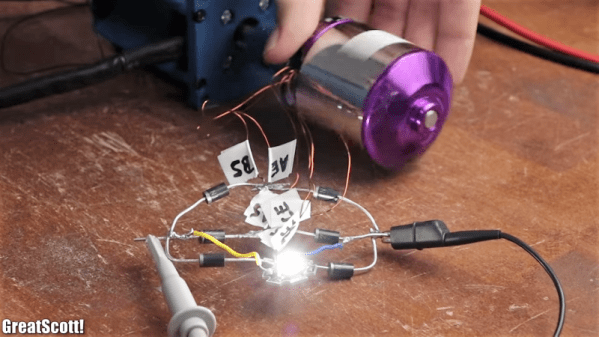
The latter approach is what [GreatScott!] settled on with his BLDC rewinding and rewiring project. Having previously explored which motors have the best potential as generators, he knew the essential problem: in rough terms, hobby BLDCs are optimized for turning volts into RPMs, and not the other way around. He started with a teardown of a small motor, to understand the mechanical challenges involved, then moved onto a larger motor. The bigger motor was stubborn, but with some elbow grease, a lot of scratches, and some destroyed bearings, the motor was relieved of both its rotor and stator. The windings were stripped off and replaced with heavier magnet wire with more turns per pole than the original. The effect of this was to drive the Kv down and allow better performance at low RPMs. Things looked even better when the windings were rewired from delta to wye configuration.

The take-home lesson is probably to use a generator where you need a generator and let motors be motors. But we appreciate [GreatScott!]’s lesson on the innards of BLDCs nonetheless, and his other work in the “DIY or buy?” vein. Whether you want to make your own inverter, turn a hard drive motor into an encoder, or roll your own lithium battery pack, he’s done a lot of the dirty work already.

Continue reading “Rewound And Rewired BLDC Makes A Half-Decent Generator”

Electric Wheelbarrow Makes Hauling Big Loads Easier

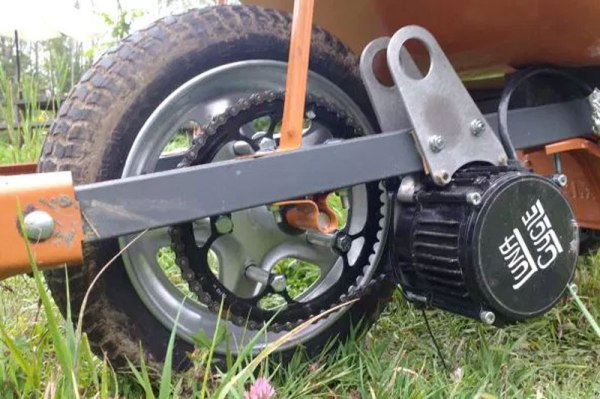
Gardening involves a depressing amount of physical activity: haul this over here, dump it there and then cover it with this. Things like wheelbarrows are still damn hard work, especially for people like who are somewhat physically compromised. That’s why we love this build from [Karl Gesslein]. He usually makes electronic bikes, adding motors to bicycles to roam the streets faster. But this time he applied his expertise to a wheelbarrow. He added a 3000W motor to the wheelbarrow, which drives the front wheel when triggered by the accelerator on the handle.

Continue reading “Electric Wheelbarrow Makes Hauling Big Loads Easier”

Power Steering Pump Repurposed For Great Speed

Electric bikes are getting a lot of attention lately. Pretty much anyone can buy a kit online and get a perfectly street legal ride with plenty of range. But if you don’t want to take the kit route, and you’d rather take a tack that will get you noticed more around these parts, take some notes from [Jule553648]’s recent build that definitely isn’t using any parts from a kit.

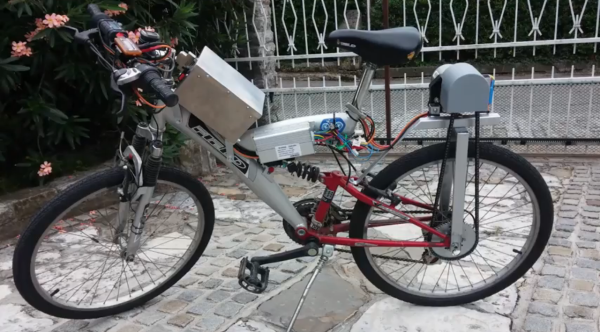
The motor from the build is an electric power steering pump from a junkyard car. This gets mounted on a one-off rear bike rack and drives the rear tire with help from some gears from a pocket bike gearbox from eBay. A lot of the parts in this build were designed and built using CAD and a machine shop, and the parts for the battery and the power controller were sourced via China to save on cost.

The whole build has a homemade vibe that we find irresistible. The bike can go 35 km/h on level ground without breaking a sweat and has about 40 km of range which is nothing to scoff at. It might even be street legal depending on the wattage of the motor and whether or not you live in Europe (where throttles are generally not allowed on electric bikes). If you’re lacking a machine shop, though, we featured a very well-built kit ebike a while back that you could use as a model to get your feet wet.

Continue reading “Power Steering Pump Repurposed For Great Speed”

Semi-automated Winder Spins Rotors For Motors

What’s your secret evil plan? Are you looking for world domination by building a machine that can truly replicate itself? Or are you just tired of winding motor rotors and other coils by hand? Either way, this automated coil winder is something you’re probably going to need.

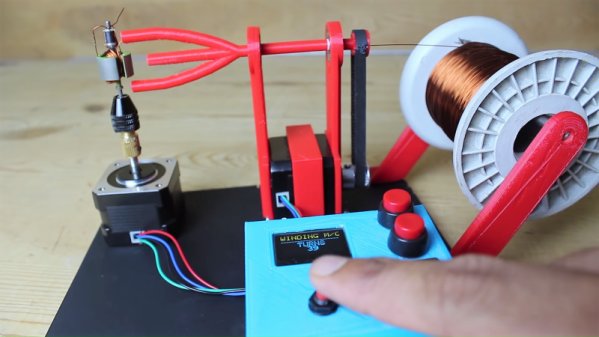
We jest in part, but it’s true that closing the loop on self-replicating machines means being able to make things like motors. And for either brushed or brushless motors, that means turning spools of wire into coils of some sort. [Mr Innovative]’s winder uses a 3D-printed tube to spin magnet wire around a rotor core. A stepper motor turns the spinner arm a specified number of times, pausing at the end so the operator can move the wire to make room for the next loop. The rotor then spins to the next position on its own stepper motor, and the winding continues. That manual step needs attention to make this a fully automated system, and we think the tension of the wire needs to be addressed so the windings are a bit tighter. But it’s still a nice start, and it gives us some ideas for related coil-winding projects.

Of course, not every motor needs wound coils. After all, brushless PCB motors with etched coils are a thing.

Continue reading “Semi-automated Winder Spins Rotors For Motors”

Electric Bike From The Ground Up

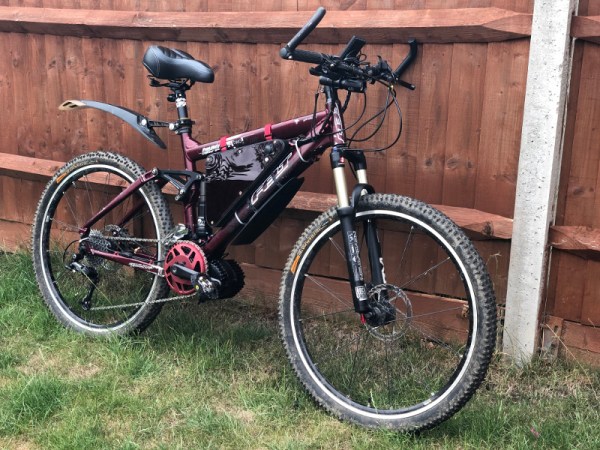
Electric vehicles are getting more traction these days, but this trend is rolling towards us in more ways than just passenger vehicles. More and more bikes are being electrified too, since the cost of batteries has come down and people realize that they can get around town easily without having to pay the exorbitant price to own, fuel, and maintain a car. Of course there are turnkey ebikes, but those don’t interest us much around here. This ebike from [Andy] is a master class in how to build your own ebike.

Due to some health issues, [Andy] needed a little bit of assistance from an electric motor on his bike, but found out that the one he wanted wouldn’t fit his current bike quite right. He bought a frame from eBay with the right dimensions and assembled the bike from scratch. Not only that, but when it was time to put the battery together he sourced individual 18650 cells and built a custom battery for the bike. His build goes into great detail on how to do all of these things, so even if you need a lithium battery for another project this build might be worth a read.

If you’ve never been on an electric bike before, they’re a lot of fun to ride. They’re also extremely economical, and a good project too if you’re looking for an excuse to go buy a kit and get to work. You can get creative with the drivetrain too if you’d like to do something out of the box, such as this bike that was powered by AA batteries and a supercapacitor.