Swarm Of Servos Plays This Robotic Glockenspiel

It’s the happiest sounding instrument in the marching band, and it’s got the best name to boot. It’s the glockenspiel, and if this robotic glockenspiel has anything to say about it, the days of human glockenspielists are numbered.

In its present prototype form, [Averton Engineering]’s “Spielatron” looks a little like something from a carousel calliope or an animatronic pizza restaurant band. Using a cast-off glockenspiel from a school music room as a base, the Spielatron uses four mallets to play all the notes. Each key is struck by a mallet secured to a base made of two servos. For lack of more descriptive mallet terminology, these servos provide pan and tilt so the mallet can strike the proper keys. The video below shows the Spielatron’s first recital.

An Arduino runs the servos and a MIDI interface; unfortunately, this version can’t play chords and is a little limited on note length, but upgrades are on the way. We’ve seen a robotic glockenspiel before with a similar design that might have some ideas for increasing performance. But if you’re looking for a more sublime sound, check out this dry ice-powered wind chime.

Continue reading “Swarm Of Servos Plays This Robotic Glockenspiel”

Reanimating Boney The Robot Dog

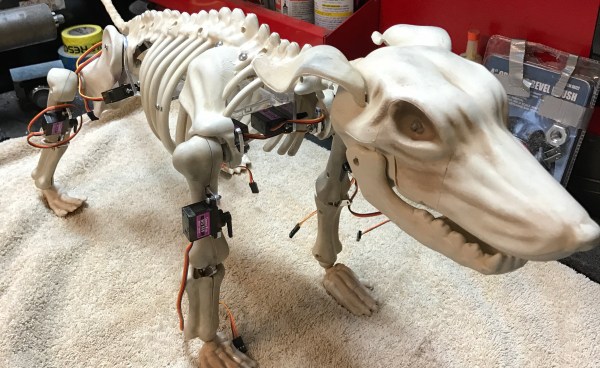
[Divconstructors] cashed in after Halloween and picked up a skeleton dog prop from the Home Depot, for the simple and logical purpose of turning it into a robot.

The first step was to cut apart the various body parts, followed by adding bearings to the joints and bolting in a metal chassis fabricated from 1/8″ aluminum stock. This is all pretty standard stuff in the Dr. Frankenstein biz. For electronics he uses a Mega with a bark-emitting MP3 shield on top of it. Separately, a servo control board manages the dozenish servos — not to mention the tail-wagging stepper.

[Divconstructors] actually bought two skeletons, one to be his protoype and the other to be the nice-looking build. However, we at Hackaday feel like he might have missed an opportunity: As any necromancer can tell you, a freakish combination of two skeletons beats out two normal skeletons any night of the week. Also, two words for you to consider: cyberdog ransomeware. We imagine you don’t really feel ransomware until there’s the family robodog ready to test out its high-torque jaw servos on your flesh. Of course if he were a real dog we could either remotely control him with a hot dog, or just give him a talking collar.

Servo-Controlled Eyeball Makes A Muggle Moody

Even when you bear a passing resemblance to the paranoid Auror of the Harry Potter universe, you still really need that wonky and wandering prosthetic eye to really sell that Mad-Eye Moody cosplay, and this one is pretty impressive.

Of course, there’s more to the [daronjay]’s prosthetic peeper than an eBay doll’s eye. There’s the micro-servo that swivels the orb, as well as a Trinket to send the PWM signal and a pocket full of batteries. The fit and finish really tie it together, though, especially considering that it’s made from, well, garbage — a metal food jar lid, a yogurt cup, and the tube of a roll-on antiperspirant. Some brass screws and a leather strap evoke the necessary Potter-verse look, and coupled with what we assume are prosthetic scars, [daronjay] really brings the character to life. We think it would be cool to have the servo eye somehow slaved to the movements of the real eye, with a little randomness thrown in to make it look good.

Marauder’s maps, wand duels, Weasley clocks — the wizarding world is ripe for creative hacking and prop making. What’s next — a Nimbus 2000 quadcopter? Please?

Continue reading “Servo-Controlled Eyeball Makes A Muggle Moody”

Open Source Motor Controller Makes Smooth Moves With Anti-Cogging

Almost two years ago, a research team showed that it was possible to get fine motor control from cheap, brushless DC motors. Normally this is not feasible because the motors are built-in such a way that the torque applied is not uniform for every position of the motor, a phenomenon known as “cogging”. This is fine for something that doesn’t need low-speed control like a fan motor, but for robotics it’s a little more important. Since that team published their results, though, we are starting to see others implement their own low-speed brushless motor controllers.

The new method of implementing anti-cogging maps out the holding torque required for any position of the motor’s shaft so this information can be used later on. Of course this requires a fair amount of calibration; [madcowswe] reports that this method requires around 5-10 minutes of calibration. [madcowswe] also did analysis of his motors to show how much harmonic content is contained in these waveforms, which helps to understand how this phenomenon arises and how to help eliminate it.

While [madcowswe] plans to add more features to this motor control algorithm such as reverse-mapping, scaling based on speed, and better memory usage, it’s a good implementation that has visible improvements over the stock motors. The original research is also worth investigating if a cheaper, better motor is something you need.

Automate Wire Prep With A Robot Wire Cutter

When you move from one-off builds to production scale, perhaps to meet that Kickstarter commitment or to keep your Tindie store stocked, you’re going to need to tool up. Jobs like building wiring harnesses can be tedious and time-consuming, so outsourcing them to this robot wire cutter might be a good idea.

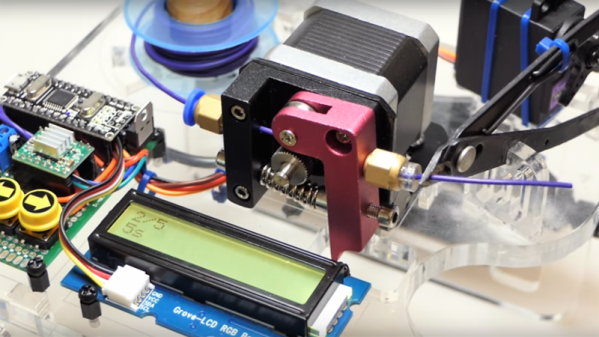
The video below tells the whole tale of this build, which despite the fact that [Maclsk] seems to have put it together quickly from scrap bin parts still looks pretty professional. The business end of the machine is a 3D printer extruder, minus the hot end, of course. A Nano controls the extruder’s stepper to shoot out the right length of wire, as well as the servo that squeezes the snippers. An LCD display and some pushbuttons provide the UI that rounds out the build. Tell it how long and how many, and you’ll be ready to build. We can see how this might be upgraded to strip the wires as well, although getting both ends stripped might be tricky.

Might this component tape-cutting robot from a few weeks back have inspired [Maclsk]’s build? Perhaps, but in any case, both are fun to watch.

Continue reading “Automate Wire Prep With A Robot Wire Cutter”

Alas, Poor Yorick! He Hath Not Amazon Prime

If you are looking around for a Halloween project, you might consider The Yorick Project from [ViennaMike]. As you can see in the video below, it marries a Raspberry Pi acting as an Amazon Alexa with an animatronic skull.

This isn’t the most technically demanding project, but it has a lot of potential for further hacking. The project includes a USB microphone, a servo controller, and an audio servo driver board. It looks like the audio servo board is controlling the jaw movement and based on the video, we wondered if you might do better running it completely in software.

Continue reading “Alas, Poor Yorick! He Hath Not Amazon Prime”

FoTW: LED Strips Make Awful Servo Drivers

We must all have at some time or another spotted a hack that seems like an incredible idea and which just has to be tried, but turns out to have been stretching the bounds of what is possible just a little too far. A chunk of our time has disappeared without trace, and we sheepishly end up buying the proper part for the job in hand.

[Orionrobots] had a conversation with a YouTube follower about LED strips. An LED strip contains a length of ready-made PWM drivers, they mused. Wouldn’t it be great then, if each of the drivers on a strip could be connected to a servo, making the strip a ready-made single-stop SPI servo driver. With a large multi-servo robot to build, he set to work on a strip of WS2801s.

If you are in the Soldering Zone and have elite skills at the iron, then soldering a wire to a surface mount driver chip is something entirely possible. For mere mortals though it’s a bit of a challenge, and he notes just how much extra time it’s added to the project. The fun starts though when the servo is hooked up, the best that can be said is that it vibrates a bit. On paper, the LED drivers should be able to drive a servo, because they can create the correct waveform. But in practice the servo is designed to accept a logic level input while the driver is designed to sit in series with an LED and control its current. In practice therefore the voltages required for a logic transition can’t quite be achieved.

He concludes by recommending that viewers splash out on a servo driver board rather than trying an LED strip. We applaud him for the effort, after all it’s a hack any of us might have thought of trying for ourselves.

Continue reading “FoTW: LED Strips Make Awful Servo Drivers”