That Time Atari Cracked The Nintendo Entertainment System

It was darkest hour for the video game industry following the holiday shopping season of 1982. The torrent of third party developed titles had flooded the home video game console market to the point of saturation. It incited a price war amongst retailers where new releases were dropped to 85% off MSRP after less than a month on the shelves. Mountains of warehouse inventory went unsold leaving a company like Atari choosing to dump the merchandise into the Chihuahuan desert rather than face the looming tax bill. As a result, the whole home video game industry receded seemingly overnight.

One company single-handedly revived video games to mainstream prominence. That company was Nintendo. They’re ostensibly seen as the “savior” of the video games industry, despite the fact that microcomputer games were still thriving (history tends to be written by the victors). Nevertheless their Nintendo Entertainment System (NES) was an innovative console featuring games with scrolling screens, arcade-like sprites. But the tactic they used to avoid repeating the 1983 collapse was to tightly control their market using the Nintendo Seal of Quality.

From the third party developer perspective, Nintendo’s Seal of Quality represented more than just another logo to throw on the box art. It represented what you could and couldn’t do with your business. Those third party licensing agreements dictated the types of games that could be made, the way the games were manufactured, the schedule on which the games shipped to retail, and even the number of games your company could make. From the customer side of things that seal stood for confidence in the product, and Nintendo would go to great lengths to ensure it did just that.

This is the story of how an Atari subsidiary company cracked the hardware security of the original Nintendo and started putting it into their unofficial cartridges.

Continue reading “That Time Atari Cracked The Nintendo Entertainment System”

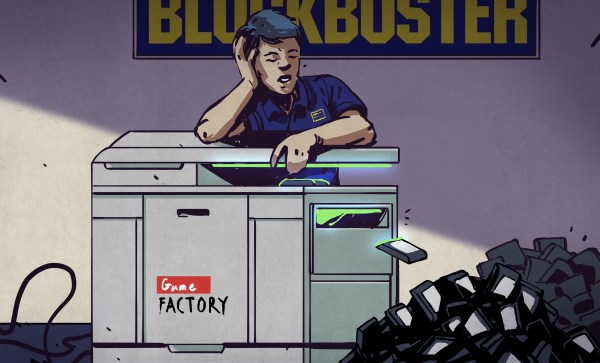
Remember When Blockbuster Video Tried Burning Game Cartridges On Demand?

By the onset of the 1990s one thing was clear, the future was digital. Analog format sales for music were down, CD sales were up; and it was evident, at least in the US, that people were bringing more computing devices into their homes. At the beginning of the decade, roughly 1 in 3 American households had a Nintendo Entertainment System in them, according to this Good Morning America segment.

With all those consoles out there, every shopping season became a contest of “who could wait in line the longest” to pickup the newest titles. This left last minute shoppers resorting to taking a rain check or return home empty handed. Things didn’t have to be this way. The digital world had emerged and physical media just needed to catch up. It would take an unlikely alliance of two disparate companies for others to open their minds.

Continue reading “Remember When Blockbuster Video Tried Burning Game Cartridges On Demand?”

This Nearly NIMO Clock Fakes It And Makes It

Pity the aficionado of rare vintage displays. While Nixies and VFD tubes get all the attention and benefit from a thriving market to satisfy demand, the rarer displays from the mid-20th century period are getting harder and harder to find. One copy of an especially rare display is hard enough to find. Six copies for a clock? That’s a tall order.

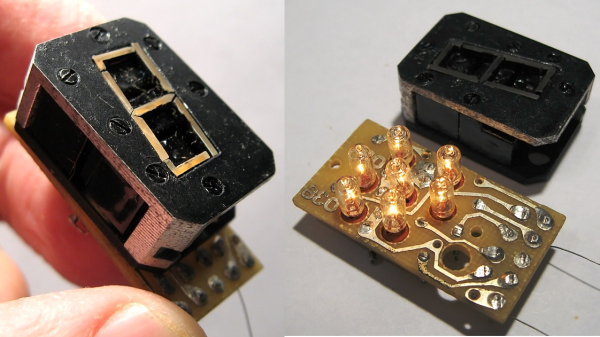
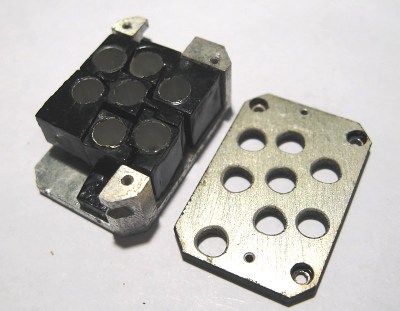
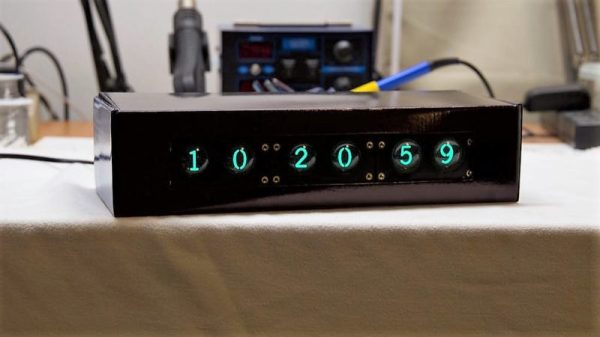
That doesn’t mean you can’t fudge it, though, which is how this faux-NIMO clock came to be. [Paul Bricmont] was inspired by [Fran Blanche]’s NIMO tube primer, wherein the rare, single-digit CRT display was put through its paces. We’ve got to admit, it’s an easy display to fall in love with, thanks to its eerie blue phosphor glow, high voltage supply, and general quirkiness. [Paul] was unable to lay hands on a single tube, though, so he faked it with six tiny TFT displays and some plastic lenses. The lenses mimic the curved front glass of the original NIMO, while the TFT displays provide the stencil-style images of each numeral. The phosphor glow comes from replacing the stock white TFT backlight with a Neopixel array that can produce just the right shade of blue-green. 3D-printed modules hold two digits each, and the usual Arduino components run the show. The effect is quite convincing, although we bet some software tweaks could add things like faux burn-in and perhaps soften the edges of the digits to really sell it.

What other rare displays could be replicated this way? Given the variety of displays that were tried in the pre-LED era, it may be a rich vein to mine.

Replace Old Electrolytics? Not So Fast… Maybe

[CuriousMarc] was restoring an old Model 19 TeleType. The design for these dates back to the 1930s, and they are built like tanks (well, except for the ones built during the war with parts using cheaper metals like zinc). Along the way, he restored a hefty tube-based power supply that had two very large electrolytic capacitors. These dated from the 1950s, and common wisdom says you should always replace old electrolytics because they don’t age well and could damage the assembly if powered up. [Marc] didn’t agree with common wisdom, and he made a video to defend his assertion which you can see below.

If you look at the construction of electrolytic capacitors, one plate of the capacitor is actually a thin layer that is formed electrically. In some cases, a capacitor with this plate is damaged can be reformed either by deliberate application of a constant current or possibly even just in normal operation.

Continue reading “Replace Old Electrolytics? Not So Fast… Maybe”

Vintage eight transistor stereo amplifier

Eight Transistor Stereo Amplifier From The Days Of Yore

Reading an article about the first transistorized Hi-Fi amplifier, [Netzener] got the itch to make one. But what to use for the starting point? Enter an old Radio Shack P-Box stereo amplifier kit. After a few modernizations and tweaks, the result is an 8-transistor stereo amplifier that’s aesthetically pleasing, sounds great, and is fully documented.

The Radio Shack kit used germanium transistors, but with their high leakage current and low thermal conductivity, he decided to convert it to work with silicon transistors. He also made some improvements to the push-pull bias circuit and limited the high-frequency response. As for the finished product, in true [Netzener] style, he assembled it all to look like the original completed Radio Shack amplifier. He even wrote up a manual which you’d think, as we did at first, was the original one, giving that old, comfortable feeling of reading quality Radio Shack documentation.

Check out the video below where he uses a 9 V battery and half a watt per channel to fill a room with clear, stereo sound.

This isn’t the first Radio Shack kit that [Netzener] has adapted. Check out his single tube radio and classic neon “Goofy Light” box.

Continue reading “Eight Transistor Stereo Amplifier From The Days Of Yore”

1960’s Console Stereo Gets Raspberry Pi Touch Screen

When he was but a wee hacker, [WhiskeyDrinker] loved to play with the big console stereo his grandparents had. The idea of a functional piece of furniture always appealed to him, and he decided that when he grew up and had a place of his own he’d get a similar stereo. Fast forward to the present, and a Craigslist ad for a working Penncrest stereo seemed to be a dream come true. Until it wasn’t.

The original physical controls are connected to the Pi’s GPIO

As difficult as it might be to believe, sometimes things we read on the Internet are not true. The “working” Penncrest radio turned out to be a dud. But realizing that the look of the cabinet was more important to him than historical accuracy, [WhiskeyDrinker] decided to outfit it with a Raspberry Pi powered touch screen that would look as close to stock hardware as possible.

The final result really does look like some kind of alternate timeline piece of consumer electronics: where chunky physical buttons and touch screens coexisted in perfect harmony. The vintage stereo aficionados will probably cry foul, but let them. [WhiskeyDrinker] did a fantastic job of blending old and new, being respectful to the original hardware and aesthetic where it made sense, and clearing house where only nostalgia had lease.

A HiFiBerry DAC+ Pro is used to get some decent audio out of the Raspberry Pi, and the touch screen interface is provided by Volumio. [WhiskeyDrinker] mentions that it even has a GPIO plugin which he successfully used to handle getting the physical buttons to play nice with their digital counterparts.

Updating old audio gear is always a sensitive subject around these parts. Sometimes they go so far that the original hardware is almost an afterthought. On the other side of the spectrum are the projects which try to take modern gear and mimic the look of the classics. In any event, one thing is clear: they don’t make ’em like they used to.

Continue reading “1960’s Console Stereo Gets Raspberry Pi Touch Screen”

Making Vintage Computing Easy, The Hard Way

If you want to not take for granted how easy and seamless computers have become, take up vintage computing as a hobby. If you venture down the retro path, you’ll quickly question how anyone ever got any useful work done with computers, and the farther back you go in computer history, the more difficult everything seems to become.

Case in point: how do you easily transfer files between a home-brew PC/XT and your modern desktop? Back in the day we did it with null modem cables or by sneaker-netting stacks of floppies, but [Scott M. Baker] found another way — putting a Raspberry Pi on the ISA bus as a virtual floppy drive. The heart of the ISA card is an IDT7130, a 1-kb RAM chip that allows simultaneous asynchronous access over dual ports. One port talks to the ISA bus and the other talks to the GPIO of the Pi, after level-shifting to make everything voltage compatible, of course. [Scott] wrote a driver for the card, plugged a Pi Zero W into the header pins, and threw a Python server together that makes local images available to the shared memory on the card. The upshot of this is that the retro machine thinks it has a floppy in it, but it’s actually a server. The video below has tons of detail and shows the card in action. Pretty slick.

[Scott]’s projects are always fun to check out, and he really seems to have the retro life dialed in. Whether it’s old jukebox hacks or a Unix-ish OS for Z80s, there’s plenty to learn. Although we’d like to see more about that PC/XT in the video; are those Nixies we spy along the front panel?

Continue reading “Making Vintage Computing Easy, The Hard Way”