Already Impressive CNC Router Gets An Extra Axis

The type of CNC machine within the financial reach of most DIYers is generally a three-axis affair, with a modest work envelope and a spindle that never quite seems powerful enough. That’s not to say that we don’t covet such a machine for our own shop of course, but comparing small machines with the “big boy” five-axis tools might leave the home-gamer feeling a tad inadequate.

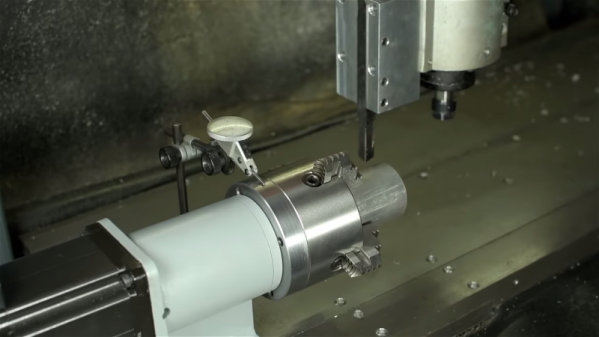
Luckily, there’s a fix that won’t necessarily break the bank: adding a fourth axis to your CNC router. [This Old Tony] tore into his CNC router – a build we’ve featured before and greatly admire – to add a machine spindle that lets him work with the machine much as if it was a CNC lathe. The first video below covers the mechanical part of the build, which involves welding and machining a sturdy assembly to hold a spindle connecting a four-jaw chuck to a Lexium MDrive, a stepper motor with integrated driver and feedback that makes it act more like a servo. [Old Tony] covered integrating the drive into Mach4 in a previous video.

The assembled machine spindle is a beefy looking affair that can smoothly ramp up to 3000 rpm and has decent enough holding torque to allow it to act as an indexing head in addition to a lathe. The second video below shows some tests turning aluminum and steel; we were surprised by how aggressive the cuts can be before stalling the spindle.

No, it’s not a Tormach or Haas or even a Pocket NC, but it’s a great addition to an already capable machine, and we’re looking forward to what [Old Tony] cranks out with it.

Continue reading “Already Impressive CNC Router Gets An Extra Axis”

See Cells In A New Light With A DIY Fluorescence Microscope

Ever since a Dutch businessman peered into the microscopic world through his brass and glass contraption in the 1600s, microscopy has had a long, rich history of DIY innovation. This DIY fluorescence microscope is another step along that DIY path that might just open up a powerful imaging technique to amateur scientists and biohackers.

In fluorescence microscopy, cells are treated with various fluorescent dyes that can be excited with light at one wavelength and emit light at another. But as [Jonathan Bumstead] points out, fluorescence microscopes are generally priced out of the range of biohackers. His homebrew scope levels the playing field a bit. The trick is to use 3D-printed parts to kit out commonly available digital cameras – a USB microscope, a DSLR, or even a smartphone camera. Excitation is provided by a ring of Nexopixel LEDs, while a movable rack holds a filter that blocks the excitation wavelength but allows the emission wavelength to pass through to the camera. He demonstrates the technique by staining some threads with fluorescent ink from a highlighter marker and placing them on a sheet of tissue paper; in conventional bright-field mode, the threads all but disappear into the background, but jump right out under fluorescence.

Ith’s true that the optics are not exactly lab quality, and the microscope is currently only set up to do reflectance imaging as opposed to the more typical transmissive mode where the light passes through the sample. That’s an easy fix, though, and reflectance mode is still useful. We’ve seen fluorescence microscopy get quite complex before, but this simple scope might be enough to get a biohacker started.

Continue reading “See Cells In A New Light With A DIY Fluorescence Microscope”

Retro Wall Phone Becomes A Doorbell, And So Much More

We have to admit that this retasked retro phone wins on style points alone. The fact that it’s filled with so much functionality is icing on the cake.

The way [SuperKris] describes his build sounds like a classic case of feature creep. Version 1 was to be a simple doorbell, but [SuperKris] would soon learn that one does not simply replace an existing bell with a phone and get results. He did some research and found that the ringer inside the bakelite beauty needs much more voltage than the standard doorbell transformer supplies, so he designed a little H-bridge circuit to drive the solenoids. A few rounds of “while I’m at it” later, the phone was stuffed with electronics, including an Arduino and an NFR24 radio module that lets it connect to Domoticz, a home automation system. The phone’s rotary dial can now control up to 10 events and respond to alarms and alerts with different ring patterns. And, oh yes – it’s a doorbell too.

In general, we prefer to see old equipment restored rather than gutted and filled with new electronics. But we can certainly get behind any effort to retask old phones with no real place in modern telecommunications. We’ve seen a few of these before, like this desk telephone that can make cell calls.

Continue reading “Retro Wall Phone Becomes A Doorbell, And So Much More”

[Ben Krasnow] Gasses MEMS Chips, For Science

Why in the world does helium kill iPhones and other members of the Apple ecosystem? Enquiring minds want to know, and [Ben Krasnow] has obliged with an investigation of the culprit: the MEMS oscillator. (YouTube, embedded below.)

When we first heard about this, courtesy in part via a Hackaday post on MRI-killed iPhones, we couldn’t imagine how poisoning a micro-electromechanical system (MEMS) part could kill a phone. We’d always associated MEMS with accelerometers and gyros, important sensors in the smartphone suite, but hardly essential. It turns out there’s another MEMS component in many Apple products: an SiT 1532 oscillator, a tiny replacement for quartz crystal oscillators.

[Ben] got a few from DigiKey and put them through some tests in a DIY gas chamber. He found that a partial pressure of helium as low as 2 kPa, or just 2% of atmospheric pressure, can kill the oscillator. To understand why, and because [Ben] has a scanning electron microscope, he lapped down some spare MEMS oscillators to expose their intricate innards. His SEM images are stunning but perplexing, raising questions about how such things could be made which he also addresses.

The bottom line: helium poisons MEMS oscillators in low enough concentrations that the original MRI story is plausible. As a bonus, we now understand MEMS devices a bit better, and have one more reason never to own an iPhone.

Continue reading “[Ben Krasnow] Gasses MEMS Chips, For Science”

A Hacked Solution For Non-Standard Audio Modules

When life hands you lemons, lemonade ends up being your drink of choice. When life hands you non-standard components, however, you’ve got little choice but to create your own standard to use them. Drinking lemonade in such a situation is left to your discretion.

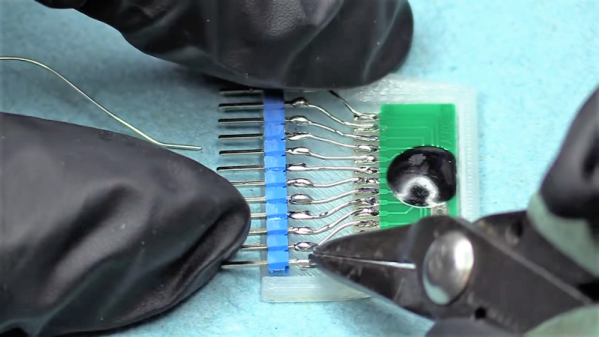
The little audio record and playback modules [Fran Blanche] scored from eBay for a buck a piece are a good example. These widgets are chip-on-board devices that probably came from some toy manufacturer and can record and playback 20 seconds of audio with just a little external circuitry. [Fran] wants to record different clips on a bunch of these, and pictured using the card-edge connector provided to plug them the recording circuit. But the pad spacing didn’t fit any connector she could find, so she came up with her own. The module and a standard 0.1″ (2.54 mm) pitch header are both glued into a 3D-printed case, and the board is connected to the header by bonding wires. It makes a nice module that’s easily plugged in for recording, and as [Fran] points out, it’s pretty adorable to boot. Check it out in the video below.

Sure, the same thing could have been accomplished with a custom PCB breaking out the module’s pins to a standard card-edge connector. But [Fran] knows a thing or two about ordering PCBs, and our guess is she wanted to get this done with what was on hand rather than wait for weeks. There’s something to be said for semi-instant gratification, after all. And lemonade.

Continue reading “A Hacked Solution For Non-Standard Audio Modules”

Of Roach Killer And Rust Remover: Sam Zeloof’s Garage-Made Chips

A normal life in hacking, if there is such a thing, seems to follow a predictable trajectory, at least in terms of the physical space it occupies. We generally start small, working on a few simple projects on the kitchen table, or if we start young enough, perhaps on a desk in our childhood bedroom. Time passes, our skills increase, and with them the need for space. Soon we’re claiming an unused room or a corner of the basement. Skills build on skills, gear accumulates, and before you know it, the garage is no longer a place for cars but a place for pushing back the darkness of our own ignorance and expanding our horizons into parts unknown.

It appears that Sam Zeloof’s annexation of the family garage occurred fairly early in life, and to a level that’s hard to comprehend. Sam seems to have caught the hacking bug early, and by the time high school rolled around, he was building out a remarkably well-equipped semiconductor fabrication lab at home. Sam has been posting his progress regularly on his own blog and on Twitter, and he dropped by the 2018 Superconference to give everyone a lesson on semiconductor physics and how he became the first hobbyist to produce an integrated circuit using lithographic processes.

Continue reading “Of Roach Killer And Rust Remover: Sam Zeloof’s Garage-Made Chips”

Self-Powered Sun Tracker Takes A Cue From NASA Solar Probe

Getting a solar array to track the sun has always been an interesting problem, and it has led to some complicated solutions. Controllers that use GPS and servos seem to be much in favor these days, but as this NASA-inspired sun tracker shows, the task needn’t be overly complex.

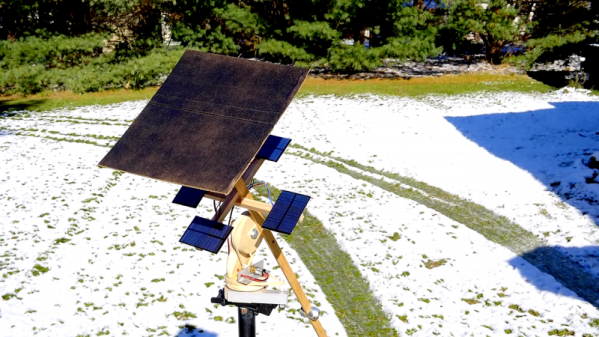
It’s pretty obvious from the video below that [NightHawkInLight]’s solar tracker is just a proof-of-concept for now, but it certainly shows promise. It’s based on NASA’s sun-skimming Parker Solar Probe, which uses sensors at the rear of the probe to maneuver the craft to keep sunlight from peeking around the sides of the shield. [NightHawkInLight]’s design simplifies that scheme even more, by using solar cells as the four sensors. The cells, mounted behind a solar shade, are directly connected to small gear motors that control azimuth and elevation. When a cell sees the sun, it powers the motor that moves the panel the right way to occlude the sun again, thereby cutting power to the motor.

[NightHawkInLight] mentions the obvious problem of what happens when the sun comes up and the array is pointing the complete opposite direction after the previous sunset, but we’re still not sure his solution – a larger array with tracking cells mounted further apart – will work. We’re also not sure how it will scale to larger arrays that need bigger motors to move. We’ve seen such arrays handled with more complicated trackers, of course, but we hope the simplicity of this design can be made practical for real-world use.

Continue reading “Self-Powered Sun Tracker Takes A Cue From NASA Solar Probe”