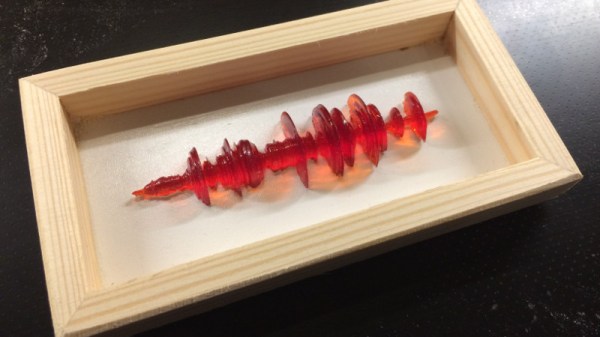
Wishing The Family A Sinusoidal Christmas

When it’s time to put together the annual Christmas card, most families take a few pictures of the kids, slap on a generic greeting, and call it a day. It used to be fairly common for the whole family to get dressed up and pose for a special Christmas picture, but who has the time anymore? It’s not like we have hours and hours to slave over a unique and memorable gift we can mail out to a dozen (or more) people.

Unless you’re [Chris Wolsey], anyway. Rather than take the easy way out and simply mailing some pictures of his daughter out to friends and family, he recorded her giving a Christmas greeting and turned the waveform of her voice into a framed physical memento. Way to wreck the curve for the rest of us, [Chris].
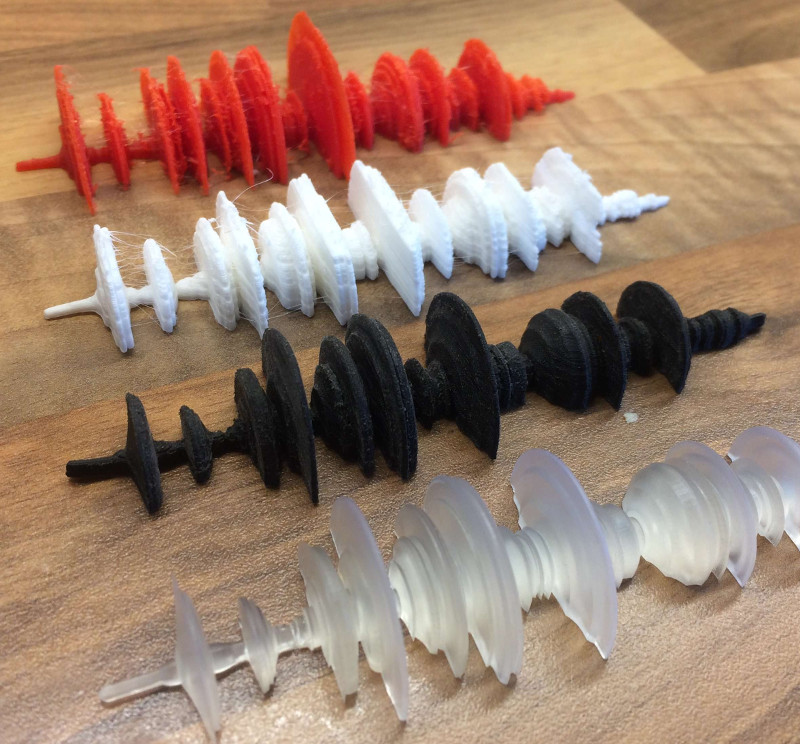
Evolution of the printed waveform.

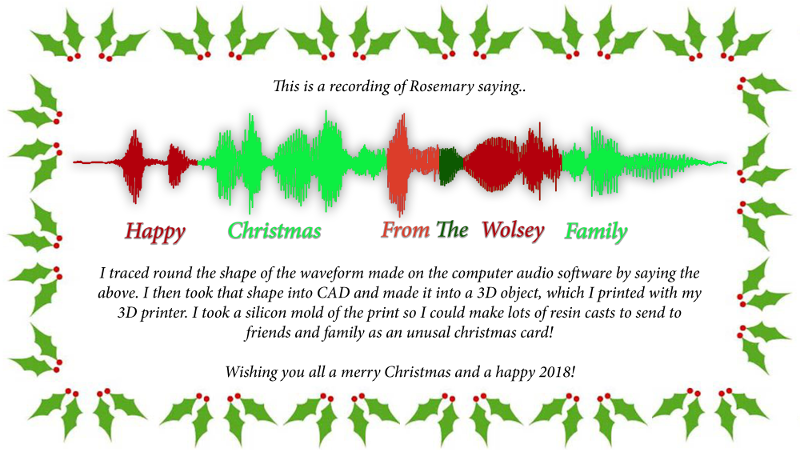
As it turns out, getting sound into CAD software isn’t exactly straightforward. To start, he made a recording of his daughter saying the words “Happy Christmas From the Wolsey Family” with Audacity, and then took a screenshot of the resulting waveform. This screenshot was then brought into Adobe Illustrator and exported to SVG, which Fusion 360 (and most other CAD packages) is able to import.

Now that the wave was in Fusion 360 he could scale it to a reasonable size, and use the revolve function to bring it into three dimensions. Cutting that object in half down the length then gave [Chris] a shape which should, theoretically, be printable on his FDM printers. But unfortunately, it wasn’t so easy. His personal Anet A8 had a tough time printing it, and the Prusa i3 MK2 at work didn’t fare much better. In the end, he had to make the leap to SLA, getting the shape printed on a Form 2 via 3D Hubs.

With the finalized shape in hand, [Chris] just need to put them into production. Printing them all via 3D Hubs wasn’t really an option, so he decided to make a mold and cast them in resin. He printed up a mold box, and after fiddling around with the mix a bit, was able to settle on a resin which allowed him to de-mold the shapes just 30 minutes after pouring.

Finally, he made frames for each cast waveform, and printed up a little label explaining just what the recipient was looking at; even going as far as showing which word corresponded to which section of the shape.
This is a fantastically executed and documented project, and while it’s too late to whip up your own version this year, we have no doubt they’ll be a few people “borrowing” this idea next time the holidays roll around.

It’s never too early to start planning for next Christmas. We’ve covered unique takes on the traditional holiday card before, as well as a sleighful of holiday decorating projects.

Edward Snowden Introduces Baby Monitor For Spies

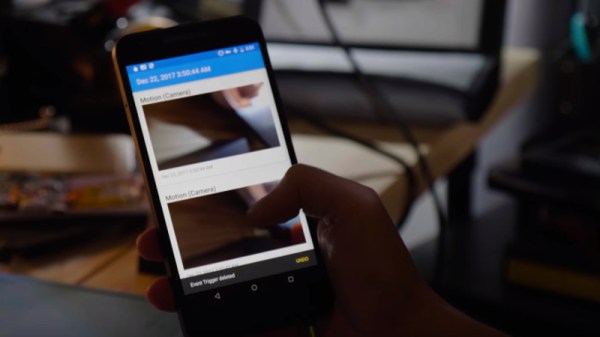
Famed whistleblower [Edward Snowden] has recently taken to YouTube to announce Haven: an Open Source application designed to allow security-conscious users turn old unused Android smartphones and tablets into high-tech monitoring devices for free. While arguably Haven doesn’t do anything that wasn’t already possible with software on the market, the fact that it’s Open Source and designed from the ground up for security does make it a bit more compelling than what’s been available thus far.

Developed by the Freedom of the Press Foundation, Haven is advertised as something of a role-reversal for the surveillance state. Instead of a smartphone’s microphone and camera spying on its owner, Haven allows the user to use those sensors to perform their own monitoring. It’s not limited to the camera and microphone either, Haven can also pull data from the smartphone’s ambient light sensor and accelerometer to help determine when somebody has moved the device or entered the room. There’s even support for monitoring the device’s power status: so if somebody tries to unplug the device or cut power to the room, the switch over to the battery will trigger the monitoring to go active.

Thanks to the Open Source nature of Haven, it’s hoped that continued development (community and otherwise) will see an expansion of the application’s capabilities. To give an example of a potential enhancement, [Snowden] mentions the possibility of using the smartphone’s barometer to detect the opening of doors and windows.

With most commercially available motion activated monitor systems, such as Nest Cam, the device requires a constant Internet connection and a subscription. Haven, on the other hand, is designed to do everything on the local device without the need for a connection to the Internet, so an intruder can’t just knock out your Wi-Fi to kill all of your monitoring. Once Haven sees or hears something it wants you to know about it can send an alert over standard SMS, or if you’re really security minded, the end-to-end encrypted Signal.

The number of people who need the type of security Haven is advertised as providing is probably pretty low; unless you’re a journalist working on a corruption case or a revolutionary plotting a coup d’etat, you’ll probably be fine with existing solutions. That being said, we’ve covered on our own pages many individuals who’ve spent considerable time and effort rolling their own remote monitoring solutions which seem to overlap the goals of Haven.

So even if your daily life is more John Doe than James Bond, you may want to check out the GitHub page for Haven or even install it on one of the incredibly cheap Android phones that are out there and take it for a spin.

Continue reading “Edward Snowden Introduces Baby Monitor For Spies”

Micro-ATX Arduino Is The Ultimate Breakout Board

If you’ve been hanging around microcontrollers and electronics for a while, you’re surely familiar with the concept of the breakout board. Instead of straining to connect wires and components to ever-shrinking ICs and MCUs, a breakout board makes it easier to interface with the device by essentially making it bigger. The Arduino itself, arguably, is a breakout board of sorts. It takes the ATmega chip, adds the hardware necessary to get it talking to a computer over USB, and brings all the GPIO pins out with easy to manage header pins.

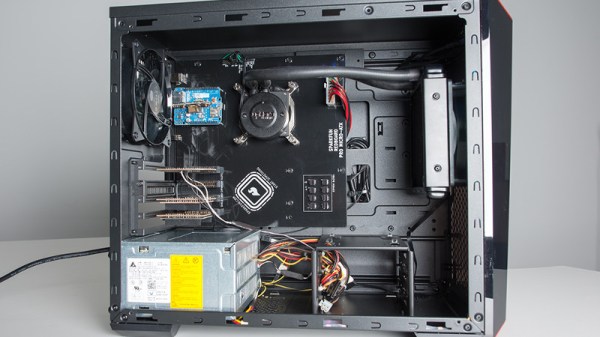
But what if you wanted an even bigger breakout board for the ATmega? Something that really had some leg room. Well, say no more, as [Nick Poole] has you covered with his insane RedBoard Pro Micro-ATX. Combining an ATmega32u4 microcontroller with standard desktop PC hardware is just as ridiculous as you’d hope, but surprisingly does offer a couple tangible benefits.

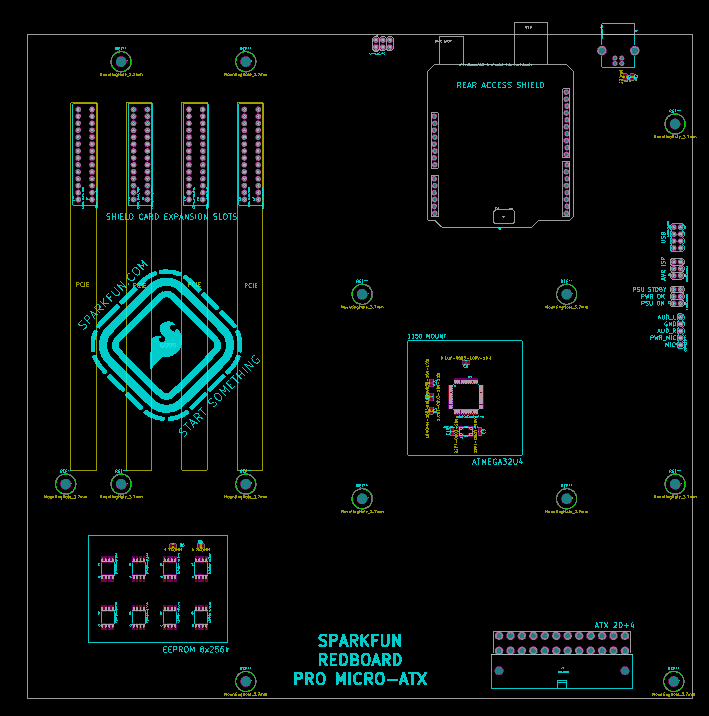
RedBoard PCB layout

The RedBoard is a fully compliant micro-ATX board, and will fit in pretty much any PC case you may have laying around in the junk pile. Everything from the stand-off placement to the alignment of the expansion card slots have been designed so it can drop right into the case of your choice.

That’s right, expansion slots. It’s not using PCI, but it does have a variation of the standard Arduino “shield” concept using 28 pin edge connectors. There’s a rear I/O panel with a USB port and ISP header, and you can even add water cooling if you really want (the board supports standard LGA 1151 socket cooling accessories).

While blowing an Arduino up to ATX size isn’t exactly practical, the RedBoard is not without legitimate advantages. Specifically, the vast amount of free space on the PCB allowed [Nick] to add 2Mbits of storage. There was even some consideration to making removable banks of “RAM” with EEPROM chips, but you’ve got to draw the line somewhere. The RedBoard also supports standard ATX power supplies, which will give you plenty of juice for add-on hardware that may be populating the expansion slots.

With as cheap and plentiful as the miniITX and microATX cases are, it’s no surprise people seem intent on cramming hardware into them. We’ve covered a number of attempts to drag other pieces of hardware kicking and screaming into that ubiquitous beige-box form factor.

Building A Supersized Game Boy Advance

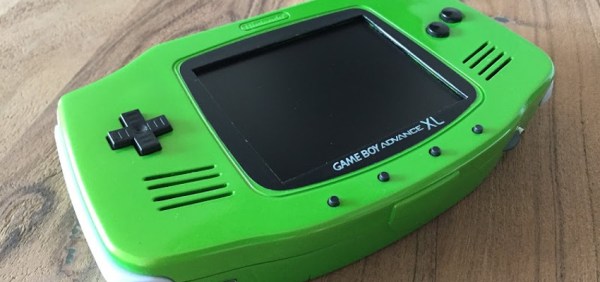
Unless you really look closely at the image above, you might not realize you aren’t looking at a normal Game Boy Advance; which is sort of the point. Even though it retains the looks of the iconic Nintendo handheld, this version built by [Akira] is supersized for adult hands. How big is it? To give you an idea, that screen is 5 inches, compared to the 2.9 inch screen the original sported.

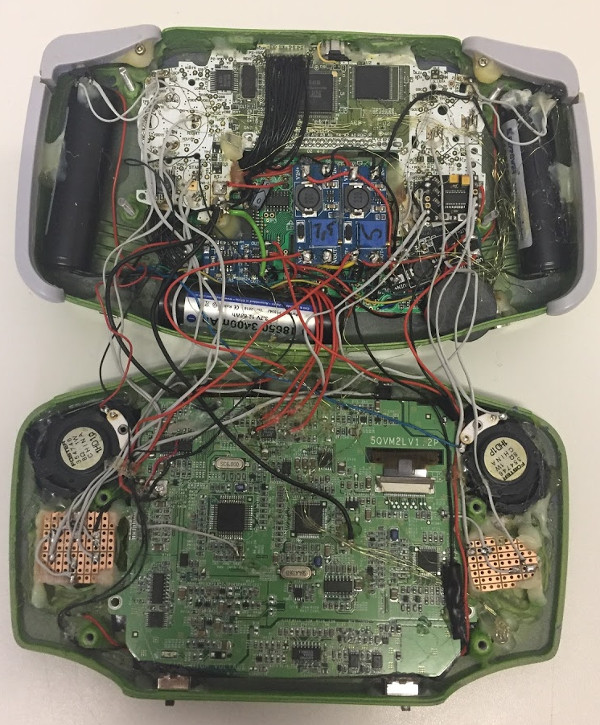
Unlike most of the portable gaming hacks we’ve covered recently, this big-boy GBA isn’t powered by a Raspberry Pi. Internally it’s packing a genuine GBA motherboard, which has been wired into a portable screen originally intended for the PlayStation.

Though that may be understating things a bit, as getting the round PCB of the original screen into the rectangular shape of the GBA meant it had to be cut down and the traces recreated with jumper wires. The original CCFL backlight of the screen had to go in the name of battery life, and in its place is the backlight system pulled from a Nintendo DSi XL.

But where did [Akira] get a giant GBA case to begin with? No, it isn’t 3D printed. It’s actually a hard carrying case that was sold for the GBA. The carrying case obviously didn’t have a cartridge slot or openings for buttons, so those sections were grafted from a donor GBA case. So despite the system overall being so much bigger than the original, the D-Pad, face buttons, and cartridge slot on the back are at normal GBA scale.

The GBA XL is really a labor of love; browsing through the build log you can see that [Akira] actually started the project back in 2014, but it kept getting shelved until more research could be done on how to pack all the desired features into the final device.

While this may be the most historically accurate attempt at making a bigger Game Boy, it certainly isn’t the first. There seems to be a fascination with turning the quintessential pocket game system into something that’s quite the opposite.

Continue reading “Building A Supersized Game Boy Advance”

Retrotechtacular: Field Assembling Airplanes Like Wartime “Ikea”

Imagine it’s 1943, and you have to transport 1,000 P-47 fighter planes from your factory in the United States to the front lines in Europe, roughly 5,000 miles over the open ocean. Flying them isn’t an option, the P-47 has a maximum range of only 1,800 miles, and the technology for air-to-air refueling of fighter planes is still a few years off. The Essex class aircraft carriers in use at this time could carry P-47s in a pinch, but the plane isn’t designed for carrier use and realistically you wouldn’t be able to fit many on anyway. So what does that leave?

It turns out, the easiest way is to simply ship them as freight. But you can’t exactly wrap a fighter plane up in brown paper and stick a stamp on it; the planes would need to be specially prepared and packed for their journey across the Atlantic. To get the P-47 inside of a reasonably shaped shipping crate, the wings, propeller, and tail had to come off and be put into a separate crate. But as any reader of Hackaday knows, getting something apart is rarely the problem, it’s getting the thing back together that’s usually the tricky part.

So begins the 1943 film “Uncrating and Assembly of the P-47 Thunderbolt Airplane which has been digitally restored and uploaded to YouTube by [Zeno’s Warbirds]. In this fascinating 40 minute video produced by the “Army Air Forces School of Applied Tactics”, the viewer is shown how the two crates containing the P-47 are to be unpacked and assembled into a ready-to-fly airplane with nothing more than manpower and standard mechanic’s tools. No cranes, no welders, not even a hanger: just a well-designed aircraft and wartime ingenuity.

Continue reading “Retrotechtacular: Field Assembling Airplanes Like Wartime “Ikea””

Aluminum Foil Heatsink Keeps LEDs In Check

In your kitchen is very likely a roll of aluminum foil, like most people you probably use it to line pans or wrap food for baking. If you heard somebody used aluminum foil in the cooling of items, you could be forgiven for thinking they were referring to wrapping leftovers and tossing them in the refrigerator. But rather than preserving Mom’s famous meatloaf, [Michael Dunn] is using that classic kitchen staple to protect his LED strips.

Cheap LED strips are becoming extremely popular and have been popping up in more and more projects, but they have a pretty serious flaw: heat dissipation. Left on their own they can get hot enough to cook themselves, which is sort of a problem when you’re looking to replace as much of your home lighting with them like [Michael] is.

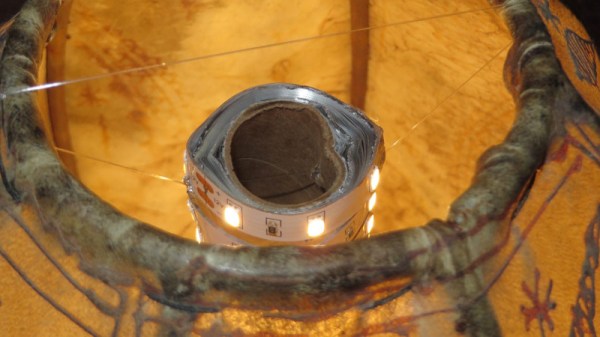
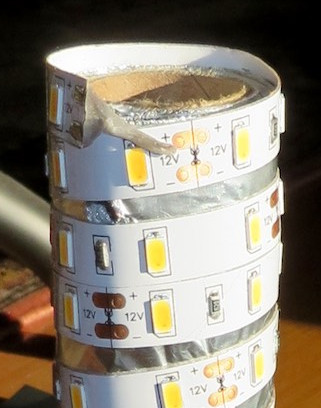
Heat was of particular concern as he was looking to retrofit a delicate shade with his beloved LED strips. Since he wanted a column of LEDs inside the unique shape of the shade, he reasoned that some kind of heat-conductive tubular structure could be used as both a mandrel to wrap the LEDs around and a way to dissipate heat. Like most of us, his first thought was copper pipe. But unfortunately the only copper pipe he had handy was of too small a diameter.

The tube of foil on the other hand was the perfect diameter, and while aluminum isn’t as good a conductor of heat as copper, it’s certainly no slouch either. Early tests weren’t that great when the tube was laying on the bench, but once it stood vertically convection got the air moving and cooled the LEDs down to where [Michael] was comfortable enough to put them inside the shade. Though he does have some lingering doubts about leaving the cardboard tube in such a toasty environment.

Going back through the archives, we’ve seen some absolutely fantastic projects utilizing LED strips in the past, some of which have come up with their own creative ways of beating the heat.

Resurrecting Dead LED Lightbulbs

If you’ve gone down the lighting isle of a store recently, you’ve no doubt noticed we are firmly in the age of the LED light bulb. Incandescent bulbs are kept in small stock for those who still have the odd-ball use case, there’s usually a handful of CFL bulbs for those who don’t mind filling their house with explosive vials of hot mercury, but mostly its all LED now. Which is as it should be: LED lighting is clearly the superior choice in terms of energy efficiency, lifetime, and environmental impact.

Unfortunately, a lot of the LED bulbs you’ll see on the rack are of pretty poor quality. In an effort to drive cost down corners get cut, and bulbs which should run for decades end up blowing after a couple of months. After yet another one failed on him, [Kerry Wong] decided to do a teardown to examine the failure in detail.

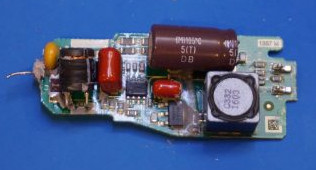
The failed LED driver.

He notes that most of the LEDs seem to fail in the same way, flickering after they are switched on until they just stop lighting up entirely. This hints at an overheating issue, and [Kerry] opines that aesthetic and cost considerations have pushed heat dissipation to the back burner in terms of design. It also doesn’t help that many of these bulbs are sitting in insulated recessed fixtures in the ceiling, making it even harder to keep them cool.

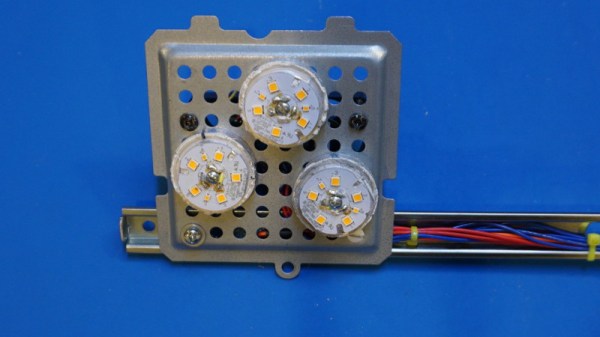
Once he separates the actual LEDs from the driver circuitry, he is able to determine that the emitters themselves still work fine. Rather than toss the whole thing in the trash, it’s possible to reuse the LEDs with a new power source, which is quickly demonstrated by showing off a shop light he built from “dead” LED light bulbs.

[Kerry Wong] isn’t the only one to put his LED bulbs under the knife. We’ve covered a number of teardowns which explore the cutting edge of home lighting; for better or for worse.

Continue reading “Resurrecting Dead LED Lightbulbs”