New Part Day: Lynxmotion Smart Servos

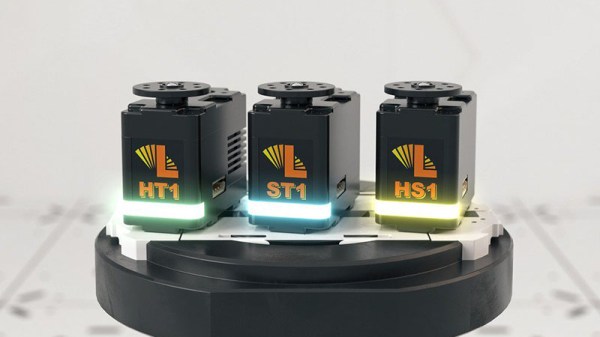
Anyone who shops for robotics kits would have come across a few designed by Lynxmotion. They’ve been helping people build robots since 1995, from robot arm kits to hexapod chassis and everything in between. We would expect these people know their motors, so when they launched their own line of servo motors called Lynxmotion Smart Servos (LSS), it is worth spending a bit of time to look over what they offer.

While these new devices have a PWM mode compatible with classic remote control servos, unleashing their full power requires bidirectional communication over a serial bus. We’ve previously given an overview of three serial bus servos already on the market for comparison. A quick look at the $68-$100 price tags listed on Lynxmotion’s parent company RobotShop made it clear they do not intend to compete on price, so what interesting features do these new kids on the block have?

Digging into product documentation found some great details. Acceleration and deceleration rates are adjustable, which can help with smoother robot movement. There’s also an adjustable level of “stiffness” that adds some “give” (compliance) so a robot won’t have to be as stiff as… well, a robot!

Mechanically, the most interesting internal component is the magnetic position sensor. They are far more precise than potentiometers, but more importantly, they allow positioning anywhere within full 360 degrees. Many other serial bus servos are constrained to positions within an arc less than 360 degrees leaving a blind spot.

An interesting quirk of the LSS offerings is that the serial communication protocol uses human-readable text characters, so sending a number 255 means transmitting a three byte string ‘2’, ‘5’, and ‘5’ instead of single byte 0xFF. This would make debugging our custom robot code far easier, at the cost of reduced bandwidth efficiency and loss of checksum for detecting communication errors. It’s a trade-off that some robot builders would be happy to make, but others might not.

Externally, these servos have bountiful mounting options including some we didn’t know to ask for. Historically Lynxmotion kits have used a wide variety of servo mounting brackets, so they are motivated to make mechanical integration easy. The most novel offering is the ability to bolt external gears to the servo body. A set of 1:3 gears allow for gearing the servo up or down, or you can use a set of 1:1 gears for a compact gripper.

As you’d expect of servos in this price range, they all have metal gears, but they also have the ability to power the motor directly from a battery pack (a 3 cell lithium polymer is recommended). There are additional features, like an RGB LED for visual feedback, which we didn’t cover here so dig into the documentation for more. We look forward to seeing how these interesting little actuators perform in future robotics projects.


Hackaday Podcast 017: Are Cheap Microcontrollers Worth It? Android On Your Bike. Plus Food Printers And Coffee Bots

Join Editors Mike Szczys and Elliot Williams as they recount a week of fascinating hacks. We take a good look at the PMS150C, a microcontroller that literally costs pennies but can only be flashed once. SNES emulators have a new trick up their sleeves to make low-def a lot less low, and you retro enthusiasts will either hate or love the NES zapper chandelier. Elliot’s enamored by a bike computer running Android core, and both Mike and Elliot delve into the food hacking scene, be it meat, chocolate, coffee, or of course frosting!

Take a look at the links below if you want to follow along, and as always, tell us what you think about this episode in the comments!

Take a look at the links below if you want to follow along, and as always, tell us what you think about this episode in the comments!

Direct download (60 MB or so.)

Continue reading “Hackaday Podcast 017: Are Cheap Microcontrollers Worth It? Android On Your Bike. Plus Food Printers And Coffee Bots”

The Cloak Of Invisibility Against Image Recognition

Adversarial attacks are not something new to the world of Deep Networks used for image recognition. However, as the research with Deep Learning grows, more flaws are uncovered. The team at the University of KU Leuven in Belgium have demonstrated how, by simple using a colored photo held near the torso of a man can render him invisible to image recognition systems based on convolutional neural networks.

Convolutional Neural Networks or CNNs are a class of Deep learning networks that reduces the number of computations to be performed by creating hierarchical patterns from simpler and smaller networks. They are becoming the norm for image recognition applications and are being used in the field. In this new paper, the addition of color patches is seen to confuse the image detector YoLo(v2) by adding noise that disrupts the calculations of the CNN. The patch is not random and can be identified using the process defined in the publication.

This attack can be implemented by printing the disruptive pattern on a t-shirt making them invisible to surveillance system detection. You can read the paper[PDF] that outlines the generation of the adversarial patch. Image recognition camouflage that works on Google’s Inception has been documented in the past and we hope to see more such hacks in the future. Its a new world out there where you hacking is colorful as ever.

Continue reading “The Cloak Of Invisibility Against Image Recognition”

Get To Know The Physics Behind Soldering And The Packaging Of ICs

Often it feels as if soldering is deemed to be more of an art form than something that’s underpinned by the cold, hard reality of physics and chemistry. From organic chemistry with rosin, to the material properties of fragile gold bond wires and silicon dies inside IC packages and the effects of thermal stress on the different parts of an IC package, it’s a complicated topic that deserves a lot more attention than it usually gets.

A casual inquiry around one’s friends, acquaintances, colleagues and perfect strangers on the internet usually reveals the same pattern: people have picked up a soldering iron at some point, and either figured out what seemed to work through trial and error, or learned from someone else who has learned what seemed to work through trial and error. Can we say something scientific about soldering?

Continue reading “Get To Know The Physics Behind Soldering And The Packaging Of ICs”

Custom Monitor For Pi-Powered Commodore 64

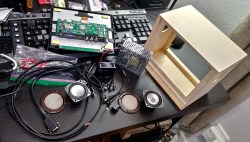
Classic games never seem to have gone out of style and with the emulation powers of the Raspberry Pi, there seems to be no end of projects folks have been coming up with. [Chris Mills] project is a great looking monitor to get his Commodore 64 fix by combining the retro looks of a home-made 64-style monitor with the Raspberry Pi.

[Chris] is only interested in Commodore 64 emulation, at least with this project, and wanted something that would fit on a desk without taking up too much room. An eight inch LCD security monitor fit the bill perfectly. [Chris] ended up building a wooden enclosure for the monitor to give it that Commodore look. The monitor, power supply and cable connections fit inside along with speakers; each of these having their inputs on the back. A fan vents in the back as well and the Pi sits outside running the Combian 64 emulation software.

[Chris] has put up some galleries of build pics. The logo from the old Commodore logo is a nice touch. Read over the Hackaday site and you could build your own Commodore 64, or use the Commodore 64 itself to house the Raspberry Pi if you wanted.


Fortran Goes Interactive

When you think of Fortran you probably think of punched cards and green bar paper. While it is true that Fortran isn’t the go-to language it used to be — pun unintentional — it still has a vibrant community of people who do serious number crunching. However, many members of that community have been seduced away by interactive tools that are also good at number crunching like MATLAB, Julian, and Python with special libraries. The LFortran project aims to create a Fortran environment with interactivity like Python, but retaining the speed that Fortran is known for.

The resulting tool is impressive. You can use it from Jupyter, can parse code targeting existing Fortran compilers, and supports Linux, Mac, and Windows. There is development to make the code fully interoperable with other languages like C or Python as well as take advantage of GPUs and other specialized hardware. They are also zeroing in on full Fortran 2018 support.

Continue reading “Fortran Goes Interactive”

Innovative Bird Feeder Design Recycles Recycling’s Garbage

Recycling beverage cartons isn’t 100% efficient. The process yields some unusable garbage as a byproduct. Why? Because containers like juice boxes are mostly paper, but also contain plastic and aluminum. The recycling process recovers the paper fibers for re-use, but what’s left after that is a mixture of plastic rejects and other bits that aren’t good for anything other than an incinerator or a landfill. Until now, anyway!

It turns out it is in fact possible to turn such reject material into a product that can be injection-molded, as shown here with [Stefan Lugtigheid]’s SAM bird feeder design. The feeder is not just made from 100% recycled materials, it’s made from the garbage of the recycling process — material that would otherwise be considered worthless. Even better, the feeder design has only the one piece. The two halves are identical, which reduces part count and simplifies assembly.

[Stefan] makes it clear that the process isn’t without its quirks. Just because it can be injection-molded doesn’t mean it works or acts the same as regular plastic. Nevertheless, the SAM birdfeeder demonstrates that it can definitely be put to practical use. We’ve seen creative reprocessing of PET bottles and sheet stock made from 3D printed trash, but recycling the garbage that comes from recycling drink cartons is some next-level stuff, for sure.