This Is The Year Conference Badges Get Their Own Badges

Over the last few years, the art and artistry of printed circuit boards has moved from business cards to the most desirable of all disposable electronics. I speak, of course, of badgelife. This is the community built on creating and distributing independent electronic conference badges at the various tech and security conferences around the globe.

Until now, badgelife has been a loose confederation of badgemakers and distributors outdoing themselves each year with ever more impressive boards, techniques, and always more blinky bling. The field is advancing so fast there is no comparison to what was being done in years past; where a simple PCB and blinking LED would have sufficed a decade ago, now we have customized microcontrollers direct from the factory, fancy new chips, and the greatest art you’ve ever seen.

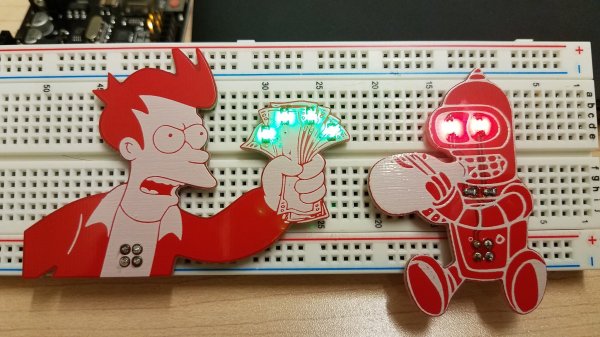
Now we have reached a threshold. The badgelife community has gotten so big, the badges are getting their own badges. This is the year of the badge add-on. We’re all building tiny trinkets for our badges, and this time, they’ll all work together. We’re exactly one year away from a sweet Voltron robot made of badges.

Continue reading “This Is The Year Conference Badges Get Their Own Badges”

Clock This! A 3D-Printed Escapement Mechanism

Traditional mechanical clockmaking is an art that despite being almost the archetype of precision engineering skill, appears rarely in our world of hardware hackers. That’s because making a clock mechanism is hard, and it is for good reason that professional clockmakers serve a long apprenticeship to learn their craft.

Though crafting one by hand is no easy task, a clock escapement is a surprisingly simple mechanism. Simple enough in fact that one can be 3D-printed, and that is just what [Josh Zhou] has done with a model posted on Thingiverse.

The model is simply the escapement mechanism, so to make a full clock there would have to be added a geartrain and clock face drive mechanism. But given a pair of 608 skateboard wheel bearings and a suitable weight and string to provide a power source, its pendulum will happily swing and provide that all-important tick. We’ve posted his short video below the break, so if Nixie clocks aren’t enough for you then perhaps you’d like to take it as inspiration to go mechanical.

A pendulum escapement of this type is only one of many varieties that have been produced over the long history of clockmaking. Our colleague [Manuel Rodriguez-Achach] took a look at some of them back in 2016.

Continue reading “Clock This! A 3D-Printed Escapement Mechanism”

Make A Natural Language Phone Bot Like Google’s Duplex AI

After seeing how Google’s Duplex AI was able to book a table at a restaurant by fooling a human maître d’ into thinking it was human, I wondered if it might be possible for us mere hackers to pull off the same feat. What could you or I do without Google’s legions of ace AI programmers and racks of neural network training hardware? Let’s look at the ways we can make a natural language bot of our own. As you’ll see, it’s entirely doable.

Continue reading “Make A Natural Language Phone Bot Like Google’s Duplex AI”

Wiping Robots And Floors: STM32duino Cleans Up

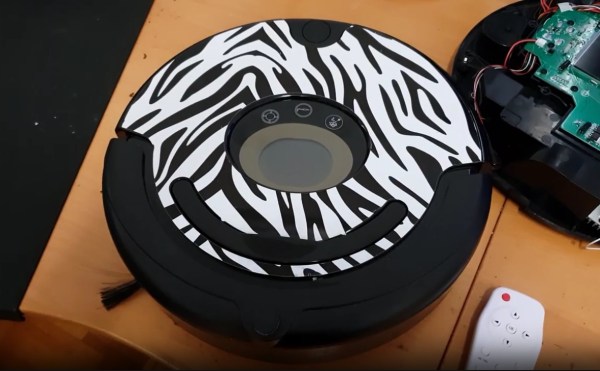
Ever find yourself with nineteen nameless robot vacuums lying around? No? Well, [Aaron Christophel] likes to live a different life, filled with zebra print robots (translated). After tearing a couple down, only ten vacuums remain — casualties are to be expected. Through their sacrifice, he found a STM32F101VBT6 processor acting as the brains for the survivors. Coincidentally, there’s a project called STM32duino designed to get those processors working with the Arduino IDE we either love or hate. [Aaron Christophel] quickly added a variant board through the project and buckled down.

Of course, he simply had to get BLINK up and running, using the back-light of the LCD screen on top of the robots. From there, the STM32 processors gave him a whole 80 GPIO pins to play with. With a considerable amount of tinkering, he had every sensor, motor, and light under his control. Considering how each of them came with a remote control, several infra-red sensors, and wheels, [Aaron Christophel] now has a small robotic fleet at his beck and call. His workshop must be immaculate by now. Maybe he’ll add a way for the vacuums to communicate with each other next. One robot gets the job done, but a whole team gets the job done in style, especially with a zebra print cleaner at the forefront.

If you want to see more of his work, he has quite a few videos on his website demonstrating the before and after of the project — just make sure to bring a translator. He even has a handy pinout for those looking to replicate his work. If you want to dive right in to STM32 programming, we have a nice article on how to get it up and debugged. Otherwise, enjoy [Aaron Christophel]’s demonstration of the eight infra-red range sensors and the custom firmware running them.

The Best New Amiga Title Of 2018?

Just because a system becomes obsolete for most of us doesn’t mean that everyone stops working with them. Take a look at this brand new game for the Amiga 500 called Worthy, which is sure to make most of us regret ever upgrading our home computers, despite the improvements made since 1987.

The group who developed the game is known as Pixelglass and they have done a lot of work on this platform, releasing several games over the past few years. Their latest is Worthy, an action-adventure game that looks similar to the top-down perspective Zelda games from the SNES. It’s an impressive piece of work for a system that few of us own anymore, but if you have one (or even if you have a good emulator) you might want to give it a whirl.

If developing games for retro systems is your style, this isn’t limited to personal computers like the Amiga. We’ve seen development platforms for the Super Nintendo that will let you run your own code, and even other methods for working with the Sega Saturn if you’re feeling really adventurous.

Thanks to [Chappy1978] for the tip!

Continue reading “The Best New Amiga Title Of 2018?”

Desktop Radio Telescope Images The WiFi Universe

It’s been a project filled with fits and starts, and it very nearly ended up as a “Fail of the Week” feature, but we’re happy to report that the [Thought Emporium]’s desktop WiFi radio telescope finally works. And it’s pretty darn cool.

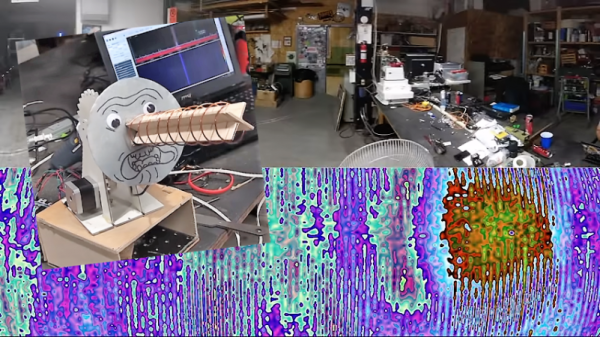
If you’ve been following along with the build like we have, you’ll know that this stems from a previous, much larger radio telescope that [Justin] used to visualize the constellation of geosynchronous digital TV satellites. This time, he set his sights closer to home and built a system to visualize the 2.4-GHz WiFi band. A simple helical antenna rides on the stepper-driven azimuth-elevation scanner. A HackRF SDR and GNU Radio form the receiver, which just captures the received signal strength indicator (RSSI) value for each point as the antenna scans. The data is then massaged into colors representing the intensity of WiFi signals received and laid over an optical image of the scanned area. The first image clearly showed a couple of hotspots, including a previously unknown router. An outdoor scan revealed routers galore, although that took a little more wizardry to pull off.

The videos below recount the whole tale in detail; skip to part three for the payoff if you must, but at the cost of missing some valuable lessons and a few cool tips, like using flattened pieces of Schedule 40 pipe as a construction material. We hope to see more from the project soon, and wonder if this FPV racing drone tracker might offer some helpful hints for expansion.

Continue reading “Desktop Radio Telescope Images The WiFi Universe”

Learn Something About Phase Locked Loops

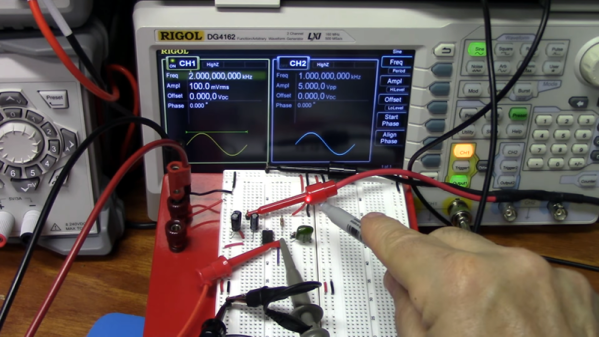
The phase locked loop, or PLL, is a real workhorse of circuit design. It is a classic feedback loop where the phase of an oscillator is locked to the phase of a reference signal using an error signal in the same basic way that perhaps a controller would hold a temperature or flow rate in a physical system. That is, a big error will induce a big change and little errors induce little changes until the output is just right. [The Offset Volt] has a few videos on PLLs that will help you understand their basic operation, how they can multiply frequencies (paradoxically, by dividing), and even demodulate FM radio signals. You can see the videos below.

The clever part of a PLL can be found in how it looks at the phase of two signals. For signals to be totally in phase, they must be at the same frequency and also must ebb and peak at the same point. It should be clear that if the frequency isn’t the same the ebbs and peaks can’t line up for any length of time. By detecting how much the signals don’t line up, an error voltage can be generated. That error voltage is used to adjust the output oscillator so that it matches the reference oscillator.

Of course, it wouldn’t be very interesting if the output frequency had to be the same as the reference frequency. The clever trick comes by dividing the output frequency. For example, a 100 MHz crystal oscillator is difficult to design. But taking a voltage-controlled oscillator at 100 MHz (nominal) and dividing its output by 100 will give you a signal you can lock to a 1 MHz crystal oscillator which is, of course, trivial to build.

Continue reading “Learn Something About Phase Locked Loops”