Hyperspectral Imaging – Seeing The Unseeable

They say that a picture is worth a thousand words. But what is a picture exactly? One definition would be a perfect reflection of what we see, like one taken with a basic camera. Our view of the natural world is constrained to a bandwidth of 400 to 700 nanometers within the electromagnetic spectrum, so our cameras produce images within this same bandwidth.

Image via Cosmos Magazine.

For example, if I take a picture of a yellow flower with my phone, the image will look just about how I saw it with my own eyes. But what if we could see the flower from a different part of the electromagnetic spectrum? What if we could see less than 400 nm or greater than 700 nm? A bee, like many other insects, can see in the ultraviolet part of the spectrum which occupies the area below 400 nm. This “yellow” flower looks drastically different to us versus a bee.

In this article, we’re going to explore how images can be produced to show spectral information outside of our limited visual capacity, and take a look at the multi-spectral cameras used to make them.  We’ll find that while it may be true that an image is worth a thousand words, it is also true that an image taken with a hyperspectral camera can be worth hundreds of thousands, if not millions, of useful data points. Continue reading “Hyperspectral Imaging – Seeing The Unseeable”
A Passive Mixer’s Adventure Through Product Development

The year was 2014, and KORG’s volca line of pint-sized synthesizers were the latest craze in the music world. Cheap synths and drum machines were suddenly a reality, all in a backpack-friendly form factor. Now practically anyone could become an electronic music sensation!

I attended a jam with friends from my record label, and as was the style at the time, we all showed up with our latest and greatest gear. There was the microKORG, a MiniNova, and a couple of guitars, but all attention was on the volcas, which were just so much fun to pick up and play with.

There was just one problem. Like any game-changing low-cost hardware, sacrifices had been made. The volcas used 3.5mm jacks for audio and sync pulses, and the initial lineup came with a bassline, lead, and drum synth. Syncing was easy, by daisy chaining cables between the boxes, but if you wanted to record or mix, you’d generally need to stack adapters to get your signals in a more typical 6.5mm TS format used by other music hardware.

After mucking around, I did some research on what other people were doing. Most were suffering just like we were, trying to patch these little machines into full-sized mixing desks. It seemed like overkill — when you just want to muck around, it’s a bit much to drag out a 24 channel powered mixer. I wanted a way to hook up 3 of these machines to a single set of headphones and just groove out.

To solve this problem, we needed a mixer to match the philosophy of the volcas; simple, accessible, and compact. It didn’t need to be gold-plated or capable of amazing sonic feats, it just had to take a few 3.5mm audio sources, and mix them down for a pair of headphones.

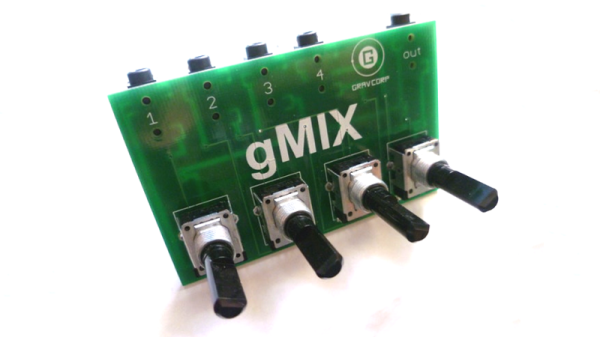
I’d heard of people using headphone splitters with mixed results, and it got me thinking about passive mixing. Suddenly it all seemed so clear — I could probably get away with a bunch of potentiometers and some passives and call it a day! With a friend desperate to get their hands on a solution, I decided to mock up a prototype and took it round to the studio to try out.

Continue reading “A Passive Mixer’s Adventure Through Product Development”

Reverse Polish Notation And Its Mildly Confusing Elegance

The best rummage sale purchase I ever made was a piece of hardware that used Reverse Polish Notation. I know what you’re thinking… RPN sounds like a sales gimmick and I got taken for a fool. But I assure you it’s not only real, but a true gem in the evolution of computing.

Best rummage sale find ever!

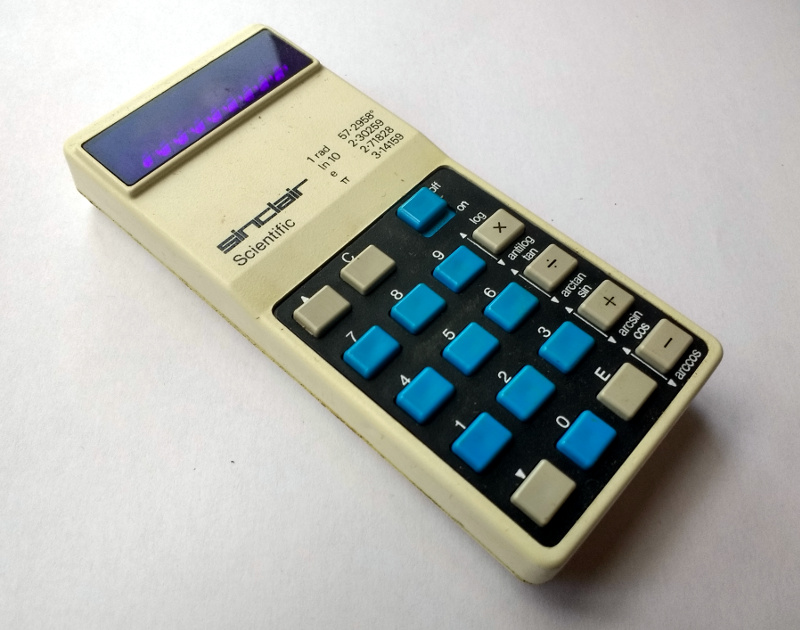
Sometime in the 1980s when I was a spotty teen, I picked up a calculator at a rummage sale. Protected by a smart plastic case, it was a pretty good condition Sinclair Scientific that turned out when I got it home to have 1975 date codes on its chips, and since anything with a Sinclair badge was worth having it became mine for a trifling amount of money. It had a set of corroded batteries that had damaged one of its terminals, but with the application of a bit of copper strip I had a working calculator.

And what a calculator! It didn’t have many buttons at a time when you judged how cool a scientific calculator was by the prolific nature of its keyboard. This one looked more akin to a run-of-the-mill arithmetic calculator, but had button modes for trigonometric functions and oddly an enter key rather than an equals sign. The handy sticker inside the case explained the mystery, this machine used so-called Reverse Polish Notation, or RPN. It spent several years on my bench before being reverently placed in a storage box of Sinclair curios which I’ve spent half a day turning the house over to find as I write this article.

Continue reading “Reverse Polish Notation And Its Mildly Confusing Elegance”

Rosalind Franklin Saw DNA First

It’s a standard science trivia question: Who discovered the structure of DNA? With the basic concepts of molecular biology now taught at a fairly detailed level in grade school, and with DNA being so easy to isolate that it makes a good demonstration project for school or home, everyone knows the names of Watson and Crick. But not many people know the story behind one of the greatest scientific achievements of the 20th century, or the name of the scientist without whose data Watson and Crick were working blind: Rosalind Franklin.

Continue reading “Rosalind Franklin Saw DNA First”

What Makes A Hacker

I think I can sum up the difference between those of us who regularly visit Hackaday and the world of non-hackers. As a case study, here is a story about how necessity is the mother of invention and the people who invent.

Hackaday has overlap with sites like Pinterest and Instructables but there is one vital difference, we choose to create something new and beautiful with the materials at hand. Often these tools and techniques are very simple. We look to make things elegant by reducing the unnecessary clutter, not adding glitter. If something could be built with a 555 timer we will let you know. If there is a better choice for a processor, we will tell you.

My first real work commute was a forty-minute eastward drive every morning and a forty-minute westward drive every evening. This route pointed my car directly into the sun twice a day. Staring into a miasma of incandescent plasma for an hour and a half a day isn’t fun, and probably isn’t safe, but we can fix that.

Continue reading “What Makes A Hacker”

MakerBot Really Wants You To Like Them Again

For the last couple years, a MakerBot press release has generally signaled that more pink slips were going to be heading out to the already shell-shocked employees at their NYC factory. But just last week something that could almost pass as good news came out of the once mighty 3D printer manufacturer, the unveiling of “MakerBot Labs”. A number of mainstream tech sites heralded this as MakerBot’s first steps back into the open source community that launched it nearly a decade ago; signs of a newer and more thoughtful MakerBot.

Reading the announcement for “MakerBot Labs”, you can almost believe it. All the buzz words are there, at least. In fact, if this announcement came from anyone else, in any other field, I’d probably be on board. Sharing knowledge and listening to the community is essential if you want to connect with hackers and makers. But this is MakerBot, and they’ve dug themselves into a very deep hole over the years.

The spectacular fall from grace that MakerBot has experienced, from industry leader to afterthought, makes this hat-in-hand peace offering hard to take seriously. It reads like a company making a last ditch effort to win back the users they were so sure they didn’t need just a few years ago. There is now a whole new generation of 3D printer owners who likely have never even seen a MakerBot printer, and it’s hard to imagine there’s still enough innovation and life in the company to turn that around before they completely fade into obscurity.

Continue reading “MakerBot Really Wants You To Like Them Again”

Artificial Intelligence At The Top Of A Professional Sport

The lights dim and the music swells as an elite competitor in a silk robe passes through a cheering crowd to take the ring. It’s a blueprint familiar to boxing, only this pugilist won’t be throwing punches.

OpenAI created an AI bot that has beaten the best players in the world at this year’s International championship. The International is an esports competition held annually for Dota 2, one of the most competitive multiplayer online battle arena (MOBA) games.

Each match of the International consists of two 5-player teams competing against each other for 35-45 minutes. In layman’s terms, it is an online version of capture the flag. While the premise may sound simple, it is actually one of the most complicated and detailed competitive games out there. The top teams are required to practice together daily, but this level of play is nothing new to them. To reach a professional level, individual players would practice obscenely late, go to sleep, and then repeat the process. For years. So how long did the AI bot have to prepare for this competition compared to these seasoned pros? A couple of months.

Continue reading “Artificial Intelligence At The Top Of A Professional Sport”