BEAM-Powered, Ball-Flinging Beam Has Us Beaming

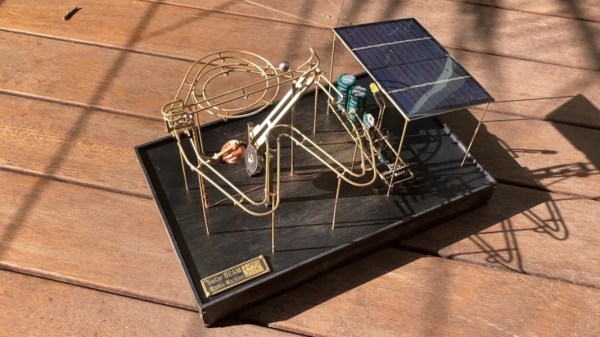
We have a soft spot for BEAM projects, because we love to see the Sun do fun things when aided by large capacitors. [NanoRobotGeek]’s marble machine is an extraordinary example — once sufficiently charged, the two 4700 μF capacitors dump power into a home-brew solenoid, which catapults the ball bearing into action toward the precipice of two tracks.

[NanoRobotGeek] started with the freely-available Suneater solar circuit. It’s a staple of BEAM robotics, slightly modified to fit the needs of this particular project. First up was verifying that the lever (or beam, if you will) principle would work at all, and [NanoRobotGeek] just built it up from there in admirable detail. The fact that it alternates between the swirly track and the zigzag track is entrancing.

There are several disciplines at play here, and we think it’s beautifully made all around, especially since this was [NanoRobotGeek]’s first foray into track bending. We love the way it flings the ball so crisply, and the track-changing lever is pretty darn satisfying, too. You can check it out in action in the video after the break.

Although this was [NanoRobotGeek]’s maiden marble track, it’s not their first circuit sculpture — check out this flapping, BEAM-powered dragonfly.

Continue reading “BEAM-Powered, Ball-Flinging Beam Has Us Beaming”

Solar Safety Bag Lights Up The Night, Charges Your Phone

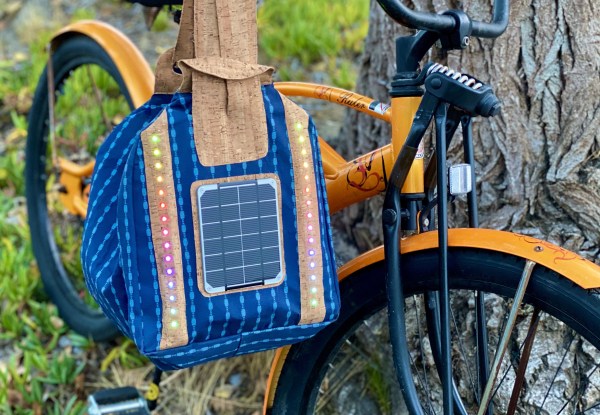
Spend enough time riding a bike, and chances are good that you’ll start carrying a few tools with you. Even if you don’t, you’re probably going to use a bag to carry something along, so why not make that bag do triple duty? This convertible backpack/tote bag can charge your phone and provide safety lighting for nighttime rides. The design lends itself nicely to turn signals, too.

This bag was designed to show off the capabilities of Loomia, a line of prototyping parts made with e-textiles and other flexible applications in mind. It can be sewn, fused, or adhered to various substrates including fabric and wood. [AmpedAtelier] is using a Beetle microcontroller to control RGB LED strips using an illuminated Loomia soft switch on the strap. The switch is wired to the microcontroller through Loomia busses running through the strap.

Although Loomia’s site has a deep dive into the capabilities of their technology, it isn’t exactly open source. If that’s what you’re after, take a look at PolySense, which uses piezoresistive dye to create textile sensors.

World Solar Challenge: How Far In A Solar Car?

Solar power is a great source of renewable energy, but has always had its limitations. At best, there’s only 1,000 Watts/m2 available at the Earth’s surface on a sunny day, and the limited efficiency of solar panels cuts this down further. It’s such a low amount that solar panels on passenger cars have been limited to menial tasks such as battery tending and running low-power ventilation fans.

However, where some might see an impossibility, others see opportunity. The World Solar Challenge is a competition that has aimed to show the true potential of solar powered transport. Now 30 years since its inception, what used to be impossible is in fact achieved by multiple teams in under one tenth of the original time. To keep competitors on their toes, the rules have been evolving over time, always pushing the boundaries of what’s possible simply with sunlight. This isn’t mainstream transportation; this is an engineering challenge. How far can you go in a solar car?

Continue reading “World Solar Challenge: How Far In A Solar Car?”

Let The Solar Free

Anyone tackling solar power for the first time will quickly find there’s a truly dizzying amount of information to understand and digest. You might think you just need to buy some solar panels, wire them together, and just sort of plug them in. But there are a hundred and one different questions about how they’ll be connected, the voltage of the panels, and the hardware for driving a load. [Michel], [case06], and [Martin Jäger] have set out to create a simpler and easier to understand charge controller named LibreSolar.

a diagram showing how the libre solar is wired up

A charge controller is fundamentally a simple idea. The goal is to charge a battery with solar panels, which means it’s essentially just a heavy-duty DC/DC buck converter. What makes this project different is that it is an open platform built for extensibility.

There are UEXT connectors included for adding extra peripherals, and with some tweaks to the STM32 firmware, it would be easy to handle small wind turbines (with some rectification to convert to DC, of course). LibreSolar seems to be designed with an eye towards creating a nano-scale localized networked grid. For example, they’ve developed a Raspberry Pi Zero module that uses WiFi to create a CAN bus allowing the boxes to communicate their maximum voltage to each other. This makes the system as plug-and-play as possible, as the bus doesn’t require a master controller to communicate.

With features such as MPPT (Maximum Power Point Tracking), 20 amp peak charging, a USB interface for updating, and several built-in protection mechanisms, it’s clearly a well thought through project. We look forward to seeing it deployed in the real world!

Skylight In Any Room

Despite a glut of introvert memes, humans need sunlight. If vitamin D isn’t your concern, the sun is a powerful heater, and it helps plants grow. Sadly for [mime], their house is not positioned well to capture all those yummy sunbeams. Luckily for us, their entry into the 2020 Hackaday Prize is their sun-tracking apparatus that redirects those powerful rays throughout the house. It uses a couple of mirrors to redirect the light around their shed and into the house. For those who work in a dim office, no amount of work is too great for a peek of natural sunlight.

Movie spoiler alert: We saw this trick in the 1985 movie Legend and it was enough to vanquish the Lord of Darkness.

This project started in 2014 and sat on hiatus for more than five years, but it is back and prime for improvements fueled by half-a-decade of experience. The parts that aren’t likely to change are the threaded struts that adjust the positioning mirror’s angle, the driving motors, and power circuitry. Their first plan was to build a solar-powered controller with an Arduino, DC motors, and sun telemetry data, but now they’re leaning toward stepper motors and a computer in the house with a long cable. They are a finalist this year, so we will keep our eyes peeled for further development.

Game Boy Plays Forever

For those of us old enough to experience it first hand, the original Game Boy was pretty incredible, but did have one major downside: battery consumption. In the 90s rechargeable batteries weren’t common, which led to most of us playing our handhelds beside power outlets. Some modern takes on the classic Game Boy address these concerns with modern hardware, but this group from the Delft University of Technology and Northwestern has created a Game Boy clone that doesn’t need any batteries at all, even though it can play games indefinitely.

This build was a proof-of-concept for something called “intermittent computing” which allows a computer to remain in a state of processing limbo until it gets enough energy to perform the next computation. The Game Boy clone, fully compatible with the original Game Boy hardware, is equipped with many tiny solar panels which can harvest energy and is able to halt itself and store its state in nonvolatile memory if it detects that there isn’t enough energy available to continue. This means that Super Mario Land isn’t exactly playable, but other games that aren’t as action-packed can be enjoyed with very little impact in gameplay.

The researchers note that it’ll be a long time before their energy-aware platform becomes commonplace in devices and replaces batteries, but they do think that internet-connected devices that don’t need to be constantly running or powered up would be a good start. There are already some low-powered options available that can keep their displays active when everything else is off, so hopefully we will see even more energy-efficient options in the near future.

Thanks to [Sascho] for the tip!

Continue reading “Game Boy Plays Forever”

Solar Satellite Glows At Night

They say that imitation is the sincerest form of flattery. If we were going to imitate one of master circuit sculptor Mohite Bhoite’s creations, we’d probably pick the little blinky solar satellite as a jumping off point just like [richardsappia] did. It’s cute, it’s functional, and it involves solar power and supercapacitors. What more could you want?

SATtiny is a pummer, which is BEAM robotics speak for a bot that soaks up the sun all day and blinks (or ‘pumms’, we suppose) for as long as it can throughout the night on the juice it collected. This one uses four mini solar panels to charge up a 4 F supercapacitor.

At the controls is an ATtiny25V, which checks every eight seconds to see if the supercapacitor is charging or not as long as there is enough light. Once night has fallen, the two red LEDs will pumm like a pair of chums until the power runs out. Check out the brief demo after the break.

Would you rather have something more nightstand-friendly? Here’s a mini night light sculpture with a friendly glow. If you haven’t started your entry into our Circuit Sculpture Challenge, there’s still plenty of time — the contest runs until November 10th.

Continue reading “Solar Satellite Glows At Night”