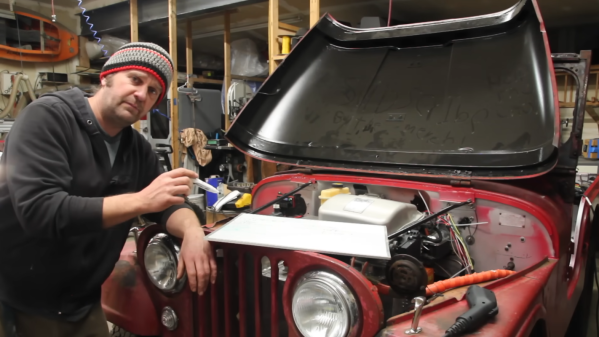
On the list of cars widely regarded as the most reliable vehicles ever built, up there with the Toyota Land Cruiser, the Honda Civic, and the Mercedes W123 diesels, is the unassuming Toyota Prius. Although it adds a bit of complexity with its hybrid drivetrain, its design eliminates a number of common wear items and also tunes it for extreme efficiency, lengthening its life and causing minimal mechanical stress. The Prius has a number of other tricks up its sleeve as well, which is why parts of its hybrid systems are often used in EV conversions like [Jeremy]’s electric CJ-5 Jeep.
Inside the Prius inverter is a buck/boost converter used for stepping up the battery voltage to power the inverter and supply power to the electric motor. [Jeremy]’s battery is much higher voltage than the stock Prius battery pack, though, which means he can bypass the converter and supply energy from his battery directly to the inverter. Since the buck/boost converter isn’t being used, he can put it to work doing other things. In this case, he’s using it as a charger. Sending the AC from a standard EV charging cord through a rectifier and then to this converter allows the Prius hardware to charge the Jeep’s battery, without adding much in the way of extra expensive electronics.
There are some other modifications to the Prius equipment in this Jeep, though, namely that [Jeremy] is using an open-source controller as the brain of this conversion. Although this video only goes into detail on some of the quirks of the Prius hardware, he has a number of other videos documenting his journey to convert this antique Jeep over to a useful electric farm vehicle which are worth checking out as well. There are plenty of other useful things that equipment from hybrid and electric vehicles can do beyond EV conversions as well, like being used for DIY powerwalls.
Continue reading “Electric Jeep With Modified Prius Hardware”
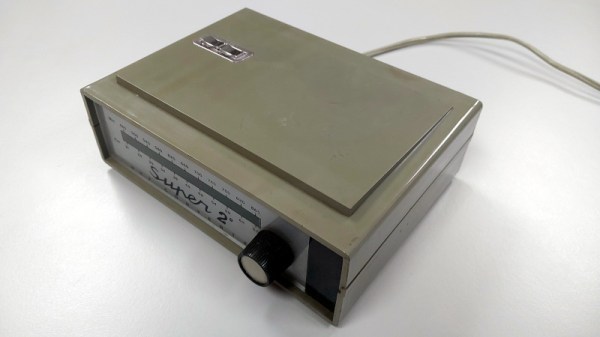
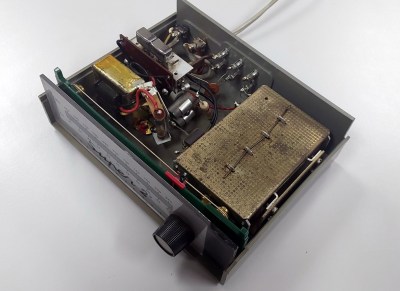 In a Dutch second-had store while on my hacker camp travels this summer, I noticed a small grey box. It was mine for the princely sum of five euros, because while I’d never seen one before I was able to guess exactly what it was. The “Super 2” weighing down my backpack was a UHF converter, a set-top box from before set-top boxes, and dating from the moment around five or six decades ago when that country expanded its TV broadcast network to include the UHF bands. If your TV was VHF it couldn’t receive the new channels, and this box was the answer to connecting your UHF antenna to that old TV.