Push Buttons, Create Music With A MIDI Fighter

Musicians have an array of electronic tools at their disposal to help make music these days. Some of these are instruments in and of themselves, and [Wai Lun] — inspired by the likes of Choke and Shawn Wasabi — built himself a midi fighter

Midi fighters are programmable instruments where each button can be either a note, sound byte, effect, or anything else which can be triggered by a button. [Lun]’s is controlled by an ATmega32u4 running Arduino libraries — flashed to be recognized as a Leonardo — and is compatible with a number of music production programs. He opted for anodized aluminum PCBs to eliminate flex when plugging away and give the device a more refined look. Check it out in action after the break!

Continue reading “Push Buttons, Create Music With A MIDI Fighter”

Wind Chimes And Dry Ice Make An Unusual Musical Instrument

When it comes to making music, there are really only a few ways to create the tones needed — pluck something, blow into something, or hit something. But where does that leave this dry-ice powered organ that recreates tunes with wind chimes and blocks of solid CO2?

It turns out this is firmly in the “hit something” camp, as [Leah Edwards] explains of her project. When the metal wind chime tubes come in contact with dry ice, the temperature difference sublimates the solid CO2. The puff of gas lifts the tube slightly, letting it fall back against the brick of dry ice and making a tone. The process is repeated rapidly, providing a vibrato effect while the tube is down. [Leah] used solenoids to lift the tubes and, having recently completed a stint at National Instruments, a bunch of NI gear to control them. The videos below show a few popular tunes and a little bit about the organ build. But what — no songs from Frozen?

We can easily imagine this same build using an Arduino or some other microcontroller. In fact, it puts us in mind of a recent reed organ MIDI project that has a few ideas to offer, like ways to quiet those solenoids.  Continue reading “Wind Chimes And Dry Ice Make An Unusual Musical Instrument”

Music Box Plays “Still Alive” Thanks To Automated Hole Puncher

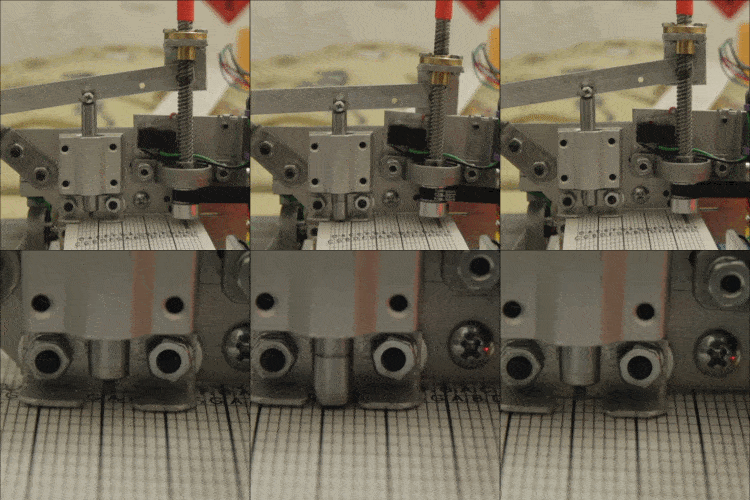
Custom hole punch and feed system

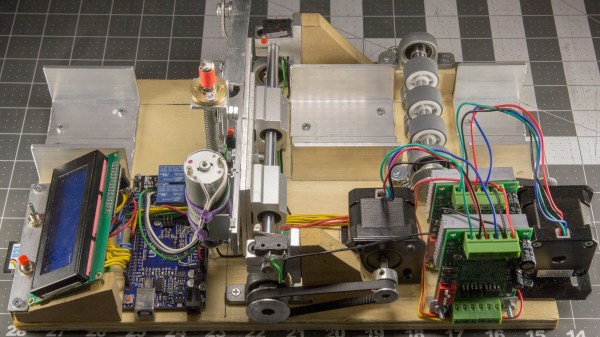
Most projects have one or two significant aspects in which custom work or clever execution is showcased, but this Music Box Hole Punching Machine by [Josh Sheldon] and his roommate [Matt] is a delight on many levels. Not only was custom hardware made to automate punching holes in long spools of paper for feeding through a music box, but a software front end to process MIDI files means that in a way, this project is really a MIDI-to-hand-cranked-music-box converter. What a time to be alive.

The hole punch is an entirely custom-made assembly, and as [Josh] observes, making a reliable hole punch turns out to be extremely challenging. Plenty of trial and error was involved, and the project’s documentation as well as an overview video go into plenty of detail. Don’t miss the music box version of “Still Alive”, either. Both are embedded below.

Continue reading “Music Box Plays “Still Alive” Thanks To Automated Hole Puncher”

Tough Pi-ano Can Take A Punch

There will be no delicate solos for [24 Hour Engineer’s] Tough Pi-ano. It was built to soak punishment from aggressive youngsters in musical therapy, specifically those on the autism spectrum and those with Down’s syndrome. The Tough Pi-ano will be bolted to a wall with heavy-duty shelf brackets so it can’t fall on anyone. The keyboard is covered in plastic and it doesn’t have any exposed metal so there will be no splinters.

[24 Hour Engineer] made a short video demonstration and if you listen closely, he has a pun in all but one sentence. We love that kind of easter egg in YouTube videos. Check it out after the break.

Inside the 48-key instrument are four Raspberry Pi Zeros where each Pi controls one octave. The redundancy ensures that a hardware failure only drops out a single octave and the kids can keep playing until replacement parts arrive. Each Pi has identical programming and a thumbwheel switch tells it which octave it will be emulating.

Programming was done with Python and Pygame and all the inputs are run to a homemade “hat” where the wires are soldered. Pygame’s sole responsibility is to monitor the GPIO and then play the appropriate note when a button is pressed, slapped, punched or sat upon.

Similar in name, the Touch Piano has no moving parts or perhaps you would rather use your Raspberry Pi in an upright piano.

Continue reading “Tough Pi-ano Can Take A Punch”

GuitarBot Brings Together Art And Engineering

Not only does the GuitarBot project show off some great design, but the care given to the documentation and directions is wonderful to see. The GuitarBot is an initiative by three University of Delaware professors, [Dustyn Roberts], [Troy Richards], and [Ashley Pigford] to introduce their students to ‘Artgineering’, a beautiful portmanteau of ‘art’ and ‘engineering’.

The GuitarBot It is designed and documented in a way that the three major elements are compartmentalized: the strummer, the brains, and the chord mechanism are all independent modules wrapped up in a single device. Anyone is, of course, free to build the whole thing, but a lot of work has been done to ease the collaboration of smaller, team-based groups that can work on and bring together individual elements.

Some aspects of the GuitarBot are still works in progress, such as the solenoid-activated chord assembly. But everything else is ready to go with Bills of Materials and build directions. An early video of a strumming test proof of concept used on a ukelele is embedded below.

Continue reading “GuitarBot Brings Together Art And Engineering”

Four Chords Should Be Enough For Anyone

You might be surprised at how many pop songs are exactly the same. Cat Scratch Fever is the exact same song as Smoke on the Water. Even one of Yeezy’s songs is strikingly similar to a weird 90s French electronic group. Musically, though, there are an incredible number of songs that follow a I-V-vi-IV progression. Let it Be is one of them, as is Beast of Burden. Lady Gaga’s Poker Face is another. Now, finally, we have automated most of the pop songs you know and love. [Sven] has created a small MIDI device that only plays a I-V-vi-IV progression, and it’s everything you could ever imagine.

The idea for this build comes from an Axis of Awesome routine demonstrating the fact that hundreds of pop songs follow the same progression. After the idea, the implementation, like the music all those millennials are listening to, is simple.

The 4chord MIDI is a small board with an old Nokia display, buttons, a single USB port, and an ATMega328 microcontroller. Using MIDI over USB, it plays the I-V-vi-IV progression in any key. It plays in chord mode, arpeggiated mode, or mixed mode at any sensible tempo.

You can check out a video of the 4chord playing several hundred songs simultaneously below.

Continue reading “Four Chords Should Be Enough For Anyone”

Meet The Video DJ Machine

Have you ever wanted to perform as a DJ but found the equipment expensive as well as intimidating? Well, your prayers have been answered by [Dror Ayalon] who has designed Nomnom 2. It is an open source, music mixing project that uses up to 16 video clips to give you control of your next hit album.

You are given charge of a physical control panel that has 16 buttons and four knobs. Each button can be used to turn on or off a particular clip while the knobs control the repetition rate, volume, speed and playable length of each track. An Arduino sits under the buttons and is responsible for sending the information to an application that runs in your web browser. The browser app uses the NexusUI library to control playback of the audio clips and bring to life the entire experience.

[Dror Ayalon] has been busy polishing his project and there are some neat videos of him demonstrating it so check out the videos below. The code is available for down from GitHub and the BOM is available at the Hackaday.io project page. The web app can be ported to a desktop app using electron and a PCB can be designed for the controller for future versions.

For now, it is incredible to see hardware and software, come together in such a harmonious fashion. This may be the start of something wonderful but if you are just looking for a way to annoy the neighbors, check out the Midi Musical Siren instead. Continue reading “Meet The Video DJ Machine”