Automatic Garage Door Opener Works For Your Cat

Using an Arduino or Raspberry Pi to perform a task in the real world is certainly a project we’ve seen here before, and certainly most of these projects help to make up the nebulous “Internet of Things” that’s all the rage these days. Once in a while though, a project comes along that really catches our eye, as is the case with [Jamie’s] meticulously documented automatic garage door opener.

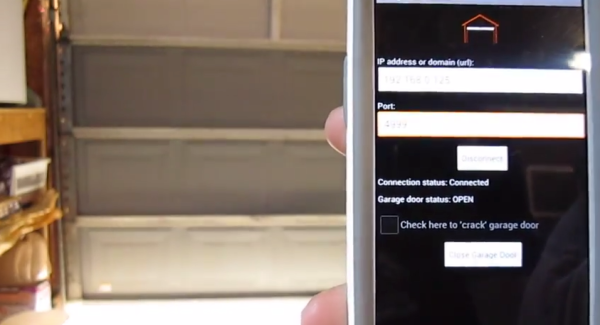
This garage door opener uses an ATMega328 to connect the internet to the garage door. A reed switch is installed which lets the device sense the position of the door, which is relayed back to the internet. [Jamie] wrote an Android app that can open and close the door and give the user the information on the door’s status. One really interesting feature is the ability to “crack” the garage door. This is done by triggering the garage door opener twice with a delay in between. From the video after the break we’d say this is how [Jamie’s] cat gets in and out.

We love seeing projects that are extremely well documented so that anyone who wants to make one can easily figure out how. Internet-connected garage door openers have been featured in other unique ways before too, but we’ve also seen ways to automatically open blinds or chicken coops!

CAMdrive

CAMdrive Is An Open Source Time-lapse Photography Controller

[Nightflyer] has been working on an open source project he calls CAMdrive. CAMdrive is designed to be a multi-axis controller for time-lapse photography. It currently only supports a single axis, but he’s looking for help in order to expand the functionality.

You may already be familiar with the idea of time-lapse photography. The principal is that your camera takes a photo automatically at a set interval. An example may be once per minute. This can be a good way to get see gradual changes over a long period of time. While this is interesting in itself, time-lapse videos can often be made more interesting by having the camera move slightly each time a photo is taken. CAMdrive aims to aid in this process by providing a framework for building systems that can pan, tilt, and slide all automatically.

The system is broken out into separate nodes. All nodes can communicate with each other via a communication bus. Power is also distributed to each node along the bus, making wiring easier. The entire network can be controlled via Bluetooth as long as any one of the nodes on the bus include a Bluetooth module. Each node also includes a motor controller and corresponding motor. This can either be a stepper motor or DC motor.

The system can be controlled using an Android app. [Nightflyer’s] main limitation at the moment is with the app. He doesn’t have much experience programming apps for Android and he’s looking for help to push the project forward. It seems like a promising project for those photography geeks out there. Continue reading “CAMdrive Is An Open Source Time-lapse Photography Controller” →

Running A Web Server On The ESP8266

We’ve written lot about the ESP8266 lately, but people keep finding more awesome uses for this inexpensive module. [Martin] decided that using the ESP8266 with an external microcontroller was overkill, and decided to implement his project entirely on the module with a built-in web server.

[Martin] started out with the ESP8266 web server firmware developed by [sprite_tm]. This firmware provides a basic web server that supports multiple connections and simple CGI scripts right on the module. The web server firmware opens up a ton of possibilities with CGI scripting. When booting up in AP mode, you can even connect the ESP8266 to another access point right from the your browser.

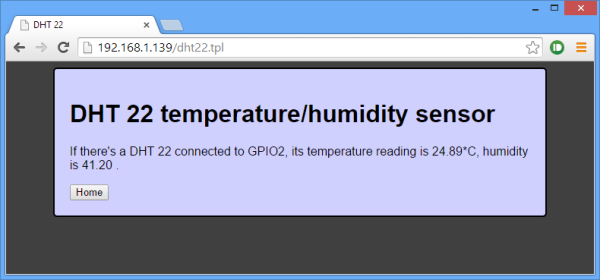
[Martin] decided to connect a DHT22 temperature/humidity sensor to the module as a proof of concept. He used a DHT22 library written for the ESP8266 to read data from the sensor, and wrote a CGI script to display the data on a web page. [Martin] also added buttons to control a GPIO pin as a proof of concept. He posted his source code and a binary (see the end of his post) so you can try out his application and mod it for your own project.

CircuitHub's Crowdsourced Group Buys

CircuitHub Launches Group Buy Crowdsourcing Campaigns

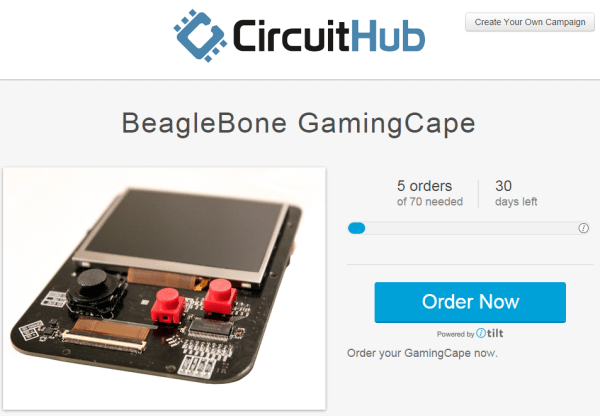
Kickstarter isn’t the solution to every manufacturing hurdle, you know? Crowdsourcing—everybody’s favorite cliché to invoke after sharing their less-than-half-baked merchandise idea—has expanded to include yet another variation, and is currently rocking [Max Thrun’s] BeagleBone GamingCape thanks to [Jason Kridner]. If the cape looks familiar, it’s because we featured it earlier this summer, when [Max] created it as part of TI’s Intern Design Challenge.

Here’s how it works. Rather than asking strangers to place pre-orders (let’s admit it, that’s ultimately how Kickstarter functions), CircuitHub campaigns work as a group-buy: upload your KiCad, Eagle or Altium design and a BOM, and you’re on your way to bulk-order savings. As [Kridner] explains in his blog post, you’ll have some finagling to do for your campaign to be successful, such as choosing between prices at different volumes, projecting how many people need to buy in as a group, etc. When he sourced the parts on his own, [Kridner] spent nearly $1000 for a single GamingCape. The CircuitHub campaign, if successful, would land everyone a board for under $100 each—and it’s assembled. 

Who needs Kickstarter; that’s hard to beat.

Improving The Parallax Propeller In An FPGA

The Parallax Propeller is an interesting chip that doesn’t get a lot of love, but since the entire chip was released as open source, that might be about to change: people are putting this chip inside FPGA and modifying the binaries to give the chip functions that never existed in the original.

Last August, Parallax released the source for the P8X32A, giving anyone with an FPGA board the ability to try out the Prop for their own designs. Since then, a few people have put some time in, cleaning up the files, unscrambling ROM images, fixing bugs, and all the general maintenance that an open source microcontroller core requires.

[Sylwester] has grabbed some of the experimental changes found on the Parallax forum and included them as a branch of the Propeller source. There is support for a second 32-bit port, giving the new chip 64 I/O pins, multiply instructions, video generators, hard-coded SD card libraries, and a variant called a microProp that has four cores instead of eight.

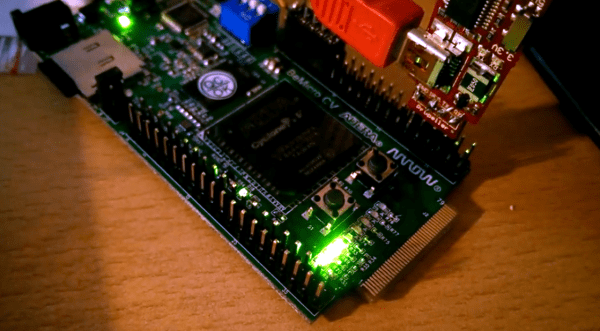
You can grab all the updated sources right here and load them up on a DE0 Nano FPGA board. If you’re exceptionally lucky and have the Altera DE2-115 dev board, you’ll also be able to run the upcoming Propeller 2.

Introducing The F*Watch, A Fully Open Electronic Watch

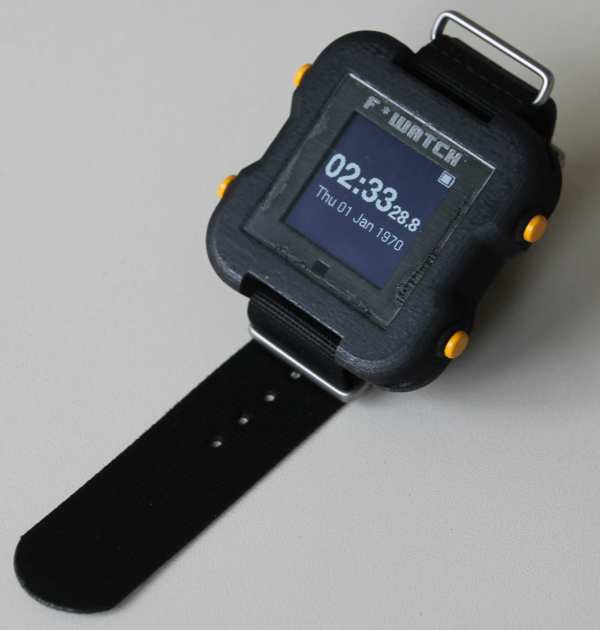
As one of their colleagues was retiring, several CERN engineers got together after hours during 4 months to develop his gift: a fully open electronic watch. It is called the F*Watch and is packed with sensors: GPS, barometer, compass, accelerometer and light sensor. The microcontroller used is a 32-bit ARM Cortex-M3 SiLabs Giant Gecko which contains 128KB of RAM and 1MB of Flash. In the above picture you’ll notice a 1.28″ 128×128 pixels Sharp Memory LCD but the main board also contains a micro-USB connector for battery charging and connectivity, a micro-SD card slot, a buzzer and a vibration motor.

The watch is powered by a 500mA LiPo battery. All the tools that were used to build it are open source (FreeCAD, KiCad, GCC, openOCD, GDB) and our readers may make one by downloading all the source files located in their repository. After the break is embedded a video showing their adventure.

Continue reading “Introducing The F*Watch, A Fully Open Electronic Watch” →

Announcing The Five Finalists For The Hackaday Prize

Six months ago we challenged you to realize the future of open, connected devices. Today we see the five finalists vying for The Hackaday Prize.

These five were chosen by our panel of Launch Judges from a pool of fifty semifinalists. All of them are tools which leverage Open Design in order to break down the barriers of entry for a wide range of interests. They will have a few more weeks to polish and refine their devices before [Chris Anderson] joins the judging panel to name the winner.

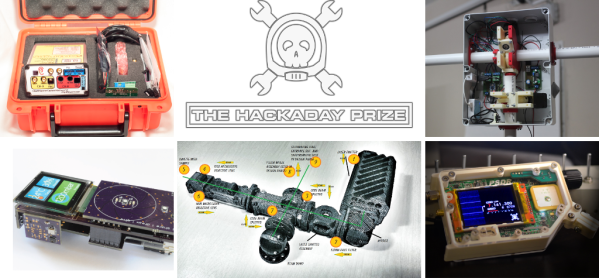
Starting on the top left and moving clockwise:

ChipWhisperer, an embedded hardware security research device goes deep into the world of hardware penetration testing. The versatile tool occupies an area in which all-in-one, wide-ranging test gear had been previously non-existant or was prohibitively expensive to small-shop hardware development which is so common today.

SatNOGS, a global network of satellite ground stations. The design demonstrates an affordable node which can be built and linked into a public network to leverage the benefits of satellites (even amateur ones) to a greater extent and for a wider portion of humanity.

PortableSDR, is a compact Software Defined Radio module that was originally designed for Ham Radio operators. The very nature of SDR makes this project a universal solution for long-range communications and data transfer especially where more ubiquitous forms of connectivity (Cell or WiFi) are not available.

ramanPi, a 3D printed Raman Spectrometer built around a RaspberryPi with some 3D printed and some off-the-shelf parts. The design even manages to account for variances in the type of optics used by anyone building their own version.

Open Source Science Tricorder, a realization of science fiction technology made possible by today’s electronics hardware advances. The handheld is a collection of sensor modules paired with a full-featured user interface all in one handheld package.

From Many, Five

The nature of a contest like the Hackaday Prize means narrowing down a set of entries to just a few, and finally to one. But this is a function of the contest and not of the initiative itself.

The Hackaday Prize stands for Open Design, a virtue that runs far and deep in the Hackaday community. The 50 semifinalists, and over 800 quarterfinalists shared their work openly and by doing so provide a learning platform, an idea engine, and are indeed the giants on whose shoulders the next evolution of hackers, designers, and engineers will stand.

Whether you submitted an entry or not, make your designs open source, interact with the growing community of hardware engineers and enthusiasts, and help spread the idea and benefits of Open Design.