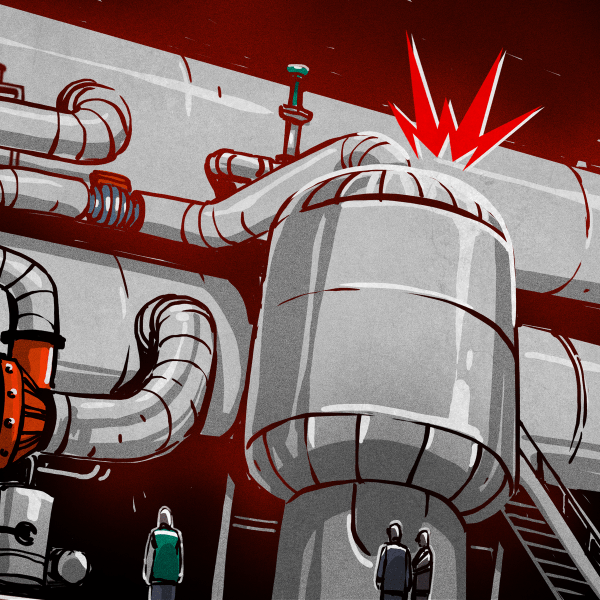
MIT Extracts Power From Temperature Fluctuations

As a civilization, we are proficient with the “boil water, make steam” method of turning various heat sources into power we feed our infrastructure. Away from that, we can use solar panels. But what if direct sunlight is not available either? A team at MIT demonstrated how to extract power from daily temperature swings.

Running on temperature difference between day and night is arguably a very indirect form of solar energy. It could work in shaded areas where solar panels would not. But lacking a time machine, or an equally improbable portal to the other side of the planet, how did they bring thermal gradient between day and night together?

This team called their invention a “thermal resonator”: an assembly of materials tuned to work over a specific range of time and temperature. When successful, the device output temperature is out-of-phase with its input: cold in one section while the other is hot, and vice versa. Energy can then be harvested from the temperature differential via “conventional thermoelectrics”.

Power output of the initial prototype is modest. Given a 10 degree Celsius daily swing in temperature, it could produce 1.3 milliwatt at maximum potential of 350 millivolt. While the Hackaday coin-cell challenge participants and other pioneers of low-power electronics could probably do something interesting, the rest of us will have to wait for thermal resonator designs to evolve and improve on its way out of the lab.

[via Engadget]

Careful Testing Reveals USB Cable Duds

What’s worse than powering up your latest build for the first time only to have absolutely nothing happen? OK, maybe it’s not as bad as releasing the Magic Smoke, but it’s still pretty bewildering to have none of your blinky lights blink like they’re supposed to.

What you do at that point is largely a matter of your troubleshooting style, and when [Scott M. Baker]’s Raspberry Pi jukebox build failed to chooch, he returned to first principles and checked the power cable. That turned out to be the culprit, but instead of giving up there, he did a thorough series of load tests on multiple USB cables to see which ones were suspect, with interesting results.

[Scott] originally used a cable with a USB-A on one end and a 3.5-mm barrel plug on the other with a switch in between, under the assumption that the plug on the Pi end would be more robust, as well as to have a power switch for the jukebox. Testing that cable using an adjustable DC load would prove that the cable was unfit for Pi duty, dropping the voltage to under 2 volts at a measly 500-mA load. Other cables proved much better under load, even those with USB mini jacks and even one with a 5.5-mm barrel. But the larger barrel-plug cable also proved to be a stinker when it was paired with an inline switch. In the video below, [Scott] walks through not only the testing process, but also gives a quick tour of his homebrew DC load.

The lesson is clear: not all USB cables are created equal, so caveat hacker. And if you’ve got a yen to check the cables in your junk bin like [Scott] did, this full-featured smart DC load might be just the thing.

Continue reading “Careful Testing Reveals USB Cable Duds”

Modernizing Puerto Rico’s Grid

After two massive hurricanes impacted Puerto Rico three months ago, the island was left with extensive damage to its electrical infrastructure. Part of the problem was that the infrastructure was woefully inadequate to withstand a hurricane impact at all. It is possible to harden buildings and infrastructure against extreme weather, and a new plan to restore Puerto Rico’s power grid will address many of these changes that, frankly, should have been made long ago.

Among the upgrades to the power distribution system are improvements to SCADA systems. SCADA allows for remote monitoring and control of substations, switchgear, and other equipment which minimizes the need for crews to investigate problems and improves reliability. SCADA can also be used for automation on a large scale, in addition to the installation of other autonomous equipment meant to isolate faults and restore power quickly. The grid will get physical upgrades as well, including equipment like poles, wire, and substations that are designed and installed to a more rigorous standard in order to make them more wind- and flood-tolerant. Additional infrastructure will be placed underground as well, and a more aggressive tree trimming program will be put in place.

The plan also calls for some 21st-century improvements as well, including the implementation of “micro grids”. These micro grids reduce the power system’s reliance on centralized power plants by placing small generation facilities (generators, rooftop solar, etc) in critical areas, like at hospitals. Micro grids can also be used in remote areas to improve reliability where it is often impractical or uneconomical to service.

While hurricanes are inevitable in certain parts of the world, the damage that they cause is often exacerbated by poor design and bad planning. Especially in the mysterious world of power generation and distribution, a robust infrastructure is extremely important for the health, safety, and well-being of the people who rely on it. Hopefully these steps will improve Puerto Rico’s situation, especially since this won’t be the last time a major storm impacts the island.
Weather Station Needs Almost No Batteries

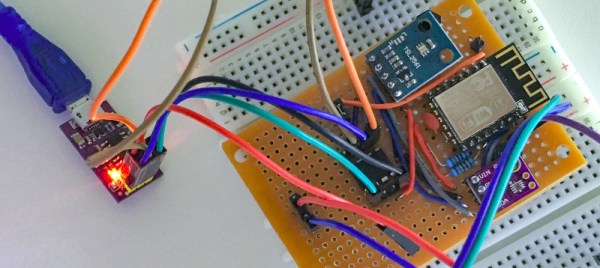
While the ESP8266 has made its way into virtually every situation where a low-cost WiFi solution is needed, it’s not known as being a low-power solution due to the amount of energy it takes to run WiFi. [Alex] took this design constraint as more of a challenge though, and with the help of an ATtiny microcontroller was able to develop a weather station using an ESP8266 that only needs new batteries every 2-4 years.

While the ESP8266 module consumes a bit of power, the ATtiny excels in low-power mode. To take advantage of this, [Alex] designed the weather station using the ATtiny to gather data every two minutes, store the data in a buffer, and upload all of it in bursts every hour using the ESP8266. This means that the power-hungry WiFi chip can stay off most of the time, drastically limiting the power demands of the station. [Alex] mostly details the setup of the ATtiny and the ESP8266 on his project page, so this could be applied anywhere that low power and network connectivity are required.

As for the weather reporting capabilities, the station is equipped to measure temperature, light, and humidity. Presumably more could be added but this might increase the power demands for the weather station as a whole. Still, changing batteries once a year instead of once every two years might be a worthwhile trade-off for anyone else attempting such an ambitious project. Other additions to the weather station that we’ve seen before might include a low-power display, too.

Instrument Packed Pedal Keeps Track Of Cyclist’s Power

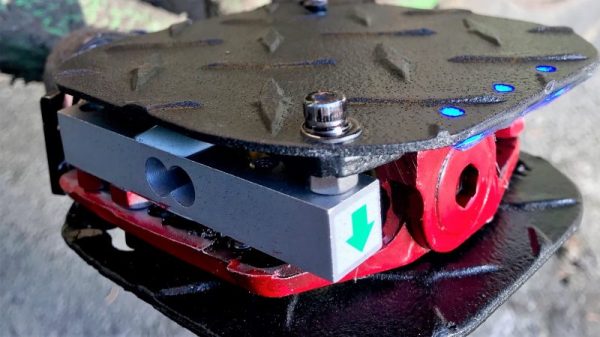
Exactly how much work is required to pedal a bike? There are plenty of ways to measure the power generated by a cyclist, but a lot of them such as heavily instrumented bottom brackets and crank arms, can be far too expensive for casual use. But for $30 in parts you can build this power-measuring bike pedal. and find out just how hard you’re stoking.

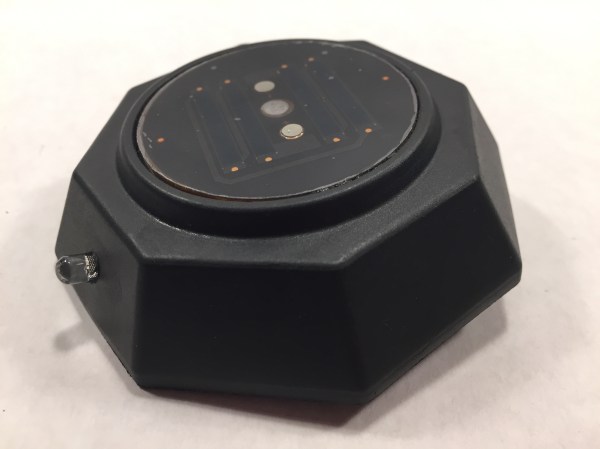
Of course it’s not just the parts but knowing what to do with them, and [rabbitcreek] has put a lot of thought and engineering into this power pedal. The main business of measuring the force applied to the crank falls to a pair of micro load cells connected in parallel. A Wemos, an HX711 load-cell amp, a small LiPo pack and charging module, a Qi wireless charger, a Hall sensor, a ruggedized power switch, and some Neopixels round out the BOM. Everything is carefully stuffed into very little space in a modified mountain bike pedal and potted in epoxy for all-weather use. The Hall sensor keeps tracks of the RPMs while the strain gauges measure the force applied to the pedal, and the numbers from a ride can be downloaded later.

We recall a similar effort using a crank studded with strain gauges. But this one is impressive because everything fits in a tidy package. And the diamond plate is a nice touch.

Hackaday Prize Entry: Modular, Rapid Deployment Power Station

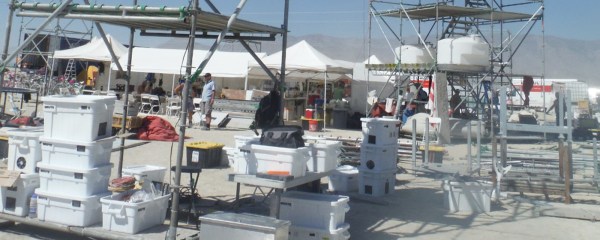
After a disaster hits, one obvious concern is getting everyone’s power restored. Even if the power plants are operational after something like a hurricane or earthquake, often the power lines that deliver that energy are destroyed. While the power company works to rebuild their infrastructure, [David Ngheim]’s mobile, rapid deployment power station can help get people back on their feet quickly. As a bonus, it uses renewable energy sources for power generation.

The modular power station was already tested at Burning Man, providing power to around 100 people. Using sets of 250 Watt panels, wind turbines, and scalable battery banks, the units all snap together like Lego and can fit inside a standard container truck or even the back of a pickup for smaller sizes. The whole thing is plug-and-play and outputs AC thanks to inverters that also ship with the units.

With all of the natural disasters we’ve seen lately, from Texas to Puerto Rico to California, this entry into the Hackaday Prize will surely gain some traction as many areas struggle to rebuild their homes and communities. With this tool under a government’s belt, restoration of power at least can be greatly simplified and hastened.

Monstrous USB Power Bank

At some point, cleaning out the spare parts bin — or cabinet, or garage — becomes a necessity. This is dangerous because it can induce many more project ideas and completely negate the original purpose. [Chaotic Mind], considering the pile of  batteries he’s collected over the past decade, decided that instead of throwing them out, he would recycle them into a grotesque USB power bank.

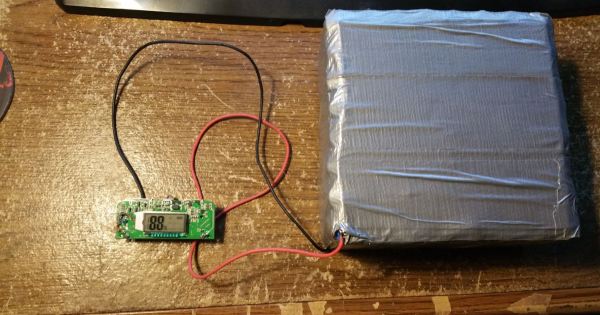
Inside the bulk of this power bank are an eye-popping 64 18650 Lithium Ion cells, mostly collected from laptop batteries, and wired in a parallel 8×8 pattern with an estimated capacity of over 100,000mAh(!!).  The gatekeeper to all this stored energy is a two-USB power bank charger board from Tindie.

Ah — but how to package all this power? The handy man’s secret weapon: duct-tape!

Continue reading “Monstrous USB Power Bank”