Massive 3D-Printed Ridable Tank Boggles The Mind

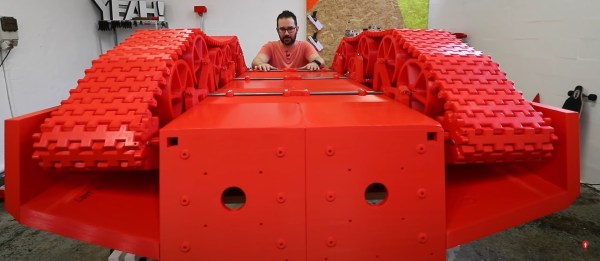
Anyone who has used an FDM 3D printer knows just how long the process can take, especially when you really start filling up the available print volume. Apparently [Ivan Miranda] has absolutely zero fear of insanely long print times, and is in the process of building a massive ridable tank (YouTube playlist of the whole build) that is almost completely 3D printed.

[Ivan] is no stranger to large prints, but this tank is on a different level altogether. The chassis, which is reinforced with aluminium and steel square tubing, took around 1200 hours to print and each of the wheels took 6 days! The rolling chassis with wheels and track weighs close to a 100 kg.  Having built a few smaller 3D printed tracked vehicles before, [Ivan] used a lot of that knowledge to design the latest monster.

Connecting the tracked section together has always proven challenging for [Ivan]. This time he used plastic fish tape (wire puller) for the pins, and blocked off the end holes with screws. The bogies (wheel sets) are also interesting, with 3D printed springs that sit parallel to the ground. Almost all the parts are printed in PLA, which can be quite brittle, so it would be interesting to see how it holds up.

[Ivan] has been working on this project since the start of 2019, and we can’t wait to see it completed. We’ve featured his signature red prints a few times, including a RC car that drives on the ceiling and a water jet drive. If you’re keen to build your own tank on the opposite side of the size spectrum, check out this tiny tank for your crawl space. Watch [Ivan] finish the rolling chassis after the break. Continue reading “Massive 3D-Printed Ridable Tank Boggles The Mind”

Hackaday Podcast 040: 3D Printed Everything, Strength V Toughness, Blades Of Fiber, And What Can’t Coffee Do?

Hackaday Editors Mike Szczys and Elliot Williams opine on the coolest hacks we saw this week. This episode is heavy with 3D printing as Prusa released a new, smaller printer, printed gearboxes continue to impress us with their power and design, hoverboards are turned into tanks, and researchers suggest you pour used coffee grounds into your prints. Don’t throw out those “toy” computers, they may be hiding vintage processors. And we have a pair of fantastic articles that cover the rise and fall of forest fire watchtowers, and raise the question of where all those wind turbine blades will go when we’re done with them.

Take a look at the links below if you want to follow along, and as always tell us what you think about this episode in the comments!

Take a look at the links below if you want to follow along, and as always, tell us what you think about this episode in the comments!

Direct download (60 MB or so.)

Continue reading “Hackaday Podcast 040: 3D Printed Everything, Strength V Toughness, Blades Of Fiber, And What Can’t Coffee Do?”

Gutted Hoverboard Becomes Formidable Track-Drive Robot

When “hoverboards” first came out, you may have been as disappointed as we were that they did not even remotely fulfill the promises of Back to the Future II. Nothing more than a fancified skateboard, hoverboards are not exactly groundbreaking technology. That doesn’t mean they’re not useful platforms for hacking, though, as this hoverboard to track-propelled robot tank conversion proves.

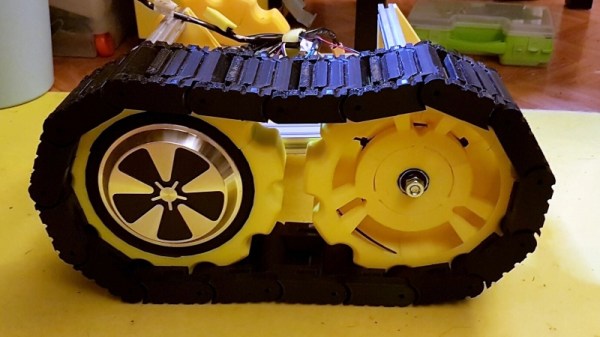
Most of the BOM for this build came from the junk bin – aluminum extrusions, brackets, and even parts cannibalized from a 3D-printer. But as [pasoftdev] points out, the new-in-box hoverboard was the real treasure trove of components. The motors, the control and driver electronics, and the big, beefy battery were all harvested and mounted to the frame. To turn the wheels into tracks, [pasoftdev] printed some sprockets to fit around the original tires. The tracks were printed in sections and screwed to the wheels. Idlers were printed in sections too, using central hubs and a clever method for connecting everything together into a sturdy wheel. Printed tank tread links finished the rolling gear eventually; each of the 34 pieces took almost five hours to print. The dedication paid off, though, as the 15-kg tank is pretty powerful; the brief video below shows it towing an office chair around without any problems.

We noticed that [pasoftdev] found the assembly of the tread links a bit problematic. These 3D-printed links that are joined by Airsoft BBs might make things a little easier next time.

Continue reading “Gutted Hoverboard Becomes Formidable Track-Drive Robot”

RPi Tank Invades Living Room, Teaches OpenCV

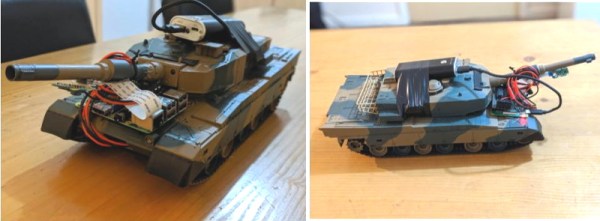
If you’re looking for a simple project to start exploring the intersection of OpenCV and robotics, then the RPi Tank created by [Vishal Varghese] might be a good place to start. A Raspberry Pi and a few bits of ancillary hardware literally taped to the top of a toy M1 Abrams tank becomes a low-cost platform for testing out concepts such as network remote control and visual line following. Sure, you don’t need to base it around an Abrams tank, but if you’re going to do it you might as well do it with style.

As this is more of a tech demonstrator, the hardware details are pretty minimal. [Vishal] says you just need a relatively recent version of the Raspberry Pi, a MotoZero motor controller, and a camera module. To provide juice for the electronics you don’t need anything more exotic than a USB power bank, which in his case has been conveniently attached to the top of the turret. He doesn’t provide exact details on how the MotoZero gets wired into the Abram’s motors, but we imagine it’s straightforward enough that the average Hackaday reader probably doesn’t need it spelled out for them.

Ultimately, the software is the heart of this project, and that’s where [Vishal] really delivers. He’s provided sample Python scripts ordered by their level of complexity, from establishing a network connection on the Raspberry Pi to following a line of tape on the ground. Whether used together or examined individually, these scripts provide a great framework to get your first project rolling. Literally.

Line following robots, in their many forms, have been a favorite hacker project for years. Whether they home in with an analog circuit or replace the lines with hidden wires, they’re a great way to get started with semi-autonomous robotics.

Tiny Tank Inspects Your Crawlspace

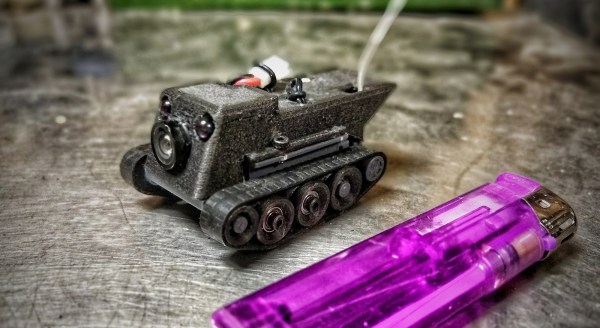
If you’ve got some drone or FPV part lying around, this is the build for you. It’s a remote controlled tank, with a camera and video transmitter, that’s only 65 mm x 40 mm x 30 mm in size. Why on Earth would you ever build something so small? You can look around in your crawlspace, I guess. Any way you look at, this thing is tiny.

The tank has traditional tank skid steering through two brushless motors. The battery is one cell, as that’s just about the largest battery you can put in a vehicle so small, and the camera is just off-the-shelf quadcopter stuff set into a 3D printed enclosure. There are a few LEDs for lights. Other than that, it’s just so tiny and so cute.

The builder behind this tank, [honnnest], put up a video going through the build and demonstrating what kind of video you can expect from a tank this small. It’s a bit fast for a tank, and that’s not even considering the scale effects, but if the chassis is 3D printed, you can always print a few reduction gears, too.

Continue reading “Tiny Tank Inspects Your Crawlspace”

Centurion Bridge Layer, Now In RC

Radio controlled models are great fun. Most of us have had a few RC cars as children and maybe dabbled with the occasional helicopter or drone. It’s a rare breed of modeler, however, that gets to drive a radio-controlled bridge laying tank.

The lads prepare to fight the good fight.

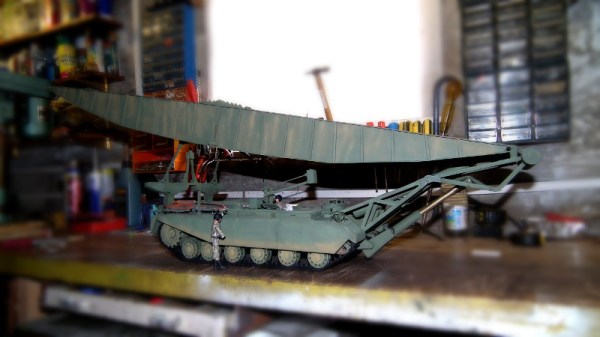
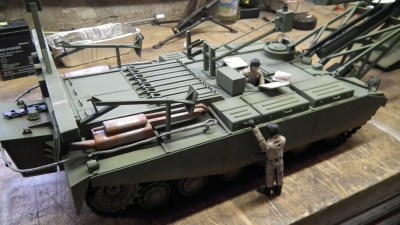
The model is a replica of the British Centurion Bridgelayer – a modified tank designed to allow mechanized units to readily cross rivers and similar obstacles in European battlefields. While the genuine article relied on hydraulics, the RC version takes a different tack. [hawkeye3guns] built custom linear actuators out of motors, gears, and brass to deploy the bridge.

The build shows other smart techniques of the enterprising modeler. Rather than start from scratch, the Centurion is built on a modified KV tank hull. After the modifications were complete, the tank received a lick of paint in the requisite British Army green. The final result is rather impressive.

It goes to show what can be achieved with some off-the-shelf parts and ingenuity. We’ve seen other impressive RC tanks before – like this French build with a homebrew targeting computer.

On The Right Tracks: Electric Wheelchair Guts Find New Life As Tank

Every hacker has dreamt of building their own tank at some point. Or maybe that’s just us. [Peter Sripol] and [Sam Foskuhl] have built one at a scale which is big enough to be rideable, but small enough that neighbors don’t get concerned.

An electric wheelchair is at the heart of the build. After ripping out its internals, the two motors with gearboxes are directly connected to the two tracks, allowing differential steering. Holding everything together is a solid welded steel frame – essential for years of reliable sieging.

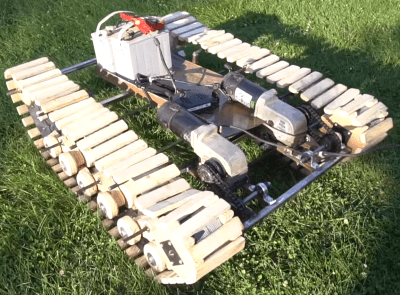
The tracks themselves are simple strips of wood, cut and assembled by hand onto a nylon belt. Meanwhile the track wheels and drive assembly are designed in CAD and cut with a CNC router from some plywood, a great choice for adding some precision to the most mechanically challenging part of the build. As always in [Peter]’s videos, a large portion is dedicated to testing – in this case with a rather large array of fireworks. We certainly wouldn’t want to be in his bad books considering his other souped-up weapons.

A small, hacked, novelty electric vehicle? Sounds like it would find some good friends at EMF Camp, especially at the Hacky Racers event.

Continue reading “On The Right Tracks: Electric Wheelchair Guts Find New Life As Tank”