posted Jun 9th 2011 11:01am by
Nick Schulze
filed under:
classic hacks,
green hacks

When notes stuck to the water heater failed [Ryan] decided to whip up “the world’s most expensive 240V relay” using a servo, a real time clock and of course an Arduino. All in an attempt to save a buck or two thanks to LA’s “Time-of-Use program”.
Using a protoshield Ryan soldered up a RTC module using the DS1307 chip. On board he added some LED’s and switches including a holiday switch keep the heater off, a next cycle button when you need some hot water and to hell with the expense, and a pulsing blue LED.. for no reason at all. The board flips the mechanical switch using a servo and piano wire, simple but effective. We wonder how many days/weeks it will take for it to offset its expense?
posted Apr 6th 2011 7:49am by
Jesse Congdon
filed under:
Microcontrollers

Gaming industry software engineer [Pedantite] writes in to let us know about his latest endeavor, an AVR based parental assistant timer: Good Times. Looking for a new project that would be both useful and interesting, his wife suggested a “time out/ time’s up timer”. Like most of us [Pedantite]‘s children are well studied in the arts of procrastination and mischief. In the kids’ case this leads to time outs and break time running amok. The solution, in this case, is pretty much an advanced DIY egg timer with fun sounds.
The timer sports all of your basic countdown-timer functions including a 4 digit 7-segment LED output display, stop light style LED indicators, and controls to start/pause and stop the count down. The count down time can be input via the +5 minute, +1 minute, and +15 second buttons. There is even a happy/sad button to toggle between “time out” and “break time” modes. Two Atmel micros power the device, an AT Tiny 2313V for the capacitive touch keypad and an AT Mega 644P for the display, audio, and time measurement. There are a lot of excellent techniques used in the build, some which we have covered here: Four 595 Shift registers for the display; A 4 bit r2r DAC for audio output.
[Pedantite] is still in the process of writing up the project in multiple posts, and would love to know what you all want to hear about. Check out his blog for details and a quick video of the timer in action! Also, if you are interested in capacitive buttons, check out part 2 of the writeup.
posted Mar 29th 2011 3:45pm by
Mike Nathan
filed under:
arduino hacks,
wireless hacks

In Colorado, amateur luge competitions are serious business.
Every winter, [Ryan's] friends dig a long luge track through the many feet of snow that occupies their yard, and have competitive sled races to see who can make it down the giant hill in the least time. They call it the Mario Cup, after one of the participants, not the Nintendo mascot, and they were in desperate need of some timing equipment.
You see, the luge track is several hundred feet long, and they decided that a human armed with a stopwatch is not a good enough means of picking a conclusive winner. A set of three Arduino sensors packed inside plastic food containers were used along with light sensors to track when the luger passed the start, midpoint, and finish lines of the race. XBee radios then transmitted the timing data back to the base station for recording.
The system worked quite well according to the participants, and they look forward to using the system again in the future. Of course, improvements have been planned, including dual timers at each checkpoint to gauge the luger’s speed, as well as a Christmas-tree starting signal like you see at drag races.
Continue reading to see a video below of the luger’s in action, as well as the timer system undergoing some tests.
[via Make]
Read the rest of this entry »
posted Mar 22nd 2011 5:04am by
Mike Nathan
filed under:
clock hacks,
Microcontrollers

Sometimes milestone birthdays can be a bit depressing. 30 is rough, and 40 tougher – but 50…that’s a big one!
[Ryan’s] uncle is going to be turning 50 shortly, and in the interest of good-natured fun, he has constructed a handy birthday countdown timer for his uncle, lest he forget (or tries to avoid) the big day.
The device displays the amount of time left before his uncle’s birthday, playing an audio clip of “Don’t fear the Reaper” when the clock strikes 00:00. This is accomplished by using the MSP430′s internal clock to keep time, while also interfacing with a Nokia 3310 LCD panel to display the countdown timer. The music is provided by the circuit board from a greeting card he gutted for the project, which was wired to the LaunchPad in order to be triggered at the right moment. Everything was crammed inside an Altoids tin, as you can see in the picture above.
Though not overly complicated, it’s a fun little project, and we’re hoping his uncle gets a big kick out of it. Once his birthday has come and gone, [Ryan] plans on converting the piece into a permanent desktop clock for his uncle.
posted Mar 3rd 2011 10:30am by
Mike Szczys
filed under:
Microcontrollers

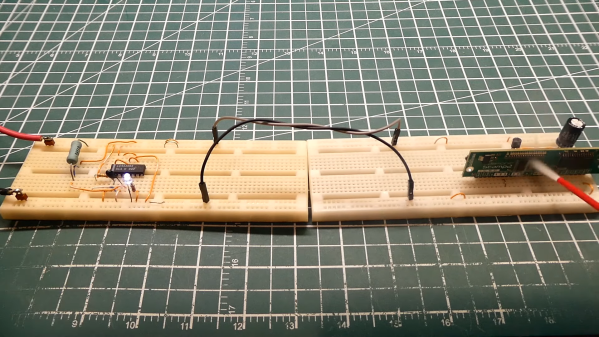
[R-B] designed a 555 timer circuit to scan a keypad. Keypads are common interfaces for small projects and require row and column scanning by a microcontroller. [R-B's] setup allows you to reduce the number of pins used on the microcontroller to just two. One is an interrupt that is triggered when any of the buttons are pushed, the other reads the frequency from the 555 chip. Each button has its own resistance which alters the frequency of the 555. The microcontroller reads the frequency for 100ms using a timer. The number of timer overflows that occur during that period directly correspond to the button press (five overflows for the numeral 5, zero overflows for the numeral zero).
We usually debounce our button presses for 40 ms, this is more than twice that amount of time but still not a staggering difference. It does make us wonder if you will miss quick button presses? The only really way to know is to try this out yourself. Check out the video after the break and don’t forget to leave a comment with your own experiences in working with the circuit.
Read the rest of this entry »
posted Feb 7th 2011 6:02am by
Kevin Dady
filed under:
home hacks

When [Deddies lab] was looking to keep their (rather large) Ficus Lyrata appropriately watered, they followed their motto, stuck a micro controller on it and whipped up an Electronic Watering Can .
The whole thing starts off with power that is switched on once a day for 15 minutes by a traditional mechanical lamp timer, and that is connected to a atmega8 micro controller running @ 1MHz which increments a counter by one. When that counter hits 7 the mega switches on a pump, watering the plant with roughly half a liter of water per week out of a bucket reservoir , which according to the article’s calculations should last about 4 months.
In order to assure that the pump does not run out of water a rubber duck was attached to a string, the other end is attached to a micro switch, and when the water gets too low the string is pulled, switching one of the micro controller’s pins low.
While we agree that it could use a low water indicator, that is trivial to add, and over all the project represents a great hack done on a Sunday using parts and materials already on hand. Join us after the break for a quick video too!
Read the rest of this entry »
posted Feb 4th 2011 12:29pm by
Mike Nathan
filed under:
arduino hacks,
home hacks

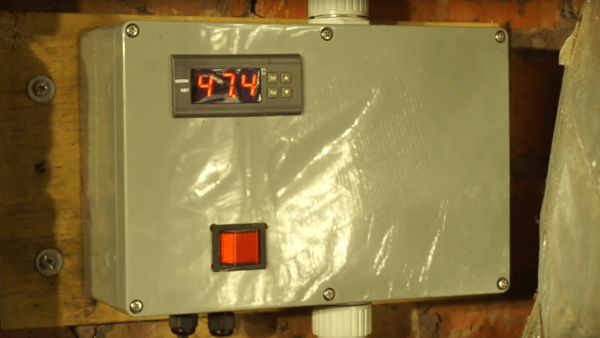
Santa brought [Quinten's] son a shiny R/C truck for Christmas, but this new toy had one drawback – its batteries could only be connected to the charger for a maximum of 6 hours, lest he turn his house into a pile of smoldering ash. With grave warnings from the manufacturer dancing in his head, he searched around for a timer that would allow him to cut power to the battery after charging for its allotted time. Coming up empty, he decided to create his own timed electric socket regulated by an Arduino he had sitting around. He grabbed a project box and wired up a nice looking socket timer, complete with an LCD status display. To make things easy for his son, he added two buttons to the front of the controller – one for selecting the amount of charging time, and one to set the timer in motion. As with his previous hacks, [Quinten] has provided plenty of documentation in the form of pictures, code, and even a video of the timer in action.
posted Jan 16th 2011 1:00pm by
Mike Szczys
filed under:
tool hacks,
transportation hacks

[Dino] is an auto mechanic and needed a way to test out fuel injectors. Commercially available tools start well over $100 and go up from there, but he built his own for about $20.
The injectors have a coil in them that needs to be tested. His design calls for a series of 0.008 millisecond pulses to test the coil. He started by setting up a 555 timer to output a one second pulse. This signal is fed into a second 555 chip that outputs the 0.008 pulses and in turn actuates a MOSFET to switch the coil on and off. To use it [Dino] connects to a 12V bench supply and to the injector, using a single button to start the test. See him explain the setup in the video after the break.
Read the rest of this entry »