Robomintoner Badminton Bot To Defeat Amateur Humans

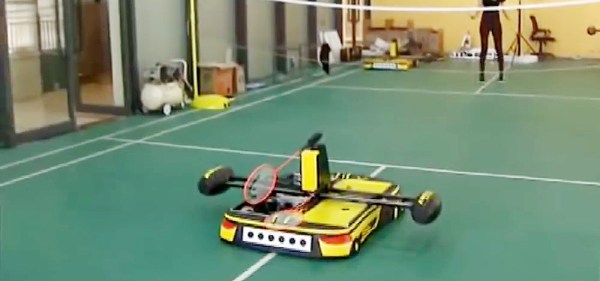
Watching robots doing sports is pretty impressive from a technical viewpoint, although we secretly smile when we compare these robots’ humble attempts to our own motoric skills. Now, a new robot named Robomintoner seeks to challenge human players, and it’s already darn good at badminton.

Continue reading “Robomintoner Badminton Bot To Defeat Amateur Humans”

Simple Clock Is Great Stepper Motor Project

You’d think that we’ve posted every possible clock here at Hackaday. It turns out that we haven’t. But we have seen enough that we’ve started to categorize clock builds in our minds. There are the accuracy clocks which strive to get every microsecond just right, the bizzaro clocks that aim for most unique mechanism, and then there are “hello world” clocks that make a great introduction to building stuff.

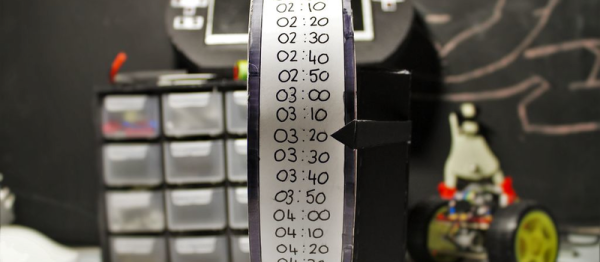
Today, we’re looking at a nice “hello world” clock. [electronics for everyone]’s build uses a stepper motor and a large labelled wheel that rotates relative to a fixed pointer. Roll the wheel, and the time changes. It looks tidy, it’s cyclical by design, and it’s a no-stress way to get your feet wet driving stepper motors. And it comes with a video, embedded below.

Continue reading “Simple Clock Is Great Stepper Motor Project”

Hackaday Prize Entry: An Internet Of Things Microscope

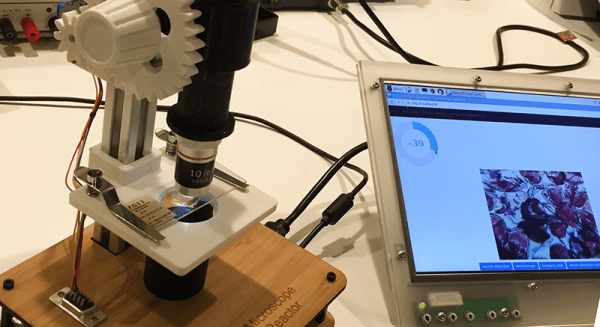
For their entry into the Citizen Scientist portion of the Hackaday Prize, the folks at Arch Reactor, the St. Louis hackerspace, are building a microscope. Not just any microscope – this one is low-cost, digital, and has a surprisingly high magnification and pretty good optics. It’s the Internet of Things Microscope, and like all good apparatus for Citizen Scientist, it’s a remarkable tool for classrooms and developing countries.

When you think of ‘classroom microscope’, you’re probably thinking about a pile of old optics sitting in the back of a storage closet. These microscopes are purely optical, without the ability to take digital pictures. The glass is good, but you’re not going to get a scanning stage when you’re dealing with 30-year-old gear made for a classroom full of sticky-handed eighth graders.

The Internet of Things Microscope includes a scanning stage that moves across the specimen on the X and Y axes, stitching digital images together to create a very large image. That’s a killer feature for a cheap digital microscope, and the folks at Arch Reactor are doing this with a few cheap stepper motors and stepper motor drivers.

The rest of the electronics are built around a Raspberry Pi, Raspberry Pi camera (which recently got a nice resolution upgrade), and a some microscope eyepieces and objectives. Everything else is 3D printed, making this a very cheap and very accessible microscope that has some killer features.

Making Graphene More Practical

[James Tour] and others at Rice University announced an improved form of graphene that uses nanoscale rivets. The material incorporates carbon nanotubes along with carbon spheres that encase iron nanoparticles. The nanotubes provide strength and higher conductivity overall, while the spheres let the material transfer more easily.

Typically, placing graphene on something involves using chemical vapor deposition on a polymer layer before transferring to another site. The polymer tends to degrade the graphene’s properties. This new material doesn’t require this intermediate step. In addition, the spheres allow interfacing to the graphene more readily.

Continue reading “Making Graphene More Practical”

Binary Keyboard Is The Purest Form Of Input Device

You may be a hardcore keyboard aficionado whose buckled-spring switches will be pried from your cold dead hands, but there is a new model on the street that relegates your blank-key Das Keyboard or your trusty IBM Model M to the toy chest.

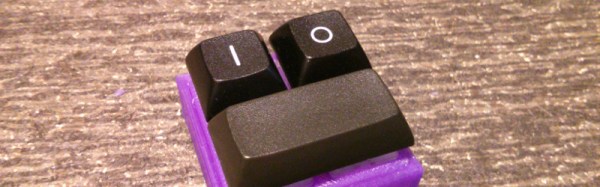
The new challenger comes from Reddit user [duckythescientist], who has created a minimalist three-key binary keyboard. It features a 0 key, a 1 key, a return key, and nothing else. Characters are entered as ASCII or Unicode, and the device emulates either a QWERTY or Dvorak keyboard layout to the host computer’s USB interface. It couldn’t be a simpler layout to learn, though we’d concede that not everyone has the entire binary Unicode table memorised.

The keys are mounted in a custom 3D printed case, and the electronics come from the creator’s own “tinydev” board based on an ATtiny85. All the code is available in a GitHub repository, and there is a very short video of its Unicode ability below the break.

Continue reading “Binary Keyboard Is The Purest Form Of Input Device”

Metal Casting With Single Shelled PLA Masters

[3DTOPO] does a lot of metal casting (video link, embedded below). That’s obvious by the full and appropriate set of safety gear, a rarity on YouTube.

They had all the equipment to do it the normal way: craft or CNC out a master, produce a drag and a copy, make any necessary cores, and finally; pour the mold. This is a long and tedious process. It has a high rate of error, and there is a parting line.

Another set of methods are the lost ones. With these methods the master is produced out of a material like foam or wax. The master is surrounded by refractory and then melted, burned, or baked out of the mold. Finally the metal is poured in. Theoretically, a perfect reproduction is made without ever having to open the mold.
Continue reading “Metal Casting With Single Shelled PLA Masters”

Red Carpet BB-8 internals

How BB-8 Works Revealed At Star Wars Celebration Europe

Finally the workings of the official BB-8 that you’ve seen rolling around at various events have been revealed. Its makers [Matt Denton] and [Josh Lee] participated in an hour-long presentation at Star Wars Celebration Europe 2016 just this past week where the various views of its internals were shown in action. It’s since had BB-8 builders (yours truly included) analyzing the workings for new ideas. We also now have the official name for it, red carpet BB-8.

For the first half of their talk they went over how BB-8 was implemented for Star Wars: The Force Awakens. As we’ve long known this was done using 7 puppeted BB-8’s, though it was revealed that only 4 were actually used, including a stationary one called the wiggler whose purpose you can guess. Another thing we didn’t know is that they did consider building a working BB-8 for filming but decided they needed something bullet proof, that would work right every time without making a film crew wait for repairs, and so went with the puppets instead.

The second half of their talk contained the big reveal, the mechanism inside red carpet BB-8’s ball. It turns out to be pretty close to what many builders have been doing. If you’ve seen the DIYer’s guide to the different BB-8 drive systems then you’ll understand when we say it’s a pendulum drive (aka axle drive). That is, there’s a motorized axle that crosses the middle of the ball and the ball rotates on that axle. Meanwhile a large mass suspended below the axle acts as the pendulum mass.

BB-8 builders have known the importance of keeping as much mass as possible as low down as possible for stability, but it was revealed the great extent to which that has been done in the red carpet version. Motors for the head’s pitch and yaw are located at the bottom and their motion is transferred up to the center using what are maybe best known as bicycle brake cables. Another big reveal was a linear actuator for the body roll, tilting the center stuff with respect to the mass lower down. The actuator itself is located in the lower section. Also, BB-8 builders have been mounting the drive motors for rotating the ball with respect to the axle, in line with the axle. However, in red carpet BB-8 the motor is also at the bottom and its motion appears to be transferred up to the axle via belt and worm gears. You may mistake the gold cylinders on either side of the central gimbal system to be motors but they’re actually Moflon slip rings.

Those are just a few of the insights gained so far from analyzing the video below. Doubtless people will be noticing a lot more in the weeks to come.

Continue reading “How BB-8 Works Revealed At Star Wars Celebration Europe”