Open-Source ARM Development Simplified

The ARM series of processors are an industry standard of sorts for a vast array of applications. Virtually anything requiring good power or heat management, or any embedded system which needs more computing power than an 8-bit microcontroller is a place where an ARM is likely found. While they do appear in various personal computers and laptops, [Pieter] felt that their documentation for embedded processors wasn’t quite as straightforward as it could be and created this development board which will hopefully help newbies to ARM learn the environment more easily.

Called the PX-HER0, it’s an ARM development board with an STM32 at its core and a small screen built in. The real work went in to the documentation for this board, though. Since it’s supposed to be a way to become more proficient in the platform, [Pieter] has gone to great lengths to make sure that all the hardware, software, and documentation are easily accessible. It also comes with the Command Line Interpreter (CLI) App which allows a user to operate the device in a Unix-like environment. The Arduino IDE is also available for use with some PX-HER0-specific examples.

[Pieter] has been around before, too. The CLI is based on work he did previously which gave an Arduino a Unix-like shell as well. Moving that to the STM32 is a useful tool to have for this board, and as a bonus everything is open source and available on his site including the hardware schematics and code.

Powering Neon With A Joule Thief

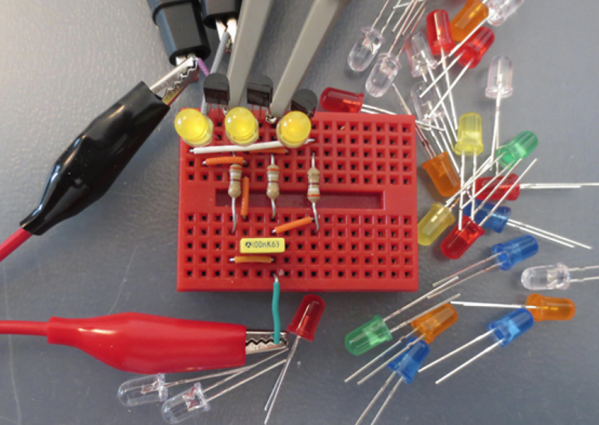
Joule thief are small, fun circuits which exploit a few characteristics of electronics and LEDs in order to “steal” virtually all of the energy stored in a battery. They can operate at incredibly small voltages and are fairly simple to make. With a few modifications to this basic circuit it’s possible to drive other things than an LED, though, like this joule thief that lights up a neon bulb.

The circuit from [suedbunker] aka [fuselage] is based on a pin from the Chaos Communication Camp which had a standard LED. To get a neon light to illuminate a few modifications to the standard joule thief are needed.

First, the windings have to be changed from 10:10 to 10:80 to increase the voltage across the bulb. Second, a transistor with slightly different characteristics was used than the original design. The capacitor was also replaced with a larger one.

While it might seem simple, the physics of how a joule thief works are anything but, and modifying the delicate circuit to work with something other than an LED is commendable. It also has a steampunk vibe which is a cool look even in projects that don’t involve steam at all.

Inside A CAN Bus Mileage Manipulator

In the days of carburetors and leaf spring suspensions, odometer fraud was pretty simple to do just by disconnecting the cable or even winding the odometer backwards. With the OBD standard and the prevalence of electronics in cars, promises were made by marketing teams that this risk had all but been eliminated. In reality, however, the manipulation of CAN bus makes odometer fraud just as easy, and [Andras] is here to show us exactly how easy with a teardown of a few cheap CAN bus adapters.

We featured another project that was a hardware teardown of one of these devices, but [Andras] takes this a step further by probing into the code running on the microcontroller. One would imagine that basic measures would have been taken by the attackers to obscure code or at least disable debugging modes, but on this one no such effort was made. [Andras] was able to dump the firmware from both of his test devices and start analyzing them.

Analyzing the codes showed identical firmware running on both devices, which made his job half as hard. It looked like the code was executing a type of man-in-the-middle attack on the CAN bus which allowed it to insert the bogus mileage reading. There’s a lot of interesting information in [Andras]’s writeup though, so if you’re interested in CAN bus or attacks like this, it’s definitely worth a read.

If Coffee == True {

Having a shared coffee maker in the workplace is both a blessing and a curse. It’s nice to have constant access to coffee, but it can be frustrating to find the coffee pot emptied right as you walk in to the break room. To solve this problem in their office, [Vitort] and co. built an IOT solution that notifies everyone of the current coffee status on a Slack channel.

This project wasn’t built just as a convenience for the office, either. It makes extensive use of AWS SNS, the simple notification system from Amazon Web Services because they wanted to learn to use this technology specifically. Besides the notification system, the device itself is based on a NodeMCU/ESP8266, communicating over WiFi, and is a simple push-button design which coffee drinkers push when a fresh pot is made, and then push again when the coffee is empty.

While relatively straightforward, this project is a good one to look at if you’ve been interested in AWS at all, especially the simple notification system. It’s a pretty versatile tool, and all of the code used in the project is available on the project page for your reading pleasure. If you’re more interested in the coffee aspect of this project, we have a special coffee maker for you too.

A Super-Brain For An E-bike

There’s no better way of improving a project than logging data to make informed decisions on future improvements. When it came to [Brian]’s latest project, an electric bike, he wanted to get as much data as he could from the time he turned it on until the time he was finished riding. He turned to a custom pyBoard-based device (and wrote it up on Hackaday.io), but made it stackable in order to get as much information from his bike as possible.

This isn’t so much an ebike project as it is about a microcontroller platform that can be used as a general purpose device. All of the bike’s controls flow through this device as a logic layer, so everything that can possibly be logged is logged, including the status of the motor and battery at any given moment. This could be used for virtually any project, and the modular nature means that you could scale it up or down based on your specific needs. The device is based on an ARM microcontroller so it has plenty of power, too.

While the microcontroller part is exceptionally useful ([Brian] talks about some of its other uses here and gives us even more data on his personal webpage), we shouldn’t miss the incredible bike that [Brian] built either. It has a 3 kW rear hub motor and can reach speeds of around 60 mph. While we let the commenters below hash out the classic argument of “bicycle vs. motorcyle” we’ll be checking out some electric vehicles that are neither.

A(nother) Minimalist Window Manager

For however many Linux distributions there are to choose from, there are perhaps even more window managers that can be paired with them, and some have dramatically different features than the X window systems that most of us are familiar with. There’s a rabbit hole to fall down, as with most Linux-related topics, but while this tiling window manager from [caoluin], called sara, adds to the cacophony, it’s also representative of any pet project that lets us take a deep dive into something personally interesting.

What started as a desire to revive an abandoned window manager called catwm eventually evolved into a fork of sorts of another popular window manager called dwm. dwm is used as a basis or as building blocks for many other window managers, and while [caoluin] was writing sara he found that many of the solutions he found converged on the same things that dwm had already implemented. In a way, it’s reassuring if your solutions are similar to tried-and-true methods already in use. For other things he found interesting solutions, and other features that dwm has he found to be unnecessary and removed them.

Does the world need another window manager? Probably not. But we can all appreciate building something from scratch, just to see how it really works under the hood. As far as that goes, we’d consider sara a success for [caoluin], and if you’re really interested in window managers then you can take a look at his Github page or one of the more esoteric window managers we’ve seen.

New Depths For IMac Repair

There’s not much economic sense in fixing a decade-old desktop computer, especially when it’s the fancy type with the screen integrated into the body of the computer, and the screen is the thing that’s broken. Luckily for [JnsBn] aka [BEAN] the computer in question was still functional with a second monitor, so he decided to implement a cheap repair to get the screen working again by making it see-through.

The only part of the screen that was broken was the backlight, which is separate from the display unit itself. In order to view at least something on the screen without an expensive replacement part, he decided to remove the backlight altogether but leave the display unit installed. With a strip of LEDs around the edge, the screen was visible again in addition to the inner depths of the computer. After a coat of white Plasti Dip on the inside of the computer, it made for an interesting effect and made the computer’s display useful again.

While none of us, including the creator, recommend coating the inside of an iMac with Plasti Dip due to the risk of fire and/or other catastrophic failure, there’s not much to lose otherwise. Just don’t shove this one into the wall. Continue reading “New Depths For IMac Repair”