
Keep Pedaling To Keep Playing

It’s been said that the best way to tackle the issue of childhood obesity would be to hook those children’s video game consoles up to a pedal-powered generator. Of course, this was said by [Alex], the creator of Cykill. Cykill interfaces an Xbox to an exercise bike, so to keep the video game going you’ll have to keep pedaling the bike.

While there is no generator involved in this project, it does mimic the effect of powering electronics from a one. The exercise bike has a set of communications wires, which are connected to a relay on the Xbox’s power plug. When the relay notices that the bike isn’t being pedaled enough, it automatically cuts power to the console. Of course, the risk of corrupting a hard drive is high with this method, but that only serves to increase the motivation to continue pedaling.

The project goes even further in order to eliminate temptation to bypass the bike. [Alex] super-glued the plug of the Xbox to the relay, making it extremely difficult to get around the exercise requirement. If you’re after usable energy instead of a daily workout, though, there are bikes out there that can power just about any piece of machinery you can imagine.

Garage Distance Sensor Kicks Tennis Ball To Curb

Those with small garages might be familiar with the method of hanging a tennis ball from a ceiling to make sure they don’t hit the back wall with their car. If the car isn’t in the garage, though, the tennis ball dangling from a string tends to get in the way. To alleviate this problem, [asaucet] created a distance sensor that can tell him when his car is the perfect distance from the garage wall.

At the heart of the distance sensor is an HC-SR04 ultrasonic rangefinder and a PIC16F88 microcontroller. [asaucet] uses a set of four LEDs to alert the driver how close they are to the garage wall. [asaucet] also goes into great detail about how to use an LCD with this microcontroller for setting up the project, and the amount of detail should be enough to get anyone started on a similar project.

While this isn’t a new idea, the details that [asaucet] goes into in setting up the microcontroller, using the distance sensor, and using an LCD are definitely worth looking into. Even without this exact application in mind, you’re sure to find some helpful information on the project page.

Continue reading “Garage Distance Sensor Kicks Tennis Ball To Curb”

Sailboat Throws Motor Overboard, Adds Sensor Array

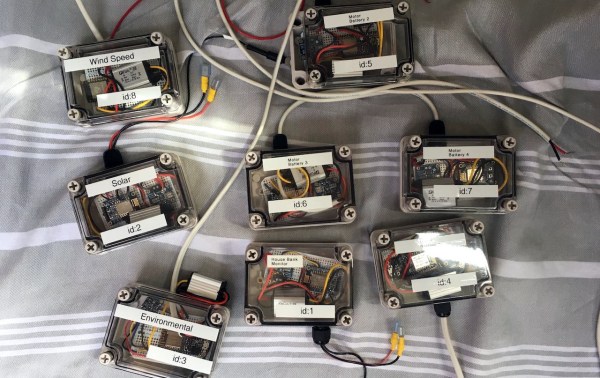
For those not familiar with sailing, it might seem like an obsolete way to get around on the water. This isn’t 1492 anymore, and it’s pretty easy to go out and get a boat with a motor to get where you need to go. Sailboats, however, are still one of the most efficient ways to travel. There are essentially no fuel costs, and maintenance on them is often easier than on a boat with an engine. Not to mention the fun involved in flying a hull on a catamaran. Anyway, if you’re [gwilken], you can bring your sailboat even further into modern times by building your own sensor array for it.

The ultimate goal of this project was to get all gauges and sensors reporting data to an iPad, rather than to random gauge clusters around the ship. This includes environmental conditions, speed, and motor status (most larger sailboats have a motor for getting around the marina). A Raspberry Pi ties it all together, including a GPS antenna for monitoring location. [gwilken] also includes a WiFi antenna and a cell antenna for maintaining a network connection for reporting all of this information. With this connectivity, he can also control some functions of the boat as well.

[gwilken] made the decision to ditch the conventional gas motor for a more energy-efficient electric motor. This also has the perk of being essentially maintenance-free, and can even charge his battery in regen mode while his boat is under sail. The sailboat is now fully equipped for the 21st century, in a similar way to another boat’s gauge cluster that was recently featured.

MagSafe Power Bank From Scrap

Just a few short years ago, it was possible to find scrapped lithium batteries for free, or at least for very cheap. What most people at the time didn’t realize is that a battery with multiple cells might go bad because only one cell is bad, leaving the others ready for salvaging. Now it’s not a secret anymore, but if you can manage to get your hands on some there’s a lot of options for use. [ijsf] took a step further with this hack, taking a few cells from a Panasonic battery and wrangling them into a MagSafe-capable power bank for a Mac.

The real hack wasn’t scavenging batteries, however, it was getting the MagSafe to signal the computer to use power from the battery bank to run the computer only, and not to use any of that energy for charging the computer’s internal batteries. This is achieved by disabling the center MagSafe pin, which is the computer’s communication line to the power adapter. After that, the battery bank could be programmed to behave properly (a feat in itself for lithium batteries) and the power bank was successfully put into operation.

Not only was this hack a great guide for how to repurpose cells from a “dead” battery, it’s also an unparalleled quick reference for any work that might need a MagSafe connector. Of course, if you’re going to work with these chargers, make sure that you’re using one that isn’t a cheap clone.

Under The Hood Of AMD’s Threadripper

Although AMD has been losing market share to Intel over the past decade, they’ve recently started to pick up steam again in the great battle for desktop processor superiority. A large part of this surge comes in the high-end, multi-core processor arena, where it seems like AMD’s threadripper is clearly superior to Intel’s competition. Thanks to overclocking expert [der8auer] we can finally see what’s going on inside of this huge chunk of silicon.

The elephant in the room is the number of dies on this chip. It has a massive footprint to accommodate all four dies, each with eight cores. However, it seems as though two of the cores are deactivated due to a combination of manufacturing processes and thermal issues. This isn’t necessarily a bad thing, either, or a reason not to use this processor if you need to utilize a huge number of cores, though; it seems as though AMD found it could use existing manufacturing techniques to save on the cost of production, while still making a competitive product.

Additionally, a larger die size than required opens the door for potentially activating the two currently disabled chips in the future. This could be the thing that brings AMD back into competition with Intel, although both companies still maintain the horrible practice of crippling their chips’ security from the start.

Failing Infrastructure And The Lessons It Teaches

Infrastructure seems so permanent and mundane that most of us never give it a second thought. Maintenance doesn’t make for a flashy news story, but you will frequently find a nagging story on the inside pages of the news cycle discussing the slowly degrading, crumbling infrastructure in the United States.

If not given proper attention, it’s easy for these structures to fall into a state of disrepair until one suddenly, and often catastrophically, fails. We’ve already looked at a precarious dam situation currently playing out in California, and although engineers have that situation under control for now, other times we haven’t been so lucky. Today we’ll delve into a couple of notable catastrophic failures and how they might be avoided in future designs.

Gaining Weight While Delaying Repairs

Most of us take infrastructure for granted every day. Power lines, roads, pipelines, and everything else have a sense of permanence and banality that can’t be easily shaken. Sadly, this reality shattered for most people in Minneapolis, Minnesota in August 2007.

Continue reading “Failing Infrastructure And The Lessons It Teaches”

Autonomous Boat Sails The High Seas

As the human population continues to rise and the amount of industry increases, almost no part of the globe feels the burdens of this activity more than the oceans. Whether it’s temperature change, oxygen or carbon dioxide content, or other characteristics, the study of the oceans will continue to be an ongoing scientific endeavor. The one main issue, though, is just how big the oceans really are. To study them in-depth will require robots, and for that reason [Mike] has created an autonomous boat.

This boat is designed to be 3D printed in sections, making it easily achievable for anyone with access to a normal-sized printer. The boat uses the uses the APM autopilot system and Rover firmware making it completely autonomous. Waypoints can be programmed in, and the boat will putter along to its next destination and perform whatever tasks it has been instructed. The computer is based on an ESP module, and the vessel has a generously sized payload bay.

While the size of the boat probably limits its ability to cross the Pacific anytime soon, it’s a good platform for other bodies of water and potentially a building block for larger ocean-worthy ships that might have an amateur community behind them in the future. In fact, non-powered vessels that sail the high seas are already a reality.

Continue reading “Autonomous Boat Sails The High Seas”