Foam Board, Old Electronics, And Imagination Make Movie Magic

When it comes to building sets and props for movies and TV, it’s so easy to get science fiction wrong – particularly with low-budget productions. It must be tempting for the set department to fall back on the “get a bunch of stuff and paint it silver” model, which can make for a tedious experience for the technically savvy in the audience.

But low-budget does not necessarily mean low production values if the right people are involved. Take [Joel Hartlaub]’s recent work building sets for a crowdfunded sci-fi film called Infinitus. It’s a post-apocalyptic story that needed an underground bunker with a Fallout vibe to it, and [Joel] jumped at the chance to hack the sets together. Using mainly vintage electronic gear and foam insulation boards CNC-routed into convincing panels, he built nicely detailed control consoles for the bunker. A voice communicator was built from an old tube-type table radio case with some seven-segment displays, and the chassis of an old LCD projector made a convincing portable computer terminal. The nicest hack was for the control panel of the airlock door. That used an old TDD, or telecommunications device for the deaf. With a keyboard and a VFD display, it fit right into the feel of the set. But [Joel] went the extra mile to make it a practical piece, by recording the modulated tones from the acoustic coupler and playing them back, to make it look as if a message was coming in. The airlock door looks great too.

Like many hacks, it’s pretty impressive what you can accomplish with a deep junk pile and a little imagination. But if you’ve got a bigger budget and you need some computer displays created, we know just the person for the job.

Continue reading “Foam Board, Old Electronics, And Imagination Make Movie Magic”

Fail Of The Week: Ambitious Vector Network Analyzer Fails To Deliver

If you’re going to fail, you might as well fail ambitiously. A complex project with a lot of subsystems has a greater chance of at least partial success, as well as providing valuable lessons in what not to do next time. At least that’s the lemonade [Josh Johnson] made from his lemon of a low-cost vector network analyzer.

For the uninitiated, a VNA is a versatile test instrument for RF work that allows you to measure both the amplitude and the phase of a signal, and it can be used for everything from antenna and filter design to characterizing transmission lines. [Josh] decided to port a lot of functionality for his low-cost VNA to a host computer and concentrate on the various RF stages of the design. Unfortunately, [Josh] found the performance of the completed VNA to be wanting, especially in the phase measurement department. He has a complete analysis of the failure modes in his thesis, but the short story is poor filtering of harmonics from the local oscillator, unexpected behavior by the AD8302 chip at the heart of his design, and calibration issues. Confounding these issues was the time constraint; [Josh] might well have gotten the issues sorted out had the clock not run out on the school year.

After reading through [Josh]’s description of his project, which was a final-year project and part of his thesis, we feel like his rating of the build as a failure is a bit harsh. Ambitious, perhaps, but with a spate of low-cost VNAs coming on the market, we can see where he got the inspiration. We understand [Josh]’s disappointment, but there were a lot of wins here, from the excellent build quality to the top-notch documentation.

Image Sensor From Discrete Parts Delivers Glorious 1-Kilopixel Images

Chances are pretty good that you have at least one digital image sensor somewhere close to you at this moment, likely within arm’s reach. The ubiquity of digital cameras is due to how cheap these sensors have become, and how easy they are to integrate into all sorts of devices. So why in the world would someone want to build an image sensor from discrete parts that’s 12,000 times worse than the average smartphone camera? Because, why not?

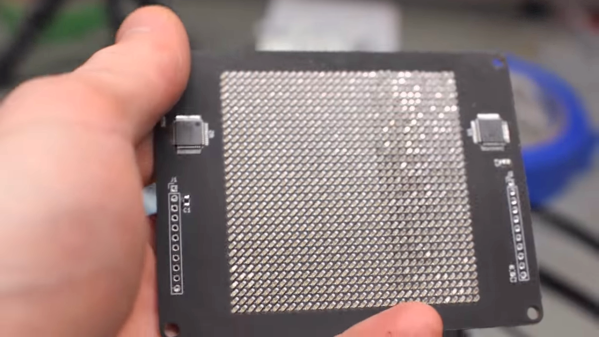
[Sean Hodgins] originally started this project as a digital pinhole camera, which is why it was called “digiObscura.” The idea was to build a 32×32 array of photosensors and focus light on it using only a pinhole, but that proved optically difficult as the small aperture greatly reduced the amount of light striking the array. The sensor, though, is where the interesting stuff is. [Sean] soldered 1,024 ALS-PT19 surface-mount phototransistors to the custom PCB along with two 32-bit analog multiplexers. The multiplexers are driven by a microcontroller to select each pixel in turn, one row and one column at a time. It takes a full five seconds to scan the array, so taking a picture hearkens back to the long exposures common in the early days of photography. And sure, it’s only a 1-kilopixel image, but it works.

[Sean] has had this project cooking for a while – in fact, the multiplexers he used for the camera came up as a separate project back in 2018. We’re glad to see that he got the rest built, even with the recycled lens he used. One wonders how a 3D-printed lens would work in front of that sensor.

Continue reading “Image Sensor From Discrete Parts Delivers Glorious 1-Kilopixel Images”

Hackaday Links Column Banner

Hackaday Links: December 29, 2019

The retrocomputing crowd will go to great lengths to recreate the computers of yesteryear, and no matter which species of computer is being restored, getting it just right is a badge of honor in the community. The case and keyboard obviously playing a big part in that look, so when a crowdfunding campaign to create new keycaps for the C64 was announced, Commodore fans jumped to fund it. Sadly, more than four years later, the promised keycaps haven’t been delivered. One disappointed backer, Jim Drew, decided he was sick of waiting, so he delved into the world of keycaps injection molding and started his own competing campaign. Jim details his adventures in his Kickstarter Indiegogo campaign, which makes for good reading even if you’re not into Commodore refurbishment. Here’s hoping Jim has better luck than the competition did.

Looking for anonymity in our increasingly surveilled world? You’re not alone, and in fact, we predict facial recognition spoofing products and methods will be a growth industry in the new decade. Aside from the obvious – and often illegal – approach of wearing a mask that blocks most of the features machine learning algorithms use to quantify your face, one now has another option, in the form of a colorful pattern that makes you invisible to the YOLOv2 algorithm. The pattern, which looks like a soft-focus crowd scene rendered in Mardi Gras colors, won’t make the algorithm think you’re someone else, but it will prevent you from being classified as a person. It won’t work with any other AI algorithm, but it’s still an interesting phenomenon.

We saw a great hack come this week about using an RTL-SDR to track down a water leak. Clayton’s water bill suddenly skyrocketed, and he wanted to track down the source. Luckily, his water meter uses the encoder receive-transmit (ERT) protocol on the 900 MHz ISM band to report his usage, so he threw an SDR dongle and rtlamr at the problem. After logging his data, massaging it a bit with some Python code, and graphing water consumption over time, he found that water was being used even when nobody was home. That helped him find the culprit – leaky flap valves in the toilets resulting in a slow drip that ran up the bill. There were probably other ways to attack the problem, but we like this approach just fine.

Are your flex PCBs making you cry? Friend of Hackaday Drew Fustini sent us a tip on teardrop pads to reduce the mechanical stress on traces when the board flexes. The trouble is that KiCad can’t natively create teardrop pads. Thankfully an action plugin makes teardrops a snap. Drew goes into a bit of detail on how the plugin works and shows the results of some test PCBs he made with them. It’s a nice trick to keep in mind for your flexible design work.

[Ben Krasnow]’s Take On DIY Air Bearings

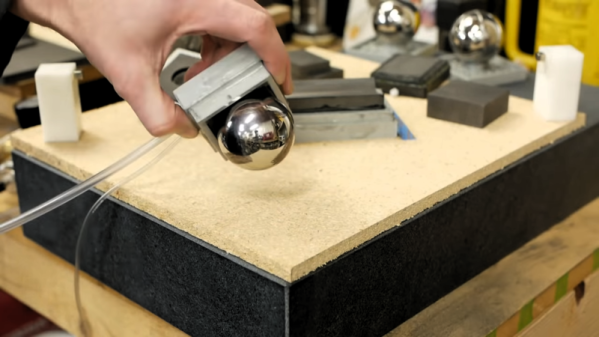
We’ve got to admit that watching [Ben Krasnow]’s new video on air bearings is tough. We found our eyes constantly checking the spherical air bearing in the foreground, which for the first eight minutes of the video just kept going. It was strangely hypnotic, and made it hard to concentrate on all the other cool stuff [Ben] was up to.

If the topic of air bearings seems familiar, it might be because we recently reported on DIY air bearings made from used EDM electrodes. [Ben] saw that too, and dusted off his old air bearing project. Literally, as it turns out, because the graphite blocks whose porosity and softness make them the perfect material for air bearings also makes for a dusty workshop. We’d recommend breathing protection of some sort while machining graphite. In addition to simple puck bearings, [Ben] came up with more complicated designs, including the aforementioned spherical bearing. He used the steel ball itself as a precision tool to grind the graphite out, first by coating it with abrasive and then by cutting grooves in it to act like a file. A cylindrical bearing was also cut, this time with sandpaper glued directly to the ground steel rod that would seat in the bearing.

[Ben]’s other innovation is vacuum preloading, where he applies both vacuum and pressure to the bearing plenum. The vacuum provides the force needed to capture the moving element while the pressure bears the load. It’s a careful balancing act, but it works well enough to capture the large steel ball and keep it turning effortlessly.

We really liked [Ben]’s take on air bearings, especially his thoughts on creating fully enclosed cylindrical bearings. Those could be useful for low-friction linear drives, and we look forward to seeing more on those.

Continue reading “[Ben Krasnow]’s Take On DIY Air Bearings”

Bend It Like Bhoite: Circuit Sculptures Shatter The Bounds Of Flatland

As electronics hobbyists, we live in a somewhat two-dimensional world. Our craft is so centered around the printed circuit board that our design tools are specifically geared to spit out files tailored to the board house, who can then ship us a study in fiberglass and copper. We daub on flux and solder, add components, apply heat, and like magic, our circuits come to life, all within a few millimeters above and below the PCB.

Breaking out of this self-imposed Flatland can be therapeutic. At least that’s how Mohit Bhoite sees his free-form circuit sculptures, which he spoke about at length at the Hackaday Superconference this year. By way of disclosure, I have to admit to being a longtime fan of Mohit’s work, both at his day job as a designer at Particle, and with his spare time hobby of creating sculptures from electronic components and brass wire which can be followed on his Twitter feed. He ended up joining us for a circuit sculpture Hack Chat just before heading to Supercon, too, so not only was I looking forward to meeting him, I was sure his talk would reveal the secrets of his art and give me the inspiration to start doing some of my own. I wasn’t disappointed on either score.

Continue reading “Bend It Like Bhoite: Circuit Sculptures Shatter The Bounds Of Flatland”

Russia’s Newest Weather Satellite May Have Been Killed By Space Junk

For humans and satellites alike, making a living in space is hard. First, there’s the problem of surviving the brief but energetic and failure-prone ride there, after which you get to alternately roast and freeze as you zip around the planet at 20 times the speed of sound. The latter fact is made all the more dangerous by the swarm of space debris, both natural and man-made, that whizzes away up there along with you, waiting to cause an accident.

One such accident has apparently led to the early demise of a Russian weather satellite. Just a few months after launch, Meteor-M 2-2 suffered a sudden orbital anomaly (link to Russian story; English translation). Analysis of the data makes it pretty clear what happened: the satellite was struck by something, and despite some ground-controller heroics which appear to have stabilized the spacecraft, the odds are that Meteor-M 2-2 will eventually succumb to its wounds.

Continue reading “Russia’s Newest Weather Satellite May Have Been Killed By Space Junk”