Project Egress: Casting The Hatch Handle

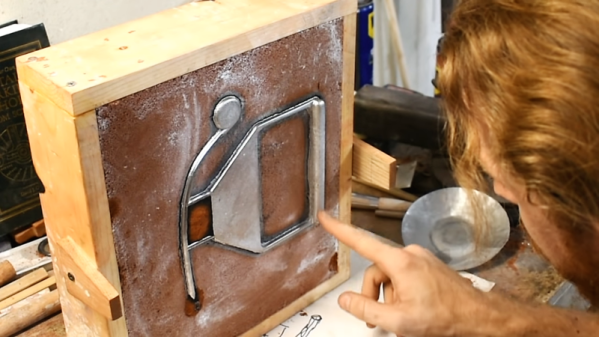
Every door needs a handle, even – especially – the door of a spaceship. And [Paul] from “Paul’s Garage” got the nod to fabricate the handle for the Apollo 11 Command Module hatch being built as part of Project Egress.

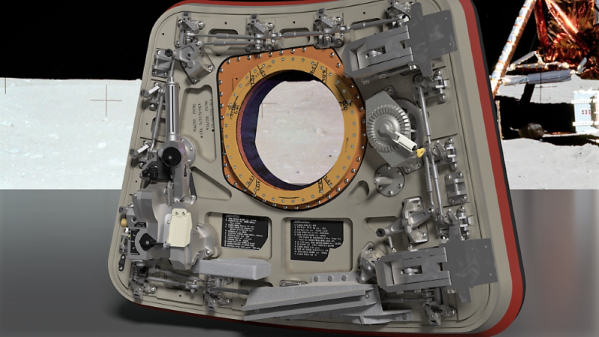
For those not familiar with Project Egress, it’s a celebration of the 50th anniversary of the first Moon landing that aims to recreate an important artifact from the mission: the Unified Crew Hatch, or UCH, from the Apollo 11 Command Module Columbia. Forty-four makers from various disciplines have been tasked with making the various pieces of the UCH, and each one is free to use whatever materials and methods he or she wants. [Paul] chose what will probably turn out to be the consensus material – aluminum – and decided to play to his strengths by casting the part.

The handle itself is a chunky affair, as one would expect from something designed to be handled by an astronaut. [Paul] started with a 3D-printed version of the handle and created a two-piece mold in casting sand. The original part was probably machined, which meant that it didn’t have the draft angle that cast parts are supposed to have to make removal from the molding medium easier. [Paul] lucked out and got a perfect mold, and a perfect pour from silicon aluminum to boot. All the casting needed was a little cleanup and some holes to bolt it to the door.

[Paul]’s handle will get shipped to the Smithsonian along with the other parts, like [Fran Blanche]’s latch assembly, so that [Adam] can assemble the hatch live during the 50th-anniversary celebration later this month. Stay tuned for more Project Egress coverage as the parts keep rolling in.
Continue reading “Project Egress: Casting The Hatch Handle”

Hacked Calipers Make Automated Measurements A Breeze

Now, digital calipers with wired interfaces to capture the current reading are nothing new. But the good ones are expensive, and really, where’s the fun in plugging a $75 cable into a computer? So when [Max Holliday] was asked to trick out some calipers for automating data capture, he had to get creative.

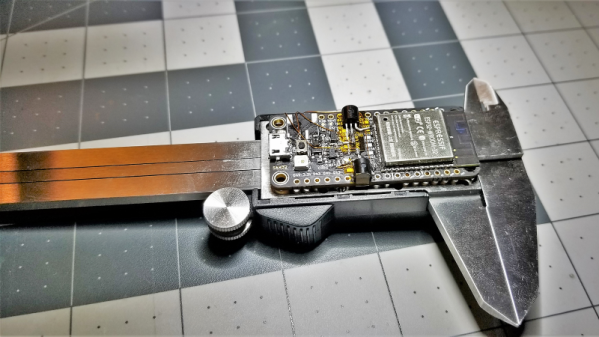
[Max] found that cheap Harbor Freight digital calipers have the telltale door that covers a serial connector, making them a perfect target for hacking. A little Internet sleuthing revealed the pinout for the connector as well as some details on the serial protocol used by most digital calipers: 24-bit packets is six four-bit words. [Max] used his SAM32, a neat open-source board with both a SAMD51 and an ESP32 that can run CircuitPython. An inverting buffer interfaces the serial lines to the board, which is just the right size to mount on the back of the caliper head. It’s hard to tell how [Max] is triggering readings, but the SAM32 is mounted as a USB device and sends keystrokes directly to a spreadsheet – yes, with the ESP32 it could have been wireless, but his client specifically requested a wired setup. Taking multiple readings is easy now that the user never has to swap calipers for a pen.

Cheap calipers like these are pretty hackable – you can add Bluetooth, turn them into DROs for a milling machine, or even make them talk.

Project Egress: [Fran] Makes A Latch

[Fran Blanche] is on the team of elite hackers that has been offered a chance to contribute to [Adam Savage]’s Project Egress, a celebration of the engineering that got humanity to the Moon 50 years ago this month. By the luck of the draw, she landed a great assignment: building a replica of one of the fifteen latches that kept the Apollo Command Module hatch dogged down against the vacuum of space, and she’s doing a great job documenting her build with some interesting videos.

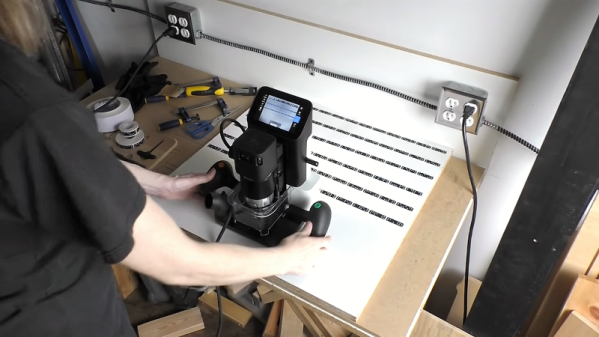
The first video below is mostly her talking through her design process, materials choices, and ideas about fabricating the somewhat intricate pieces of the latch. All 44 makers involved in the project get to choose what materials and methods they’ll use to make their parts, and [Fran] decided to use wood. Her first inclination was to use oak and brass, a nice combination with an 80s vibe, but in the second video, which covers more of the initial fabrication, she explains her switch to walnut. Unfortunately, the only CNC option she has is a Shaper Origin, which presents some difficulties; the handheld tool requires some complicated fixturing to safely machine the small parts needed, and its inability to read STL files means that [Fran] is stuck with a complicated software toolchain to drive the tool.

There are more videos to come as [Fran] gets further into the build, and we’re looking forward to seeing how her part and the rest of the makers’ builds come out.

Continue reading “Project Egress: [Fran] Makes A Latch”

Forty Four Hackers And A Hatch: Progress Egress Takes Off

The 50th anniversary of the first Moon landing is rapidly approaching, and uber space-nerd Adam Savage is in the thick of the celebration of all the amazing feats of engineering that made humanity’s first steps out of the cradle possible. And in a grand and very hacker-friendly style, we might add, as his Project Egress aims to build a full-scale replica of the Apollo 11 Command Module Columbia’s hatch.

Continue reading “Forty Four Hackers And A Hatch: Progress Egress Takes Off”

AI Recognizes And Locks Out Murder Cats

Anyone with a cat knows that the little purring ball of fluff in your lap is one tiny step away from turning into a bloodthirsty serial killer. Give kitty half a chance and something small and defenseless is going to meet a slow, painful end. And your little killer is as likely as not to show off its handiwork by bringing home its victim – “Look what I did for you, human! Are you not proud?”

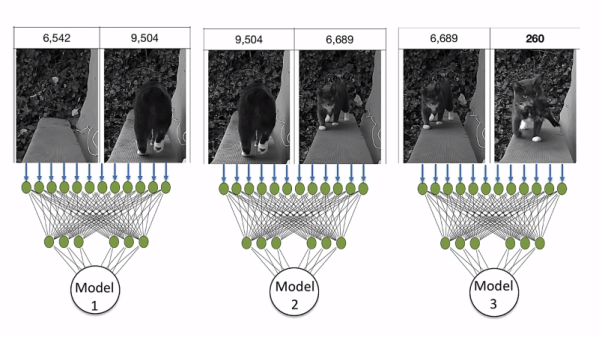
As useful as a murder-cat can be, dragging the bodies home for you to deal with can be – inconvenient. To thwart his adorable serial killer [Metric], Amazon engineer [Ben Hamm] turned to an AI system to lock his prey-laden cat out of the house. [Metric] comes and goes as he pleases through a cat flap, which thanks to a solenoid and an Arduino is now lockable. The decision to block entrance to [Metric] is based on an Amazon AWS DeepLens AI camera, which watches the approach to the cat flap. [Ben] trained three models: one to determine if [Metric] was in the scene, one to determine whether he’s coming or going, and one to see if he’s alone or accompanied by a lifeless friend, in which case he’s locked out for 15 minutes and an automatic donation is made to the Audubon Society – that last bit is pure genius. The video below is a brief but hilarious summary of the project for an audience in Seattle that really seems quite amused by the whole thing.

So your cat isn’t quite the murder fiend that [Metric] is? An RFID-based cat door might suit your needs better.

Continue reading “AI Recognizes And Locks Out Murder Cats”

Wire Bender Aims To Take Circuit Sculptures To The Next Level

It doesn’t seem as though bending wire would be much of a chore, but when you’re making art from your circuits, it can be everything. Just the right angle in just the right place can make the difference between a circuit sculpture that draws gasps and one that’s only “Meh.”

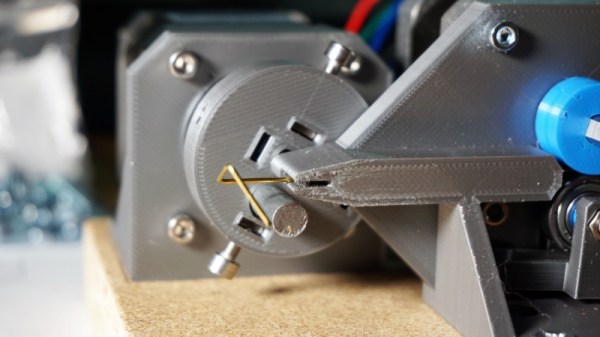
[Jiří Praus] creates circuit sculptures that are about as far away from the “Meh” end of the spectrum as possible. And to help him make them even more spectacular, he has started prototyping a wire-bending machine to add precision to his bends. There’s no build log at the moment, but the video below shows progress to date. All the parts are 3D-printed, with two NEMA 17 steppers taking care of both wire feed and moving the bending head. It appears that the head has multiple slots for tools of different shapes. For now, the wire is rotated around its long axis manually, but another stepper could be added to take care of that job.

[Jiří] tells us that while he loves making circuit sculptures like his amazing mechanical tulip, he hates repeating himself. He hopes this bender will make repeat jobs a little less tedious and a lot more precise, and we hope he goes forward with the build so we get to see both it and more of his wonderful works of circuit art.

Continue reading “Wire Bender Aims To Take Circuit Sculptures To The Next Level”

Logic And EEPROMs Bring VGA To Life, Sans Microcontroller

For whatever reason, the Video Graphics Array standard seems to attract a lot of hardware hacks. Most of them tend to center around tricking a microcontroller into generating the signals needed to send images to a VGA monitor. We love those hacks, but this one takes a different tack – a microcontroller-free VGA display that uses only simple logic chips and EEPROMs.

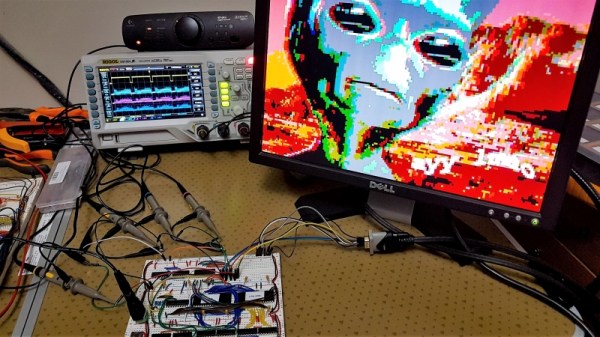
When we first spied this project, [PH4Nz] had not yet shared his schematics and code, but has since posted everything on GitHub. His original description was enough to whet our appetite, though. He starts with a 27.175-MHz clock and divides that by 4 with a 74HCT163, which has the effect of expanding the 160×240 pixels image stored in one of the EEPROMs to 640×480. Two 8-bit counters keep track of horizontal and vertical positions, while the other EEPROM takes care of generating the Hsync and Vsync signals. It’s all quite hackish, but it works. [PH4Nz] tells us that the whole thing is in support of a larger project: an 8-bit computer made from logic chips. We’re looking forward to seeing that one too.

This isn’t the first microcontroller-less VGA project we’ve seen, of course. Here’s a similar one also based on EEPROMs, and one with TTL logic chips. And we still love VGA on a microcontroller such as the ESP32; after all, there’s more than one way to hack.

Thanks to [John U] for the tip.