Countdown To The GPS Timepocalypse

There’s a bug about to hit older GPS hardware that has echos of Y2K. Those old enough to have experienced the transition from the 1990s to the 2000s will no doubt recall the dreaded “Year 2000 Bug” that was supposed to spell the doom of civilization. Thanks to short-sighted software engineering that only recorded two digits for year, we were told that date calculations would fail en masse in software that ran everything from the power grid to digital watches. Massive remediation efforts were undertaken, companies rehired programmers whose outdated skills were suddenly back in demand, and in the end, pretty much nothing actually happened.

Yet another epoch is upon us, far less well-known but potentially deeper and more insidious. On Saturday April 6, 2019 — that’s tomorrow — GPS receivers may suffer from software issues due to rollover of their time counters. This could result in anything from minor inconvenience to major confusion, with an outside chance of chaos. Some alarmists are even stating that they won’t fly this weekend, for fear of the consequences.

So what are the real potential consequences, and what’s the problem with GPS in the first place? Unsurprisingly, it all boils down to basic math.


Continue reading “Countdown To The GPS Timepocalypse”

But Can Your AI Recognize Slugs?

The common garden slug is a mystery. Observing these creatures as they slowly emerge from their slimy lairs each evening, it’s hard to imagine how much damage they can do. With paradoxical speed, they can mow down row after row of tender seedlings, leaving nothing but misery in their mucusy wake.

To combat this slug menace, [Tegwyn☠Twmffat] (the [☠] is silent) is developing this AI-powered slug busting system. The squeamish or those challenged by the ethics of slug eradication can relax: no slugs have been harmed yet. So far [Tegwyn] has concentrated on the detection of slugs, a considerably non-trivial problem since there are few AI models that are already trained for slugs.

So far, [Tegwyn] has acquired 5,712 images of slugs in their natural environment – no mean feat as they only come out at night, they blend into their background, and their slimy surface makes for challenging reflections. The video below shows moderate success of the trained model using a static image of a slug; it also gives a glimpse at the hardware used, which includes an Nvidia Jetson TX2. [Tegwyn] plans to capture even more images to refine the model and boost it up from the 50 to 60% confidence level to something that will allow for the remediation phase of the project, which apparently involves lasers. Although he’s willing to entertain other methods of disposal; perhaps a salt-shooting turret gun?

This isn’t the first garden-tending project [Tegwyn] has tackled. You may recall The Weedinator, his 2018 Hackaday Prize entry. This slug buster is one of his entries for the 2019 Hackaday Prize, which was just announced. We’re looking forward to seeing the onslaught of cool new projects everyone will be coming up with.

Continue reading “But Can Your AI Recognize Slugs?”

A 6502 Computer, With Acres Of Breadboard And Dozens Of Chips

Imagine you’re time-warped back to 1979 and tasked with constructing a personal computer. Could you do it? [RadicalBrad] thinks he can, and his 6502-based “Super VIC” build looks like it’s off to a great retrocomputing start.

Most emulations of old hardware these days go the FPGA route, and while we respect those projects immensely, there’s something to be said for applying a highly artificial constraint at the outset of a project. [RadicalBrad] chose to design like it’s 1979, and limited his ode to the machines of his youth to the 6502 CPU and logic and RAM chips available before 1980. The computer will support NTSC video output and 4-channels of 8-bit sound. No circuit boards will be used – everything is to be assembled on solderless breadboards. So far he has 48 (!) of them ganged together, which sounds like an enormous amount of space to work with, but he still found things crowded enough that some of the DIP bodies were trimmed a bit to fit more closely on the breadboards. The SRAM posed a problem, though, in that the 512K chips he wanted were not available in DIPs. To stay faithful to the constraints, he soldered the SOJ-packaged RAM chips into 40-PIN DIP headers – all 25 chips! We can’t recall a PC of the era sporting 12 megabytes of RAM, but no matter – it’s too cool not to love.

[RadicalBrad] has his work cut out for him, and this could take years to finish. We’re keen to follow his progress and can’t wait till it boots for the first time. Until it does, we’ll just gaze upon such discrete computing wonders as this almost-as-simple-as-possible computer, or even this delightfully noisy adder for a relay computer.

Solar Circuit Sculpture Pumms The Night Away

A word of warning: Google for the definition of the word “pummer” at your own risk. Rest assured that this beautiful solar-powered circuit sculpture fits the only definition of pummer that we care to deal with.

For the unfamiliar, a pummer is a device from the BEAM style of robotics, a sort of cyborg plant that absorbs solar energy during the day and turns it into a gently pulsating light that “pumms” away the dark hours.

[Mohit Bhoite]’s take on the pummer is an extraordinary model of a satellite executed mainly in brass rod. His attention to detail on the framework boggles our minds; we could work for days on a brass rod and never achieve the straight lines and perfect corners he did. The wings support two solar cells, while the hull of the satellite holds a dead-bugged 74HC240 octal buffer/line-driver chip and all the other pumm-enabling components. A one farad supercap – mounted to look like a dish antenna – is charged during the day and a single LED beacon blinks into the night.

No schematic is provided, but there are probably enough closeup shots to reverse engineer this, which actually sounds like a fun exercise. (Or you can cheat and fetch the PDF copy of the old Make magazine article that inspired him.)

Hats off to [Mohit] for a top-notch circuit sculpture. We’ve seen similarly detailed and well-executed sculptures from him before; something tells us this won’t be the last.

Thanks to [Varun Reddy] for the tip.

Nixie Power Supply Shows Ins And Out Of Offshore Manufacturing

[Tony] built a high-efficiency power supply for Nixie tube projects. But that’s not what this post is about, really.

As you read through [Tony]’s extremely detailed post on Hackaday.io, you’ll be reading through an object lesson in electronic design that covers the entire process, from the initial concept – a really nice, reliable 170 V power supply for Nixie tubes – right through to getting the board manufactured and setting up a Tindie store to sell them.

[Tony] saw the need for a solid, well-made high-voltage supply, so it delved into data sheets and found a design that would work – as he points out, no need to reinvent the wheel. He built and tested a prototype, made a few tweaks, then took PCBWay up on their offer to stuff 10 boards for a mere $88. There were some gotchas to work around, but he got enough units to test before deciding to ramp up to production.

Things got interesting there; ordering full reels of parts like flyback transformers turned out to be really important and not that easy, and the ongoing trade war between China and the US resulted in unexpected cost increases. But FedEx snafus notwithstanding, the process of getting a 200-unit production run built and shipped seemed remarkably easy. [Tony] even details his pricing and marketing strategy for the boards, which are available on Tindie and eBay.

We learned a ton from this project, not least being how hard it is for the little guy to make a buck in this space. And still, [Tony]’s excellent documentation makes the process seem approachable enough to be attractive, if only we had a decent idea for a widget.

A Word Clock, The Hard Way

We’ve all seen word clocks, and they’re great, but there are only so many ways to show the time in words. This word clock with 114 servos is the hard way to do it.

We’re not sure what [Moritz v. Sivers] was aiming for with this projection clock, but he certainly got it right. The basic idea is to project the characters needed to compose the time messages onto a translucent PVC screen, which could certainly have been accomplished with just a simple character mask and some LEDs. But for extra effect, [Moritz] mounted each character to a letterbox mounted over a Neopixel. The letterboxes are attached to a rack and pinion driven by a micro servo. The closer they get to the screen, the sharper the focus and the smaller the size of the character. Add in a little color changing and the time appears to float out from a jumbled, unfocused background. It’s quite eye-catching, and worth the 200+ hours of printing time it took to make all the parts. Complete build instructions are available, and a demo video is after the break.

We like pretty much any word clock – big, small, or even widescreen. This one really pushes all our buttons, though.

Continue reading “A Word Clock, The Hard Way”

Mains Power Supply For ATtiny Project Is Probably A Bad Idea

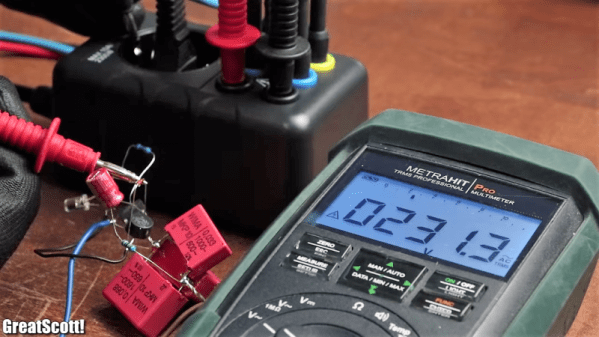
When designing a mains power supply for a small load DC circuit, there are plenty of considerations. Small size, efficiency, and cost of materials all spring to mind. Potential lethality seems like it would be a bad thing to design in, but that didn’t stop [Great Scott!] from exploring capacitive drop power supplies. You know, for science.

The backstory here is that [Great Scott!] is working on a super-secret ATtiny project that needs to be powered off mains. Switching power supplies are practically de rigueur for such applications, but compared to the intended microcontroller circuit they are actually quite large, and they’ve just been so done before. So in order to learn a thing or two, [Scott!] designed a capacitive dropper supply, where the reactance of the cap acts like a dropping resistor to limit the current. His first try was just a capacitor in series with an LED; this didn’t end well for the LED.

To understand why, he reverse-engineered a few low-current mains devices and found that practical capacitive droppers need a few more components, chiefly a series resistance to prevent inrush current from getting out of hand, but also a bridge rectifier and a zener to clamp things down. Wiring up all that resulted in a working capacitive dropper supply, but a the cost of as much real estate as a small switcher, and with the extra bonus of being potentially lethal if the power supply is plugged in the wrong way. Side note: we thought German line cords were polarized to prevent this, but apparently not? (Ed Note: Nope!)

As always, even when [Great Scott!]’s projects don’t exactly work out, like a suboptimal 3D-printed BLDC or why not to bother building your own DC-AC inverter, we enjoy the learning that results.

Continue reading “Mains Power Supply For ATtiny Project Is Probably A Bad Idea”