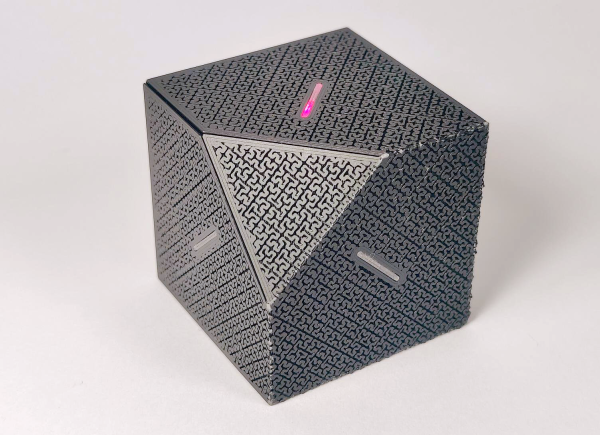
A desktop Borg cube. Just kidding, it's a buttonless, cube-shaped timer with a really neat 3D-printed enclosure.

FlipBuddy Is Borg, You Will Be Assimilated

When you think about it, time is all we’ve really got. Where to go from there is ultimately up to you. Maybe you use an app to track every task, or just go with the onboard timer. But that can be a lot of steps to begin with, and then the phone screen goes dark again. For some people, the whole out of sight, out of mind thing will kick in. At worst, you get distracted, start doing something else, and then feel guilty and frustrated when the timer starts going off.
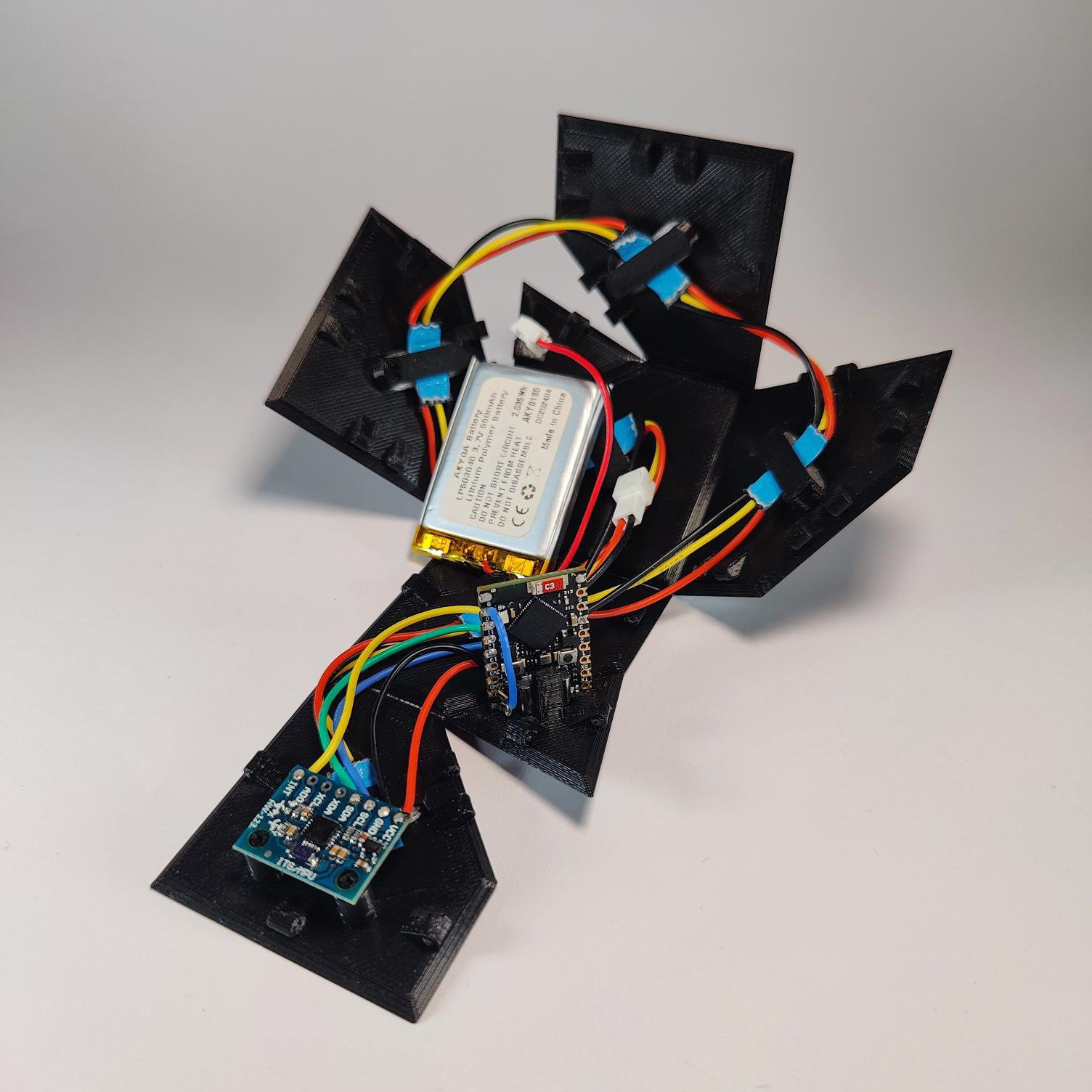
The guts of FlipBuddy inside the unfurled enclosure.But there’s hope for us visual simpletons, and the purveyor of that hope is [Edris] of Ponderly Robotics. You see, [Edris] created an extremely easy-to-use timer that looks like something you’d find on Captain Picard’s desk as a token of defeating the Borg. But the affably-named FlipBuddy is far more useful than that description implies.

[Edris] uses the open-source FlipBuddy every day, and swears by its simplicity. The point is accessibility, and respect for privacy. That said, there’s a companion app to provide insight.

Basically, you assign a task to each cube face. Choose one, and place the cube with that side facing up. FlipBuddy wakes up, connects to WiFi, and then pushes your session to the cloud, bypassing the need for your phone.

Time to switch tasks? Just put the new side face up. When you’re done for the day, use the stop face, which we’re hoping means to set it on the knocked-off corner.

You don’t need much to make FlipBuddy come to life. [Edris] used an ESP32 (an S3 SuperMini or similar will work), an MPU6050, six WS2812B LEDs, and a 3.7 V Li-Po cell. The beautiful, 3D printed origami mesh enclosure prints as a single, flat piece, and you get to fold it up around the internals and make your new buddy come to life.

Part of the point of FlipBuddy is that it can become as intuitive as punching a chess clock. So if it’s buttons you’re after, check out this simple Pomodoro timer.
Wrist Welcomes Wii Nunchuk As Gloriously Ergonomic Macropad

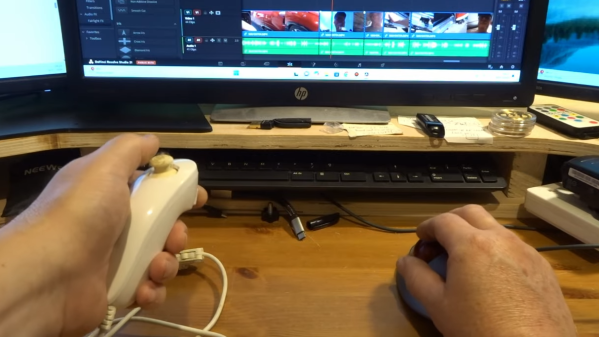
[John Dingley] spends a lot of time editing videos, and as many of us know, when it comes to repetitive tasks the more ergonomic the better.

Keyboard shortcuts exist for common video editing functions, but [John] found that the vast majority of his work needed only three or four of them. Feeling he could do better than a three-key macropad, he turned to what’s perhaps one of the most ergonomic devices ever designed — the Wii Nunchuk.

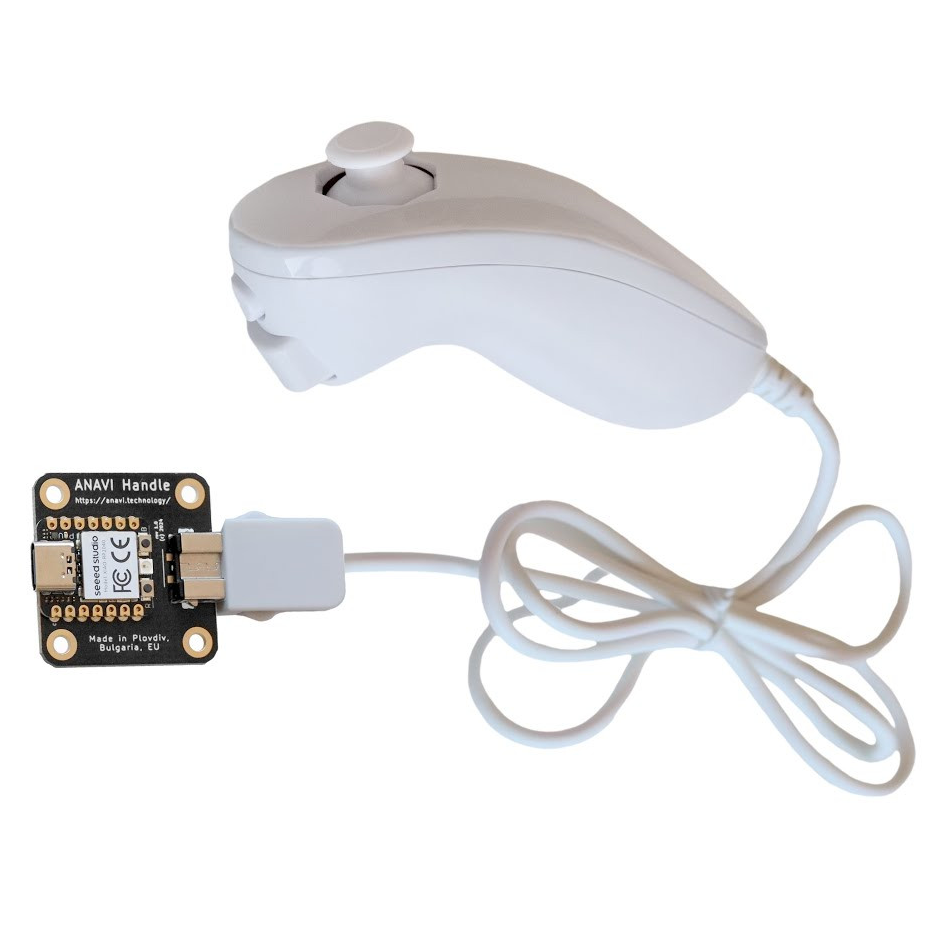
A Wii Nunchuk is an I2C device, so there needs to be some intermediary device involved if you want to plug it into a computer. [John] solves that with the ANAVI Handle, an open source adapter to make a Nunchuk act like a USB Human Interface Device (HID). That addresses the connectivity problem, but the default firmware on the adapter only treats the Nunchuk as a mouse or joystick, so a few more changes are required before it can be pressed into service as an ultra-comfortable macropad.

The ANAVI Handle runs CircuitPython code on an RP2040, and modifying its behavior is as simple as plugging it in via USB and editing the code right on the device. One has to define some keyboard events, configure the device to act as a keyboard, and send the right events when the buttons or joystick get pushed. [John] provides the code, and walks through the changes on video so even those without any coding experience can get it done.

The Nunchuk design is still being sold and used today, and it’s shown up in all kinds of places. We’ve seen a Bluetooth-enabled one and even seen a Raspberry Pi Zero shoehorned into one, complete with HDMI output.

Continue reading “Wrist Welcomes Wii Nunchuk As Gloriously Ergonomic Macropad”

A 3D Printed Cycloidal Gearbox

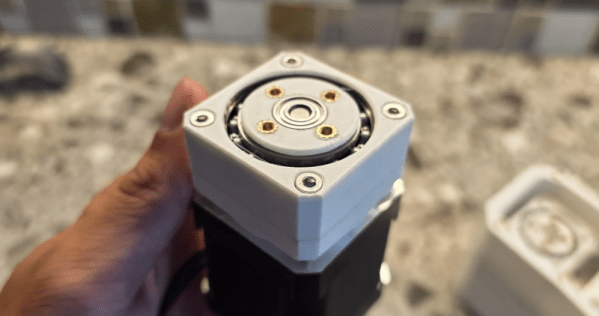
Stepper motors are undeniably useful, but sometimes they need a bit of gearing to help perform their task. [Gjhudson2008] has a compact gearbox for NEMA 17 or 23 steppers that is mostly 3D printed. How compact? The gearbox, named VANTIX, is exactly the height of a standard NEMA 17 axle.

However, for it to be that thin, your stepper has to have the D-bore on the shaft go all the way down. Some steppers leave a shank uncut at the base, and that won’t work for VANTIX.

The recommendation is to print in ABS with a 0.2 mm nozzle for certain parts to help improve tolerance. Most of the assembly is either press fit or installed during the printing process. Some parts of the gearbox are better to print with a larger nozzle, too.

There are some heat-set inserts and, of course, you’ll need lube to keep everything moving smoothly. There are a few top plates you can print to fit various mounting scenarios.

We have seen a number of similar designs. We’ve also looked at some e-bike-inspired drives.

NASA’s Just Prolonged Voyager 2’s Science Mission With A Big Bang

Letting go is hard, especially when it concerns an irreplaceable space probe like the two Voyagers. Fortunately JPL engineers have managed to pull off a ‘big bang’ switch on Voyager 2, involving two heaters and another device that was kept on to keep providing sufficient heat to the spacecraft to allow it to keep functioning. After all, while the vacuum of space isn’t cold, out in deep space you’re radiating away all your precious heat.

Unfortunately the official press release is exceedingly limited in details, but The Register was kind enough to nag a NASA spokesperson about it, and gave us some technical details. The short version is that these heaters don’t just keep the electronics within a happy operating range, they also keep the fuel lines warm and capable of providing fuel for attitude adjustments.

With this switch, apparently enough of the rapidly diminishing power from the RTG has been freed up that the Voyager 2 has just gained a whole extra year on its extended mission. The JPL team hopes to perform the same switch on the Voyager 1 spacecraft soon, giving it a similar boost to its expected lifespan, before both of them go quiet in the depths of space.

Thanks to [Mark Stevens] for the tip.

Rubidium Frequency Standard Explained

You’ve probably heard of rubidium frequency standards, which are used where you need an extremely accurate time or frequency reference. [IMSAI] guy has a good explainer video about what’s actually going on inside one of these standards. Much of the basic idea also applies to cesium standards.

The explainer starts with the periodic table. Rubidium and cesium are both alkali metals, with a single electron in their outermost electron shell. Rubidium has 37 electrons, with the outermost one relatively loosely bound. Naturally occurring rubidium consists mainly of two isotopes, rubidium-85 and rubidium-87, which have the same number of protons and electrons but different numbers of neutrons.

A rubidium standard typically has three gas cells that have a bit of rubidium in them. An RF-excited rubidium-87 discharge lamp produces light at very specific wavelengths. The RF energy excites rubidium atoms into higher electronic states, and when their electrons fall back to lower-energy states, the atoms emit photons.

That light passes through a filter cell containing rubidium-85. The filter preferentially absorbs part of the lamp’s spectrum, leaving light that optically pumps the rubidium-87 atoms in the second resonance cell into one of two closely spaced hyperfine states of the atom’s ground state.

Those two states differ because of the interaction between the magnetic moment of the outer electron and that of the rubidium-87 nucleus. Their energy separation corresponds to a microwave frequency of about 6.835 GHz.

The resonance cell is illuminated by the filtered light while also being exposed to microwave energy from a local oscillator. When the microwave frequency is exactly equal to the rubidium-87 hyperfine transition frequency, it transfers atoms between the two ground-state hyperfine levels. That changes how strongly the cell absorbs the optical pumping light, producing a detectable dip in the light reaching a photodetector.

Electronics then servo the microwave oscillator onto the center of that absorption dip, using a feedback technique somewhat analogous to a phase-locked loop. Once locked, the oscillator is effectively referenced to an atomic transition rather than to the dimensions or mechanical properties of a crystal, giving you an extremely stable frequency standard.

Continue reading “Rubidium Frequency Standard Explained”

Phantomdrive Keeps Your Secrets Out Of Sight

It’s a complex world out there, and more than ever folks may find themselves in a situation where they want to keep particular bits of information away from prying eyes. At the same time, overly complex methods of file security can make it difficult to share said information with the intended recipients impractical. So what’s the solution?

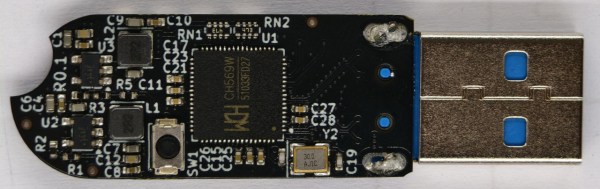
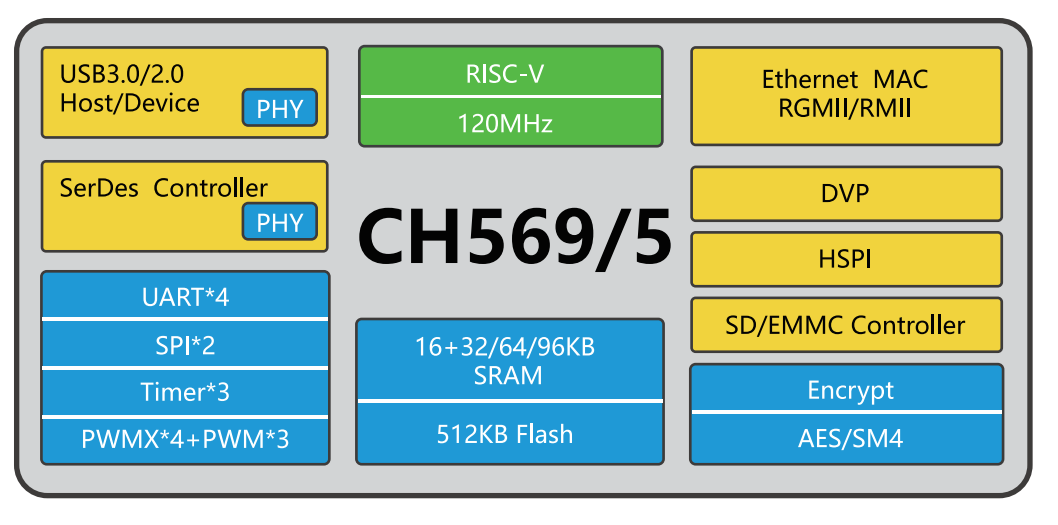
One proposal from [Ryan Walker] AKA [machinehum] is the Phantomdrive — a fully open source USB flash drive that features a secret secondary filesystem. Not only is the existence of this data hidden from the operating system under normal circumstances, but it’s encrypted with AES-256. Rather than relying on software running on the computer to handle the decryption, the CH569 chip that powers the drive does it internally.

To complete this platform-agnostic approach, [machinehum] had to come up with a way for the user to unlock the secure storage that didn’t require running any code on the client machine. A hardware solution such as a keypad is the obvious answer, but in this case, was out of the question as it would immediately tip off an observer about the drive’s true nature. A covert storage device needs a similarly inconspicuous method of authentication.

That’s why the firmware on the Phantomdrive keeps an eye on all the write operations to the unsecured section of the drive looking for the string password:. Once it sees that, it treats whatever follows as the decryption key. If it’s correct, the previously inaccessible data will appear to the operating system as a new drive.

[machinehum] cautions that none of this has been professionally audited from a security standpoint, and that you should treat this whole concept as an experiment. In other words, it’s probably more than sufficient for the average person, but no guarantees on how long it would last should a three letter agency gets too interested in what you’re up to.

If this seems a bit familiar, it’s because the Phantomdrive follows up [machinehum]’s self-destructing USB flash drive from a few years back. The concept is essentially the same, except this time there’s no Magic Smoke getting released.

Continue reading “Phantomdrive Keeps Your Secrets Out Of Sight”

CNC’d, CNC-inspired Adjustable Wrench Won’t Round Your Bolts

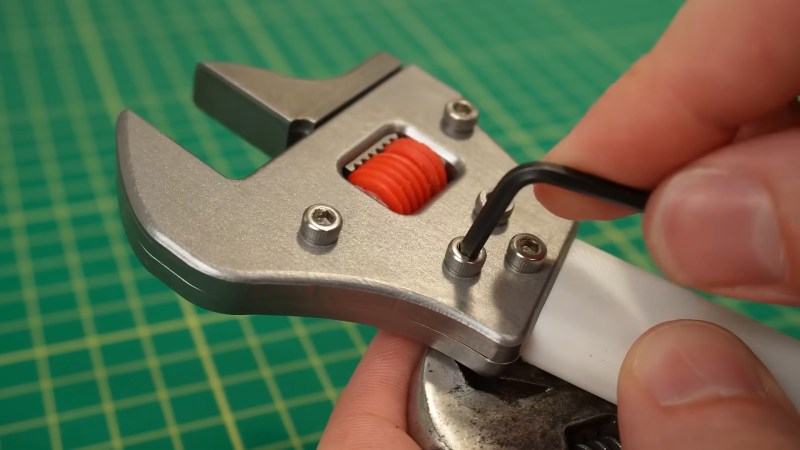
We’ve probably all got one item in our toolboxes or chests that we really, really don’t like, but find too handy to toss. For [Someone Should Make That], that item was the bolt-rounding adjustable wrench. Rather than continuing to gripe about it, or alter his habits to make greater use of the full wrench set he also owns, he decided to build a better mousetrap. By mousetrap, we mean adjustable wrench.

It took a couple of iterations on-screen before he hits on a solution that seems to work quite well indeed. The problem [Someone] had with his adjustable wrench was one of physical slop: once adjusted, there’s just too much play in the mechanism, which results in rounded-off bolt heads. [Someone]’s CNC’d solution takes inspiration from the CNC machine that manufactures it: he’s using spring-loading in the adjustment screw akin to what you find in the anti-backlash nut on your CNC mill or 3D printer’s ball threads. The tension from the springs keeps the wrench tight to the bolt, and that keeps [Someone] from rounding them off. Speaking of 3D printers, he prototyped in plastic before machining, and the screw in the end product stayed that way. It would be interesting to see how well that holds up.

Not only do we appreciate that it’s solved a common problem many of us have, the ethos of “this angers me, so I shall hack it” is one we support 100%, so do give a watch unless you’re one of those people who absolutely can’t stand videos, even when they’re spring-loaded to have no slop. There’s some good tips for beginner CNC operators in there, too.

This isn’t the first time someone’s tried to reinvent this particular wheel, though the last version we liked was a ratchet.

Continue reading “CNC’d, CNC-inspired Adjustable Wrench Won’t Round Your Bolts”