The Secret Of Twinkling Christmas Lights

With the holidays over, many of us are braving the elements to take down all those holiday lights. LED lights have largely taken over the market, but in some places, you can still get classic incandescent bulbs. There are some effects that LEDs can’t quite mimic yet. One of those is the magic of “twinkling” light sets, which [Alec Watson] explains in a Technology Connections video. Everyone has seen bulbs that flash, and strings that dim. But the twinkle effect until recently has been hard to describe.

Typical flashing bulbs use a bimetallic strip. As the filament of the bulb heats up, the strip bends, opening the circuit. Then the strip cools and closes the circuit again. Twinkling lights do exactly the opposite. The bimetallic strip shorts the bulb out rather than open the circuit. Twinkling sets also use a lot of bimetallic strip bulbs – typically every fifth bulb has a strip. The result of the bulbs being shorted out is that all be the bulbs in set see a higher voltage. This makes the entire strip shimmer in time with the flashing. That’s where the twinkling magic comes from.

It occurs to us that the voltage on the strip would be a great source of random seeds. Sure, you’d have to replace bulbs now and again, but how many people can say they get their random numbers from a set of Christmas lights?

If you’re curious how incandescent Christmas lights can blow and not take out the whole strip, check out this article about anti-fuses.

Continue reading “The Secret Of Twinkling Christmas Lights”

Tearing Down A Darkroom Relic For Buried Treasure

If your goal is to harvest unique parts from defunct devices, the further back in time you go, the better the pickings stand to be. At least that’s what [Kerry Wong] discovered during his tear-down of a darkroom color analyzer from the early 1980s.

For readers whose experience with photography has been solely digital, you need to understand that there once was a time when images were made with real cameras on real film, and serious amateurs and pros had darkrooms to process the film. Black and white processing was pretty straightforward in terms of chemistry — it was just developer, stop, and fixing. Color processes were much trickier, and when it came to enlarging your film onto color photo paper, things could get really complicated. [Kerry]’s eBay find, a Besler PM1A color analyzer, was intended to help out in the color lab by balancing the mix of cyan, blue, and yellow components in the enlarger.

The instrument, which no doubt demanded a princely sum back in the day, is actually really simple, with the object of [Kerry]’s desire, a PM1A photomultiplier tube and its driver, being the only real find.  Still, it’s an interesting teardown, and we’re eager to see what [Kerry] makes of the gem. A muon detector, perhaps? An X-ray backscatter machine? Or perhaps repeating his old speed of light experiments is on the docket.

Continue reading “Tearing Down A Darkroom Relic For Buried Treasure”

Power Your Guitar Pedals With Drill Batteries

Guitar pedals are a great way to experiment with the sound of your instrument. However, they require electricity, and when you’re using more than a couple, it can get messy. Some will run on batteries, while others are thirstier for more current and will only work with a plugback. There are a great many solutions out there, but most people with more than a few pedals to power will end up going to some kind of mains powered solution. [Don] is here to show us that it’s not the only way.

Mains power is great for some things, but where pedals are concerned, it’s not always perfect. There are issues with noise, both from cheap power supplies and poorly designed pedals, and it means you’re always hunting for a power socket, which is limiting for buskers.

[Don] realised that the common drill battery is a compact source of clean, DC power, and decided to use that to power his rig. By slapping together a drill battery with a pre-assembled buck converter and a 3D printed adapter, he was able to build a portable power supply for his pedals. Thanks to the fact that the vast majority of pedals use 9V DC with the same input jack design, it’s a cinch to wire up. With an appropriately sized buck converter, a drill battery could supply even a hefty pedalboard for a significant period of time.

Overall, it’s a great hack that solves a problem faced by many performing musicians. We’ve seen our fair share of guitar pedals around Hackaday – perhaps you’d like to see how one makes it from concept to production?

Continue reading “Power Your Guitar Pedals With Drill Batteries”

TRS-80 Model 100 Goes Cellular

There are a few old products that have rabid fan bases, and the TRS-80 Model 100 is one of those. Depending on your point of view it’s either a small laptop or a large organizer, but in 1983 it was the ultimate computer on the go. The $1100 version had a whopping 8K of memory and the LCD screen showed 8 lines of 40 characters in glorious monochrome. One cool feature was the built-in 300 baud phone modem, which [Trammell Hudson] wanted to try, but he doesn’t have a landline. He tried a VOiP phone, but it wouldn’t wedge into the acoustic couplers well enough. Then he decided to go cellular.

He had already hooked up an old ITT 500 series dial phone to an Adafruit Fona ceullar board. He even has Teensy software to decode the dial, drive the dial tone and otherwise make the phone work. This time he hooked a handset up through a headset jack.

Continue reading “TRS-80 Model 100 Goes Cellular”

Vectrex, Finally In Color

The Vectrex is everybody’s favourite vector-based console from the early 1980s. Vector graphics really didn’t catch on in the videogame market, but the Vectrex has, nonetheless held on to a diehard contingent of fans that continue to tinker with the platform to this day. [Arcade Jason] just so happens to be leading the pack right now.

The Vectrex has always been a monochrome machine, capable of only displaying white lines on its vector monitor. Color was provided by plastic overlays that were stuck to the screen, however this was never considered a particularly mindblowing addition to the console. [Jason] decided he could do better, and dug deep into his collection of vector monitors.

With a 36″ color vector monitor to hand, the Vectrex was laid out on the bench, ready for hacking. The bus heading to one of the DACs was hijacked, and fed through a series of OR and AND logic to generate color signals, since the original Vectrex hardware had no way of doing so. This is then fed to the color monitor, with amazing results.

[Jason]’s setup is capable of generating 8 colors on the screen, and it’s almost by some weird coincidence that this really does make the classic Vectrex games pop in a way they never have before. It’s also a testament to a simpler time that it’s possible to hack this console’s video signals on a breadboard; modern hardware runs much too fast to get away with such hijinx.

It’s an epic hack that through experimentation and some serendipity, has turned out some exciting results. [Jason] is now in the process of taking this to the next level, experimenting with adding color intensity control and other features to the mix.

It’s not [Jason]’s first time around these parts, either – we saw his big-screen Vectrex just a month ago!

[Thanks to Morris for the tip!]

Continue reading “Vectrex, Finally In Color”

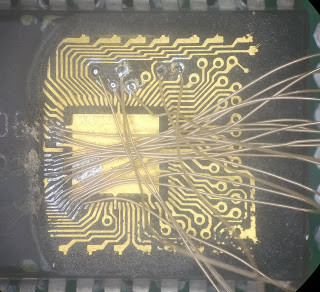
Tips On Building The BlackIce BBC Micro

You can look at pictures and video of the Grand Canyon, Paris, New York City or anywhere else, and yet when you finally see those places with your own eyes it is somehow different. Fielding an old computer like the BBC Micro on an FPGA has been done before. But there’s always something to learn when you do it yourself. [Machina] took a BlackIce board and made a BBC Micro replica, but he learned a few things along the way and decided to share them for our benefit.

He used the BlackIce board with [Dave’s] BBC Micro implementation that we’ve covered before. [Machina] was impressed that the board takes PMOD plug ins, so it was easy — almost — to add a VGA and keyboard port. Although both gave him some unexpected problems.

Continue reading “Tips On Building The BlackIce BBC Micro”

Why Sony’s Trinitron Tubes Were The Best

If you’re old enough to remember Cathode Ray Tube (CRT) Televisions, you probably remember that Sony sold the top products. Their Trinitron tubes always made the best TVs and Computer Monitors. [Alec Watson] dives into the history of the Sony Trinitron tube.

Sony Color TVs didn’t start with Trinitron — for several years, Sony sold Chromatron tubes. Chromatron tubes used individually charged wires placed just behind the phosphor screen. The tubes worked, but they were expensive and didn’t offer any advantage over common shadow mask tubes. It was clear the company had to innovate, and thanks to some creative engineering, the Trinitron was born.

Closeup of a Trinitron tube shows unbroken vertical stripes which led to a brighter picture.

All color TV’s shoot three electron guns at a phosphor screen. Typical color TVs use a shadow mask — a metal sheet with tiny holes cut out. The holes ensure that the electron guns hit only the red, green and blue dots of phosphor. Trinitrons use vertical bars of single phosphor color and a picket fence like aperture grille. The aperture grill blocks less of the electron beam than a shadow mask, which results in a much brighter image. Trinitrons also use a single electron gun, with three separate cathodes.

[Alec] is doing some amazing work describing early TV systems and retro consumer electronics over on his YouTube channel, Technology Connections. We’ve added him to our Must watch subscription list.

Interested in retro CRTs? Check out Dan’s article on cleaning up the fogged plastic safety screen on the front of many CRTs.

Continue reading “Why Sony’s Trinitron Tubes Were The Best”