Electronics Manufacturers React To China Trade Tariffs

Mere weeks ago, the United States announced it was set to impose a 25% tariff on over 800 categories of Chinese goods. These tariffs include nearly every component that goes into the manufacture of any piece of electronic hardware, from resistors to capacitors, semiconductors to microcontrollers, and even the raw components that are turned into printed circuit boards. These tariffs will increase the cost of materials for electronics, even if those electronics are ultimately manufactured in the United States because suppliers and subcontractors must source their materials from somewhere, and more often than not, that place is China.

Now, manufacturers are feeling the pinch. An email distributed by Moog Music last Friday has asked their supporters to contact their senators and representatives.

In the world of musical synthesizers, there is no bigger name than Moog. The company was founded in the 1950s manufacturing theremins, and in the 1960s, production moved to synthesizers. The famous Minimoog, launched in 1970, has been featured on tens of thousands of albums. Modern music simply wouldn’t exist without Moog synthesizers. After a buyout, mismanagement, and bankruptcy in the 1980s, the company was reborn in the early 2000s, moved into a beautiful factory in Asheville, North Carolina, and has gone on to produce some of the most popular synthesizers ever made.

The company’s statement says these new tariffs will, ‘immediately and drastically increase the cost of building our instruments, and have the very real potential of forcing us to lay off workers and could.. require us to move some, if not all, of our manufacturing overseas’. In a statement on Twitter, Moog says they source half their PCBs and a majority of other materials domestically, already paying up to 30% more than if the PCBs were sourced from China. However, because the raw materials for PCB manufacture are also sourced from China, board manufacturers for Moog’s synths will be forced to pass along the 25% tariff to their customers.

The threat of Moog being forced to move production of their instruments to China is real. Like cell phones, laptops, and other finished goods, synthesizers are not covered by the new tariff. As noted by Bunnie Huang, these tariffs have the perverse incentive of shifting US manufacturing jobs to China.

These tariffs have been a point of contention for the electronics and engineering communities. Anyone can easily pull up the distributor information from a Mouser or Digikey order and find the country of origin for an entire Bill of Materials. It has already been confirmed that most of the FR4 and other raw components that go into manufacturing PCBs in the United States come from Chinese suppliers. These items can be cross-referenced with the list of items that will be subject to a 25% tariff next week. Manufacturing electronics in the United States, even if you get your PCBs from US manufacturers and parts from US suppliers, will cost more in just a few short days.

Coolest Way To Watch 3D Printing: Lights, Camera, Octolapse!

Octoprint is a household name for anyone into 3D printing and anyone regularly reading Hackaday. Described by creator Gina Häußge as “the snappy web interface for your 3D printer”, Octoprint allows you to control effectively any desktop 3D printer over the local network or Internet. It even has webcam support so you can watch your printer while it works, meaning you can finally put that video baby monitor back into the crib with Junior.

While the core functionality of Octoprint is fantastic alone, its true power is unlocked through the plugin system and the community that’s sprung up around it. With plugins, Octoprint can do everything from control RGB light strips in your printer’s enclosure to sending status messages via Discord. One particularly popular plugin that has been making the rounds lately is Octolapse by [FormerLurker]. This plugin provides a comprehensive intelligent system for creating time-lapse videos of prints.

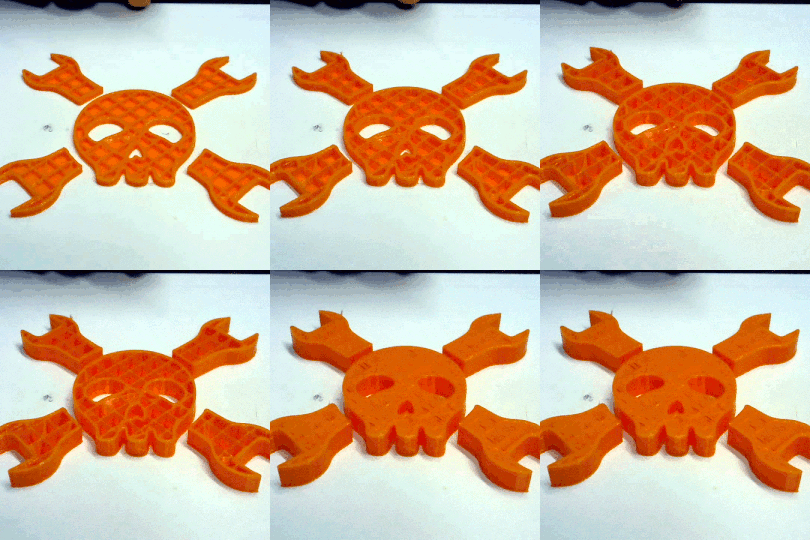
What does that mean? Well, instead of simply taking a picture every few seconds like you’d do traditionally, Octolapse actually keeps track of the printer’s motions while its running. It can then take a picture at the opportune moment to create a number of user-selected effects. More importantly, it can even take control of the printer directly; moving the hotend away from the print before taking a picture. The effect is that the print simply “grows” out of the bed.

I thought it would be interesting to take a closer look at Octolapse and see just what it takes to create one of those awesome time-lapse videos. It turned out to be somewhat trickier than I anticipated, but the end results are so fantastic I’d say it’s a technique worth mastering.

Continue reading “Coolest Way To Watch 3D Printing: Lights, Camera, Octolapse!”

How Etak Paved The Way To Personal Navigation

Our recent “Retrotechtacular” feature on an early 1970s dead-reckoning car navigation system stirred a memory of another pre-GPS solution for the question that had vexed the motoring public on road trips into unfamiliar areas for decades: “Where the heck are we?” In an age when the tattered remains of long-outdated paper roadmaps were often the best navigational aid a driver had, the dream of an in-dash scrolling map seemed like something Q would build for James Bond to destroy.

And yet, in the mid-1980s, just such a device was designed and made available to the public. Dubbed Etak, the system was simultaneously far ahead of its time and doomed to failure by the constellation of global positioning satellites being assembled overhead as it was being rolled out. Given the constraints it was operating under, Etak worked very well, and even managed to introduce some of the features of modern GPS that we take for granted, such as searching for services and businesses. Here’s a little bit about how the system came to be and how it worked.

Continue reading “How Etak Paved The Way To Personal Navigation”

Linux Fu: Scripting For Binary Files

If you ever need to write a binary file from a traditional language like C, it isn’t all that hard to do. About the worst thing you might have to deal with is attempts to fake line endings across Windows and Linux, but there’s usually a way to turn that off if it is on by default. However, if you are using some type of scripting language, binary file support might be a bit more difficult. One answer is to use a tool like xxd or t2b (text-to-binary) to handle the details. You can find the code for t2b on GitHub including prebuilt binaries for many platforms. You should be able to install xxd from your system repository.

These tools take very different approaches. You might be familiar with tools like od or hexdump for producing readable representations of binary files. The xxd tool can actually do the same thing — although it is not as flexible. What xxd can even reverse itself so that it can rebuild a binary file from a hex dump it creates (something other tools can’t do). The t2b tool takes a much different approach. You issue commands to it that causes it to write an original hex file.

Both of these approaches have some merit. If you are editing a binary file in a scripting language, xxd makes perfect sense. You can convert the file to text, process it, and then roll it back to binary using one program. On the other hand, if you are creating a binary file from scratch, the t2b program has some advantages, too.

I decided to write a few test scripts using bash to show how it all works. These aren’t production scripts so they won’t be as hardened as they could be, but there is no reason they couldn’t be made as robust as you were willing to make them.

Continue reading “Linux Fu: Scripting For Binary Files”

Move Aside Mercury: Measuring Temperature Accurately With An RTD

Temperature is one of the most frequently measured physical quantities, and features prominently in many of our projects, from weather stations to 3D printers. Most commonly we’ll see thermistors, thermocouples, infrared sensors, or a dedicated IC used to measure temperature. It’s even possible to use only an ordinary diode, leading to some interesting techniques.

Often we only need to know the temperature within a degree Celsius or two, and any of these tools are fine. Until fairly recently, when we needed to know the temperature precisely, reliably, and over a wide range we used mercury thermometers. The devices themselves were marvels of instrumentation, but mercury is a hazardous substance, and since 2011 NIST will no longer calibrate mercury thermometers.

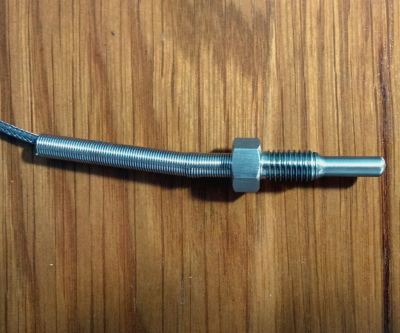
A typical Pt100 RTD probe

Luckily, resistance temperature detectors (RTDs) are an excellent alternative. These usually consist of very thin wires of pure platinum, and are identified by their resistance at 0 °C. For example, a Pt100 RTD has a resistance of 100 Ω at 0 °C.

An accuracy of +/- 0.15 °C at 0 °C is typical, but accuracies down to +/- 0.03 °C are available. The functional temperature range is typically quite high, with -70 °C to 200 °C being common, with some specialized probes working well over 900 °C.

It’s not uncommon for the lead wires on these probes to be a meter or more in length, and this can be a significant source of error. To account for this, you will see that RTD probes are sold in two, three, and four wire configurations. Two-wire configurations do not account for lead wire resistance, three-wire probes account for lead resistance but assume all lead wires have the same resistance, and four-wire configurations are most effective at eliminating this error.

In this article we’ll be using a 3-wire probe as it’s a good balance between cost, space, and accuracy. I found this detailed treatment of the differences between probe types useful in making this decision.

Continue reading “Move Aside Mercury: Measuring Temperature Accurately With An RTD”

Keep It Close: A Private Git Server Crash Course

At this point, everyone has already heard that Microsoft is buying GitHub. Acquisitions of this scale take time, but most expect everything to be official by 2019. The general opinion online seems to be one of unease, and rightfully so. Even if we ignore Microsoft’s history of shady practices, there’s always an element of unease when somebody new takes over something you love. Sometimes it ends up being beneficial, the beginning of a new and better era. But sometimes…

Let’s not dwell on what might become of GitHub. While GitHub is the most popular web-based interface for Git, it’s not the only one. For example GitLab, a fully open source competitor to GitHub, is reporting record numbers of new repositories being created after word of the Microsoft buyout was confirmed. But even GitLab, while certainly worth checking out in these uncertain times, might be more than you strictly need.

Let’s be realistic. Most of the software projects hackers work on don’t need even half the features that GitHub/GitLab offer. Whether you’ve simply got a private project you want to maintain revisions of, or you’re working with a small group collaboratively in a hackerspace setting, you don’t need anything that isn’t already provided by the core Git software.

Let’s take a look at how quickly and easily you can setup a private Git server for you and your colleagues without having to worry about Microsoft (or anyone else) having their fingers around your code.

Continue reading “Keep It Close: A Private Git Server Crash Course”

Hackers Want Cambridge Dictionary To Change Their Definition

Maybe it’s the silly season of high summer, or maybe a PR bunny at a cybersecurity company has simply hit the jackpot with a story syndicated by the Press Association, but the non-tech media has been earnestly talking about a call upon the Cambridge Dictionary to remove the word “illegal” from their definition of “Hacker”. The weighty tome from the famous British university lists the word as either “a person who is skilled in the use of computer systems, often one who illegally obtains access to private computer systems:” in its learners dictionary, or as “someone who illegally uses a computer to access information stored on another computer system or to spread a computer virus” in its academic dictionary. The cybersecurity company in question argues that hackers in fact do a lot of the work that improves cybersecurity and are thus all-round Good Eggs, and not those nasty computer crooks we hear so much about in the papers.

We’re right behind them on the point about illegality, because while there are those who adopt the hacker sobriquet that wear hats of all colours including black, for us being a hacker is about having the curiosity to tinker with anything presented to us, whatever it is. It’s a word that originated among railway modelers (Internet Archived version), hardly a community that’s known for its criminal tendencies!

Popular Usage Informs Definition

It is however futile to attempt to influence a dictionary in this way. There are two types of lexicography: Prescriptive and Descriptive. With prescriptive lexicography, the dictionary instructs what something must mean or how it should be spelled, while descriptive lexicography tells you how something is used in the real world based on extensive usage research. Thus venerable lexicographers such as Samuel Johnson or Noah Webster told you a particular way to use your English, while their modern equivalents lead you towards current usage with plenty of examples.

It’s something that can cause significant discontent among some dictionary users as we can see from our consternation over the word “hacker”. The administration team at all dictionaries will be familiar with the constant stream of letters of complaint from people outraged that their pet piece of language is not reflected in the volume they regard as an authority. But while modern lexicographers admit that they sometimes walk in an uneasy balance between the two approaches, they are at heart scientists with a rigorous approach to evidence-based research, and are very proud of their efforts.

Big Data Makes for Big Dictionaries

Lexicographic research comes from huge corpora, databases of tens or hundreds of millions of words of written English, from which they can extract the subtlest of language trends to see where a word is going. These can be interesting and engrossing tools for anyone, not just linguists, so we’d urge you to have a go for yourself.

Sadly for us the corpus evidence shows the definition for “Hacker” has very firmly trended toward the tabloid newspaper meaning that associates cybercriminality. All we can do is subvert that trend by doing our best to own the word as we would prefer it to be used, re-appropriating it. At least the other weighty tome from a well-known British university has a secondary sense that we do agree with: An enthusiastic and skilful computer programmer or user“.

Disclosure: Jenny List used to work in the dictionary business.