Measuring Parts Badly For Accurate Reverse Engineering

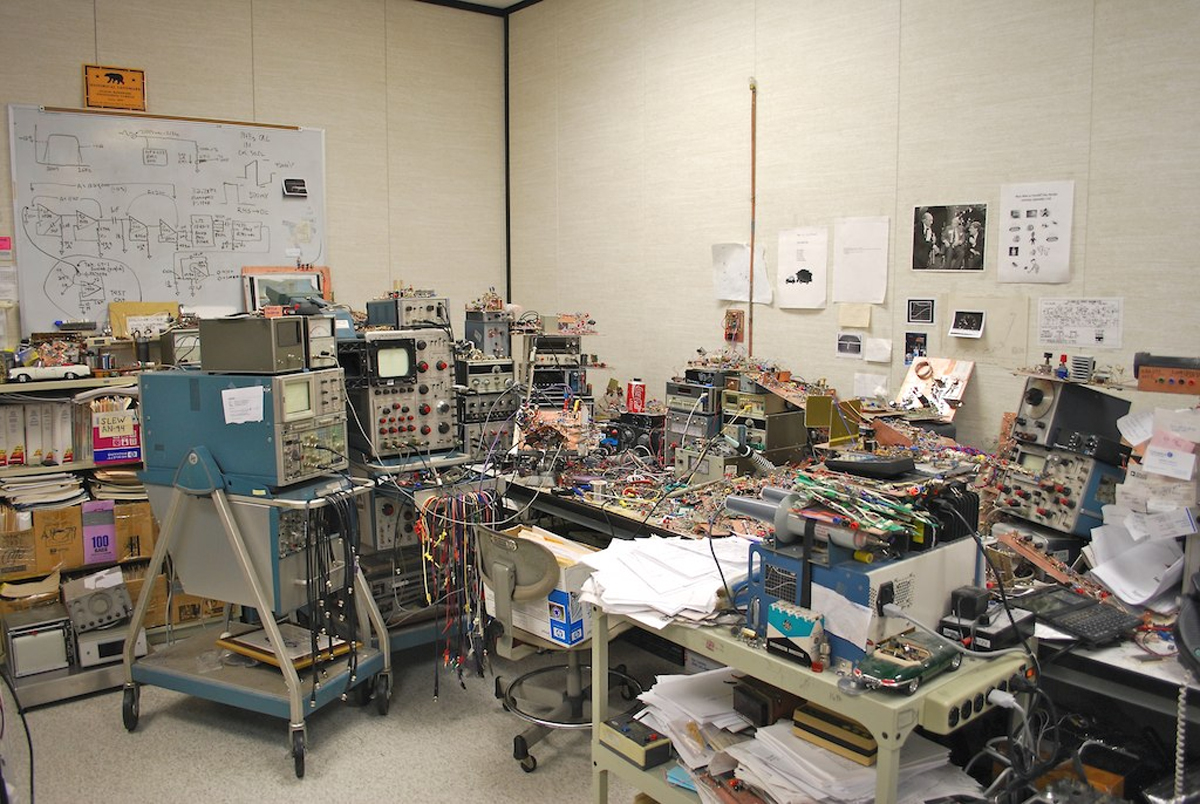
Previous headquarters of Useful Thing Inc.
Previous headquarters of Useful Thing Inc. They made the best widget you could buy in the 80s.

Like most hackers, I’ve run into a part that looks like it might do what I want, but the only documentation came from a company so thoroughly defunct their corporate office is now a nail salon and a Subway.

So, as any hacker who’s wandered through a discount store with a spare twenty, at one point I bought a Chinese caliper. Sure it measures wrong when the battery is low, the temperature has changed, if I’ve held it in my hand too long, the moon is out, etc. but it was only twenty dollars. Either way, how do I get accurate measurements out of it? Well, half-wizardry and telling yourself educated lies.

There are two golden rules to getting accurate measurements by telling lies. It may be obvious to some, but it took me quite a bit of suffering to arrive at them.

  1. Engineers are lazy. So lazy. Most things are going to be even numbers, common fractions, and if possible standard sizes. If sheets and screws come in 2 and 3mm then you bet you’re going to see a lot of 2mm and 3mm features. Also, even though the metric world is supposedly pure, you’re still going to see more 0.25 (1/4) mm measurements than you are .333333 (1/3) mm measurements. Because some small fractions are easier to think about than decimals.
  2. Your eyes lie. If it matters, measure it to be sure.

Continue reading “Measuring Parts Badly For Accurate Reverse Engineering”

Most Of What You Wish You Knew About Coils Of Wire But Were Afraid To Ask

If you are a novice electronic constructor, you will become familiar with common electronic components. Resistors, capacitors, transistors, diodes, LEDs, integrated circuits. These are the fodder for countless learning projects, and will light up the breadboards of many a Raspberry Pi or Arduino owner.

There is a glaring omission in that list, the inductor. True, it’s not a component with much application in simple analogue or logic circuits, and it’s also a bit more expensive than other passive components. But this omission creates a knowledge gap with respect to inductors, a tendency for their use to be thought of as something of a black art, and a trepidation surrounding their use in kits and projects.

We think this is a shame, so here follows an introduction to inductors for the inductor novice, an attempt to demystify them and encourage you to look at them afresh if you have always steered clear of them.

Continue reading “Most Of What You Wish You Knew About Coils Of Wire But Were Afraid To Ask”

All Quiet On The West Virginia Border: The National Radio Quiet Zone

Ask a hundred people why they like to escape to the forest and you’ll probably get a hundred reasons, but chances are good that more than a few will say they seek the peace and quiet of the woods. And while the woods can be a raucous place between the wildlife and the human visitors, it is indeed a world apart from a busy city street, at least in the audio frequencies. But on the EM spectrum, most forests are nearly as noisy as your average cube farm, and that turns out to be a huge problem if you happen to run exquisitely sensitive radio receivers.  That’s the reason for the National Radio Quiet Zone, a 13,000 square mile electromagnetic safe-zone in the woods west of Washington DC. Who’s listening to what and why are a fascinating part of this story, as are the steps that are taken to keep this area as electromagnetically quiet as possible.

Continue reading “All Quiet On The West Virginia Border: The National Radio Quiet Zone”

Tales Of Garage Design: Achieving Precision From Imprecise Parts

Designing parts to fit perfectly together is hard. Whether it’s the coarseness of our fabrication tools or the procedures of the vendor who makes our parts, parts are rarely the exact dimension that we wish they were. Sadly, this is the penalty that we pay by living in a real world: none of our procedures (or even our measurement tools!) are perfect. In a world of imperfect parts, imperfect procedures, and imperfect measurement techniques, how on earth are we supposed to build anything that works? Fortunately, we’re in luck! From the brooding minds of past engineers, comes a suite of design techniques that can combat the imperfections of living in an erroneous world.

Continue reading “Tales Of Garage Design: Achieving Precision From Imprecise Parts”

IPhone Microscopy And Other Adventures

CMOS imaging chips have been steadily improving, their cost and performance being driven by the highly competitive smartphone industry. As CMOS sensors get better and cheaper, they get more interesting for hacker lab projects. In this post I’m going to demonstrate a few applications of the high-resolution sensor that you’ve already got in your pocket — or wherever you store your cell phone.

CMOS vs CCD

First lets quickly review image sensors. You’ve probably head of CMOS and CCD sensors, but what’s the difference exactly?

cddandcmos
CCD and CMOS imaging sensors: from this excellent page at CERN.

As the figure above shows, CCD and CMOS sensors are both basically photodiode arrays. Photons that hit regions on the chip are converted into a charge by a photodiode. The difference is in how this charge in shoved around. CCD sensors are analogue devices, the charge is shifted through the chip and out to a single amplifier. CMOS sensors have amplifiers embedded in each cell and also generally include on-chip analogue to digital conversion allowing complete “camera-on-a-chip” solutions.

Because CMOS sensors amplify and move the signal into the digital domain sooner, they can use cheaper manufacturing processes allowing lower-cost imaging chips to be developed. Traditionally they’ve also had a number of disadvantages however, because more circuitry is included in each cell, less space is left to collect light. And because multiple amplifiers are used, it’s harder to get consistent images due to slight fabrication differences between the amplifiers in each cell. Until recently CMOS sensors were considered a low-end option. While CCD sensors (and usually large cooled CCD sensors) are still often preferred for scientific applications with big budgets, CMOS sensors have now however gained in-roads in high performance DSLRs.

Continue reading “IPhone Microscopy And Other Adventures”

Continuing The Dialog: “It’s Time Software People And Mechanical People Had A Talk”

A while back I wrote a piece titled, “It’s Time the Software People and Mechanical People Sat Down and Had a Talk“. It was mostly a reaction to what I believe to be a growing problem in the hacker community. Bad mechanical designs get passed on by what is essentially digital word of mouth. A sort of mythology grows around these bad designs, and they start to separate from science. Rather than combat this, people tend to defend them much like one would defend a favorite band or a painting. This comes out of various ignorance, which were covered in more detail in the original article.

There was an excellent discussion in the comments, which reaffirmed why I like writing for Hackaday so much. You guys seriously rock. After reading through the comments and thinking about it, some of my views have changed. Some have stayed the same.

It has nothing to do with software guys.

being-wrong-quoteI definitely made a cognitive error. I think a lot of people who get into hardware hacking from the hobby world have a beginning in software. It makes sense, they’re already reading blogs like this one. Maybe they buy an Arduino and start messing around. It’s not long before they buy a 3D printer, and then naturally want to contribute back.

Since a larger portion of amateur mechanical designers come from software, it would make sense that when I had a bad interaction with someone over a design critique, they would be end up coming at it from a software perspective. So with a sample size too small, that didn’t fully take into account my positive interactions along with the negative ones, I made a false generalization. Sorry. When I sat down to think about it, I could easily have written an article titled, “It’s time the amateur mechanical designers and the professionals had a talk.” with the same point at the end.

Though, the part about hardware costs still applies.

I started out rather aggressively by stating that software people don’t understand the cost of physical things. I would, change that to: “anyone who hasn’t designed a physical product from napkin to market doesn’t understand the cost of things.”

Continue reading “Continuing The Dialog: “It’s Time Software People And Mechanical People Had A Talk””

Today’s Hackaday Belgrade Conference

The time has arrived, the greatest hardware conference on earth has landed in Belgrade, Serbia. All of the talks are live streaming now! The lineup of speakers is incredible and you can bask in every minute of it.

Don’t settle for a one-way media experience. Take part in the conversation with the live chat. Click the “request to join this project” button in the upper right of the Hackaday Belgrade Project page.

There’s always one more thing, right? Hack the badge! Try your hand at writing code for the badge using the software emulator, then submit it to the competition. We’ll be starting the Badge demo party at 23:45 (UTC+1). Want someone to try your code out on a badge ahead of time? Just jump on the chat (mentioned above) and ask!

Want to feel the pulse of the hardware community in Europe… this is it.