An Interview With Alex Williams, Grand Prize Winner

Alex Williams pulled off an incredible engineering project. He developed an Autonomous Underwater Vehicle (AUV) which uses a buoyancy engine rather than propellers as its propulsion mechanism and made the entire project Open Source and Open Hardware.

The design aims to make extended duration missions a possibility by using very little power to move the vessel. What’s as remarkable as the project itself is that Alex made a goal for himself to document the project to the level that it is fully reproducible. His success in both of these areas is what makes the Open Source Underwater Glider the perfect Grand Prize winner for the 2017 Hackaday Prize.

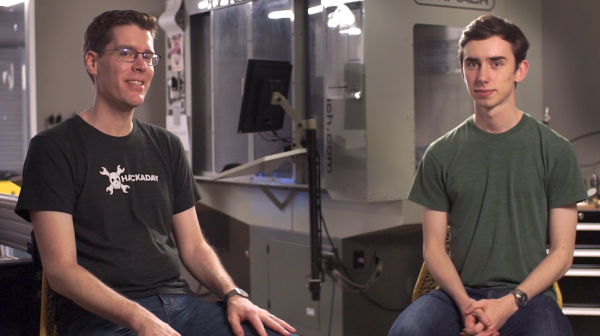
We got to sit down with Alex the morning after he won to talk about the project and the path he took to get here.

Continue reading “An Interview With Alex Williams, Grand Prize Winner”

Hackaday Links Column Banner

Hackaday Links: November 19, 2017

[Peter]’s homebuilt ultralight is actually flying now and not in ground effect, much to the chagrin of YouTube commenters. [Peter Sripol] built a Part 103 ultralight (no license required, any moron can jump in one and fly) in his basement out of foam board from Lowes. Now, he’s actually doing flight testing, and he managed to build a good plane. Someone gifted him a ballistic parachute so the GoFundMe for the parachute is unneeded right now, but this gift parachute is a bit too big for the airframe. Not a problem; he’ll just sell it and buy the smaller model.

Last week, rumors circulated of Broadcom acquiring Qualcomm for the sum of One… Hundred… Billion Dollars. It looks like that’s not happening now. Qualcomm rejected a deal for $103B, saying the offer, ‘undervalued the company and would face regulatory hurdles.’ Does this mean the deal is off? No, there are 80s guys out there who put the dollar signs in Busine$$, and there’s politicking going on.

A few links posts ago, I pointed out there were some very fancy LED panels available on eBay for very cheap. The Barco NX-4 LED panels are a 32×36 panels of RGB LEDs, driven very quickly by some FPGA goodness. The reverse engineering of these panels is well underway, and [Ian] and his team almost have everything figured out. Glad I got my ten panels…

TechShop is gone. With a heavy heart, we bid adieu to a business with a whole bunch of tools anyone can use. This leaves a lot of people with TechShop memberships out in the cold, and to ease the pain, Glowforge, Inventables, Formlabs, and littleBits are offering some discounts so you can build a hackerspace in your garage or basement. In other TechShop news, the question on everyone’s mind is, ‘what are they going to do with all the machines?’. Nobody knows, but the smart money is a liquidation/auction. Yes, in a few months, you’ll probably be renting a U-Haul and driving to TechShop one last time.

3D Hubs has come out with a 3D Printing Handbook. There’s a lot in the world of filament-based 3D printing that isn’t written down. It’s all based on experience, passed on from person to person. How much of an overhang can you really get away with? How do you orient a part correctly? God damned stringing. How do you design a friction-fit between two parts? All of these techniques are learned by experience. Is it possible to put this knowledge in a book? I have no idea, so look for that review in a week or two.

Like many of us, I’m sure, [Adam] is a collector of vintage computers. Instead of letting them sit in the attic, he’s taking gorgeous pictures of them. The collection includes most of the big-time Atari and Commodore 8-bitters, your requisite Apples, all of the case designs of the all-in-one Macs, some Pentium-era PCs, and even a few of the post-97 Macs. Is that Bondi Blue? Bonus points: all of these images are free to use with attribution.

Nvidia is blowing out their TX1 development kits. You can grab one for $200. What’s the TX1? It’s a really, really fast ARM computer stuffed into a heat sink that’s about the size of a deck of cards. You can attach it to a MiniITX breakout board that provides you with Ethernet, WiFi, and a bunch of other goodies. It’s a step above the Raspberry Pi for sure and is capable enough to run as a normal desktop computer.

Brits: Make A Vote, Put Cash A Hackerspace’s Way

Those of you who have been involved in the running of a hackerspace or makerspace will know the never-ending struggle to maintain financial solvency, and the quest for sources of income to move your organisation forward. It’s certainly a topic upon which Hackaday’s crew have some experience, more than one of us has helped run a space.

A good avenue to explore lies with community grants: money from organisations on a philanthropic basis to invest in community organisations. These can come from charities, governmental organisations, or even from companies as part of their corporate social responsibility. It’s this last source of grant money that claims our attention today, because we are in the final days of voting for the Aviva Community Fund, in which the British financial and insurance company makes grants for worthy causes across the country. The causes compete to gain as much support as they can, and hope to thus win their prize.

Among the many worthy recipients of the cash are a selection of hackerspaces. First up are Hitchin Hackspace, whose Big Hak full-size rendition of a Milton Bradley Big Trak toy was featured in our coverage of EMF Camp 2016. They are building a new space in what we’ll call a redundant community facility because it sounds better than “Former public toilet”, and winning a grant will help them a lot in that aim.

Then we have East London Makerspace. They have secured an unused garage to turn into a makerspace, as the capital’s population of our community swells to support ever more spaces in its different suburbs. Like Hitchin, the money would go to the essential work involved in creating a functioning space where previously there was nothing.

Finally, we have the unexpected, a heating system from Milton Keynes Men In Sheds. If you know about Men In Sheds as a community organisation for older people, you’ll be wondering why this is listed here. What we haven’t told you is that MK Makerspace is a subgroup of the MK Shed that occupies the upstairs portion of their building, and what warms the Shedders also warms the hacker community of one of Britain’s new towns.

These appear to be the only hackerspaces bidding for grant money, but votes can usefully be given to other allied causes. Linlithgow Remakery and Tool Library, for instance could use a boost, as could the other Men In Sheds groups scattered across the competition.

So if you are one of Hackaday’s British readers, please take a minute to stop by the voting pages listed above, and give them a boost. You have a couple of days to get your votes in, so make them count, and make a difference!

Disclosure: [Jenny List] is a member of Milton Keynes Makerspace.

New Part Day: A Fake Sun

LED technology has improved by leaps and bounds in recent years, with what was once considered unachievable being common place now. Two of the main parameters of interest, total input power and conversion efficiency have been steadily increasing over the years. An efficacy of 120 lumens/watt is fairly common nowadays, and it may not be improbable to expect double this figure in the near future. Input power ratings have also steadily increased, with single LED units capable of 100 W or more becoming common.

But the Chinese manufacturer Yuji seems to have hit the ball out of the park by introducing their BC-Series, 500 W, high CRI, high Power, COB LED. Single, 500 W COB LED’s are not new and have been available since a couple of years, but their emitting surface areas are quite large. For example, a typical eBay search throws up parts such as this one – 500 W, high Power LED, 60,000 lm, 6000-6500K. It has a large, square emitting area of 47.6 x 47.6 mm. By comparison, the Yuji BC-Series are 27 mm square, with an active emitting area only 19 mm in diameter. This small emitting area makes it easier to design efficient reflector and/or lens units for the LED.

Luminous Flux is between 18,000 to 21,000 for a color temperature of 3200 K, and between 20,000 to 24,000 for the 5600 K type. Further, this high power rating is accompanied with a pretty high color rendering index (CRI) above 95. This allows the LED to faithfully reveal the natural colors of objects due to its wide spectrum. Electrically, it is rated for 12 Amps with input voltage between 35 V to 39 V. This translates to between 420 W ~ 468 W of input electrical power. Some quick math tells us that the efficacy efficiency works out to just a little over 50 lm/W, which isn’t all that great. But with light sources, you can have high-efficacy high-efficiency or high CRI, but not both – that’s just how the physics of it works.

At US $ 500 a pop, these eye blinders do not come cheap and may not find much use for individual hackers. But for some applications, such as studio and theatre lighting or photography, they may be just what the Doctor prescribed. In the video after the break, you can see [Matt] from DIY Perks give a rundown of the LED’s features and take it for a test ride.

Continue reading “New Part Day: A Fake Sun”

Radio Apocalypse: The Emergency Broadcast System

Some sounds are capable of evoking instant terror. It might be the shriek of a mountain lion, or a sudden clap of thunder. Whatever your trigger sound, it instantly stimulates something deep in the lizard brain that says: get ready, danger is at hand.

For my part, you can’t get much scarier than the instantly recognizable two-tone alert signal (audio link warning) from the Emergency Broadcast System (EBS). For anyone who grew up watching TV in the 60s and 70s in the US, it was something you heard on at least a weekly basis, with that awful tone followed by a grave announcement that “the broadcasters of your area, in voluntary cooperation with the FCC and other authorities, have developed this system to keep you informed in the event of an emergency.” It was a constant reminder that white-hot death could rain from the sky at any moment, and the idea that the last thing you may ever hear was that tone was sickening.

While I no longer have a five-year-old’s response to that sound, it’s still a powerful reminder of a scary time. And the fact that it’s still in use today, at least partially, seems like a good reason to look at the EBS in a little more depth, and find out the story behind the soundtrack of the end of the world.

Continue reading “Radio Apocalypse: The Emergency Broadcast System”

Friday Hack Chat: High Speed Data Acquisition

For this week’s Hack Chat, we’re going to be talking all about High-Speed Data Acquisition. If you’ve ever needed to shove voltages, currents, logic signals, temperature, pressure, or sound into a computer, you’ve used a DAQ. If you’ve ever needed to acquire a signal at a very high speed, you’ve probably paid a lot of money for that piece of equipment.

Our guest for this week’s Hack Chat will be [Kumar Abhishek], engineering student, Hackaday Prize finalist, and creator of the very, very cool Beaglelogic, a logic analyzer for the BeagleBone. The interesting bit about the Beaglelogic is its utilization of the Programmable Real-Time Units (PRUs) found in every BeagleBone.

These PRUs are basically DMA machines, shuttling bits back and forth between memory and GPIOs. This year, [Kumar] turned the Beaglelogic cape into the Beaglelogic Standalone, a device based on the Octavo Systems OSD3358 (the ‘BeagleBone On A Chip‘) that gives those Saleae logic analyzers a run for their money.

In this Hack Chat, we’ll be discussing the PRUs found in various iterations of the BeagleBoard, how the Beaglelogic performs its data acquisition, and how programming the PRUs is actually accomplished. If you have a question for [Kumar], leave a comment on the Hack Chat page

join-hack-chatOur Hack Chats are live community events on the Hackaday.io Hack Chat group messaging. Usually, our Hack Chats go down at noon, PDT, Friday. This one is different. Because [Kumar] is in India, we’ll be running this Hack Chat at 9:30a PST, Friday, November 17th. What time is that in India, and what time is that where you live? Who cares! Here’s a time zone converter!

Click that speech bubble to the left, and you’ll be taken directly to the Hack Chat group on Hackaday.io.

You don’t have to wait until Friday; join whenever you want and you can see what the community is talking about.

We’re also looking for new Hack Chat guests! If you’ve built something cool, you’re working on an interesting project, or you’re about to introduce a really cool product, hit us up! Email our wonderful community managers, and we’ll see if we can slot you in.

Visual 3D Print Finishing Guide

With 3D printers now dropping to record low prices, more and more people are getting on the additive manufacturing bandwagon. As a long time believer in consumer-level desktop 3D printing, this is a very exciting time for me; the creativity coming out of places like Thingiverse or the 3D printing communities on Reddit is absolutely incredible. But the realist in me knows that despite what slick promotional material from the manufacturers may lead you to believe, these aren’t Star Trek-level replicators. What comes out of these machines is often riddled with imperfections (from small to soul crushing), and can require considerable cleanup work before they start to look like finished pieces.

If all you hope to get out of your 3D printer are some decent toy boats and some low-poly Pokemon, then have no fear. Even the most finicky of cheap printers can pump those out all day. But if you’re looking to build display pieces, cosplay props, or even prototypes that are worth showing to investors, you’ve got some work cut out for you.

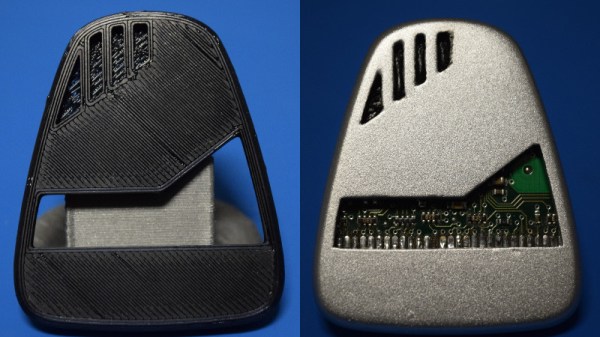
With time, patience, and a few commercial products, you can accomplish the ultimate goal: turning a 3D printed object into something that doesn’t look like it was 3D printed. For the purposes of this demonstration I’ll be creating a replica of the mobile emitter used by the “Emergency Medical Hologram” in Star Trek: Voyager. I can neither confirm nor deny I selected this example due to the fact that I’m currently re-watching Voyager on Netflix. Let’s make it look good.

Continue reading “Visual 3D Print Finishing Guide”