Turning Scrap Metal Into Something To Work With

Blacksmiths will frequently work to a customer’s commission, and sometimes those commissions can be somewhat unusual. [Copperrein] had just such a piece of work come his way, a ceremonial sword to be made from a supplied collection of iron and steel items. To render them into something useful he had to melt them together, and the story of how he did that is particularly interesting.

We’re introduced to the Aristotle furnace, a fairly simple top-fed air blast charcoal furnace capable of melting almost any ferrous scrap into a so-called “bloom”, a lump of iron with some slag and carbon inclusions. These furnaces are often built as holes in the ground, but he’s made his atop a portable forge at working height to save bending over it for seven hours.

The source material was a very mixed bag, so the first order was to strip it in an acid bath of any coatings which might contaminate the resulting bloom. The parts, including things as diverse as a huge wrought-iton bolt, a scythe blade, and a pair of dividers, were then cut into small pieces one by one and fed into the furnace. They melt as they progress down through the furnace, resulting in a bloom of iron. The bloom is impure and will need significant working to expel any inclusions, but the final result will be something like the wrought iron of old. Let’s hope he has a power hammer, working the bloom would be hard work by hand!

If this catches your attention, you may be interested in a bit of blast furnace iron smelting. And of course, there is also our ongoing blacksmithing series to get you going at the anvil. You could even make a nail.

Via Reddit.

Thanks [Mike] for the tip.

Spin Me Right Round, Baby: Generator Building Experiments For Mere Mortals

How many of you plan to build a wind-powered generator in the next year? Okay, both of you can put your hands down. Even if you don’t want to wind your coils manually, learning about the principles in an electric generator might spark your interest. There is a lot of math to engineering a commercial model, but if we approach a simple version by looking at the components one at a time, it’s much easier to understand.

For this adventure, [K&J Magnetics] start by dissect a commercial generator. They picked a simple version that might serve a campsite well, so there is no transmission or blade angle apparatus to complicate things. It’s the parts you’d expect, a rotor and a stator, one with permanent magnets and the other with coils of wire.

The fun of this project is copying the components found in the commercial hardware and varying the windings and coil count to see how it affects performance. If you have ever wound magnet wire around a nail to make an electromagnet, you know it is tedious work so check out their 3D printed coil holder with an embedded magnet to trigger a winding count and a socket to fit on a sewing machine bobbin winder. If you are going to make a bunch of coils, this is going to save headaches and wrist tendons.

They use an iterative process to demonstrate the effect of multiple coils on a generator. The first test run uses just three coils but doesn’t generate much power at all, even when spun by an electric drill. Six windings do better, but a dozen finally does the trick, even when turning the generator by hand. We don’t know about their use of cheap silicone diodes though, that seems like unintentional hobbling, but we digress.

Making turbine blades doesn’t have to be a sore chore either, and PVC may be the ticket there, you may also consider the vertical axis wind turbine which is safer at patio level. Now, you folks building generators, remember to tip us off!

Continue reading “Spin Me Right Round, Baby: Generator Building Experiments For Mere Mortals”

That E-Cig Battery Probably Fits Into Sunglasses

This particular e-cigarette is a little bigger than a typical cigarette, with a matching battery.

E-cigarettes use electrical power to rapidly heat and vaporize a base liquid such as propylene glycol, and that power comes from a battery. These devices are functionally straightforward but it can be a messy process on the inside. Thankfully though the batteries can be salvaged once components like heating elements either gum up or burn out.

[facelesstech] decided to use the battery from an e-cig as the power source for a smart sunglasses project, which uses two RGB LED rings to put on a light show. Opening up the device it was discovered that the battery was a straightforward lithium-polymer cell, in AAAA size. If you’ve ever torn open a 9 v battery and discovered the six diminutive cylinders inside, an AAAA cell is about the same size as one of those. However, the battery from the e-cig is both rechargeable and has a nominal voltage of 3.7 volts, which can happily drive a microcontroller project. The small battery fit nicely into one arm of the glasses, and when covered with heat-shrink, was hardly noticeable. The battery charger doesn’t fit inside the glasses, but one can’t have everything.

The ability of an e-cigarette to pump out clouds of vapor has led to some interesting hacks. One such is a DIY portable fog machine, which opens all kinds of doors for costuming applications.

Preserved Lemons On A Hacker’s Budget

“If you wish to make an apple pie from scratch, you must first invent the universe.” [Carl Sagan]. If you wish to make preserved lemons the same way as [Uri Tuchman], you have to start with that mentality. Video also below. The recipe for [Uri]’s preserved lemons involves two ingredients see sea salt, and sliced lemons, but we don’t expect you came here looking for a recipe and the food is less important than the journey.

Recipes take for granted that we have all the necessary utensils on hand, but what if you are missing one? What if you are missing all of them? Life’s lemons won’t get the best of us, and if we’re utensil-poor and tool-rich we will make those lemons regret trying to take a bite out of us. The first fixture for cutting lemons is a cutting board, then a knife, and finally an airtight container. We see him make all of them from stock material by hand. Does that seem like a lot of work? You forgot that if you’re going to eat up, you’ll need a serving platter and fork. If he ever opens a restaurant, don’t expect it to be fast food.

Maybe humans will only need one tool in the kitchen someday but at least one cat receives food from a single silicone-brained tool.

Continue reading “Preserved Lemons On A Hacker’s Budget”

A New KiCAD Tutorial Hits The Scene

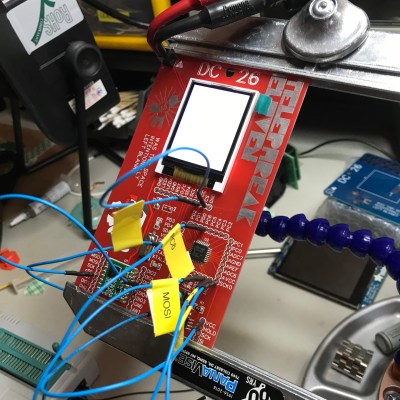
KiCAD has a rightfully earned image problem regarding beginners. The shiny new version 5 has improved things (and we’re very excited for v6!) but the tool is a bit obtuse even when coming from a electronics design background, so we’re always excited to see new learning material. [Mike Watts] is the latest to join the esteemed group of people willing to export their knowledge with his KiCAD tutorial series on GitHub that takes the aspiring user from schematic through fab and assembly.

The tutorial is focused around the process of creating a development board for the dimuitive Microchip née Atmel ATSAMD10 Cortex M0 ARM CPU. It opens by asking the reader to create a schematic and proceeds to teach by directing them to perform certain actions then explaining what’s going on and which shortcuts can accelerate things. This method continues through layout, manufacturing, and assembly.

Of note is that when defining the board outline [Mike] describes how to use OpenSCAD to parametrically define it; a neat micro-tutorial on using the two great tools to compliment each other. We also love that upon successful completion of the tutorial series the user will have developed a tiny but useful development board that can be assembled for about $3 in single quantities!

As with all open source work, if you have quibbles or want to contribute open a pull request and give [Mike] a hand!

Make Your Own SPL DB Meter With A Microphone And MCU

Measuring equipment such as SPL (Sound Pressure Level) decibel meters may seem daunting, but this article by [Shawon M. Shahryiar] shows that making your own need only have two essential ingredients: a microphone and a microcontroller. Obviously the microphone is for measuring the sound pressure level, and its output is then fed into the ADC of the microcontroller which does some math before sending the result to a display.

[Shawon] runs through all of the theory behind the calculations that have to be performed, before showing the C code that runs on the PIC18F242 8-bit MCU targeted by the prototype setup. The display is a graphical LCD type, capable of displaying the text with values as well as bar graphs indicating the measured levels. For the measurements themselves, the RMS value is taken of 16 ADC samples while the algorithm takes into account the specifications of the Seeed-sourced microphone module, specifically its average 50 dB sensitivity rating.

Although a full schematic is not provided, the essentials are all there for anyone to build their own SPL dB meter using virtually any microphone and MCU with built-in ADC. As the article also notes, opting for a higher quality microphone will yield better result and of course a faster MCU will offer more options, including FFT processing. Since the code itself is fairly basic, it should be easy enough to port it to an ARM-based MCU, which would allow one to use for example a TFT LCD.

Take a peek after the break for a video of the article’s SPL dB meter in action.

Continue reading “Make Your Own SPL DB Meter With A Microphone And MCU”

Making Flexible Overmolded Parts With Urethane Resin

Resin casting videos have taken social media by storm of late. Everything from inlaid driftwood tables to fancy pens are getting the treatment. Pouring some nicely colored epoxy is straightforward enough, but it’s just the tip of the iceberg. [Eric Strebel] has some serious skills in resin casting, and has lately been working on some overmolded electroniics with urethane resin (Youtube link, embedded below).

The build starts with the creation of a silicone mold, using a 3D printed SLA master. The part in question is for a prototype medical device, and requires overmolding, in which a flexible PCB is covered in flexible urethane. Wooden pins are used to allow the flexible PCB to clip into the mold for accurate location, and a small shield is placed over the metal contacts of the PCB to avoid them being covered in silicone.

Initial tests are done with an empty mold to determine the correct material to use, before the actual parts are ready to produce. [Eric] takes great care with the final production, as any mistakes would waste the expensive prototype PCBs provided to him by the client. With the electronics placed in the mold, the resin is degassed and carefully injected, using a syringe to minimise the chance of any air bubbles. With some delicate cleanup by hand, the completed parts are ready for delivery.

It’s a process that covers the basics of overmolding for a prototype part, as well as showing off [Eric]’s skill at producing quality prototype parts. We’ve seen [Eric]’s work before, too – like his discussion of the value of cardboard in product design. Video after the break.

Continue reading “Making Flexible Overmolded Parts With Urethane Resin”