A Stepper Motor For Two Dimensions

We’ve all heard linear motors, like those propelling Maglev trains, described as “unrolled” versions of regular electric motors. The analogy is apt and helps to understand how a linear motor works, but it begs the question: what if we could unroll the stator in two dimensions instead of just one?

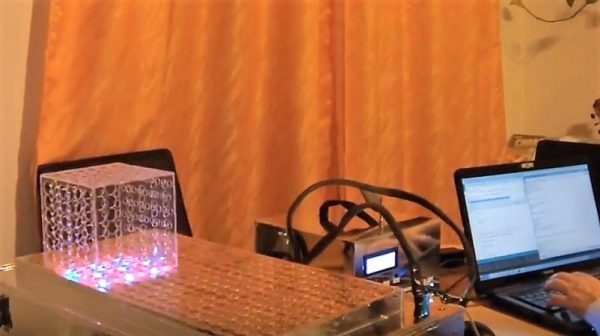
That’s the idea behind [BetaChecker’s] two-axis stepper motor, which looks like it has a lot of potential for some interesting applications. Build details are sparse, but from what we can gather from the videos and the Hackaday.io post, [BetaChecker] has created a platen of 288 hand-wound copper coils, each of which can be selectively controlled through a large number of L293 H-bridge chips and an Arduino Mega. A variety of sleds, each with neodymium magnets in the base, can be applied to the platen, and depending on how the coils are energized, the sled can move in either dimension. For vertical applications, it looks like some coils are used to hold the sled to the platen while others are used to propel it. There are RGB LEDs inside the bore of each coil, although their function beyond zazzle is unclear.

We’d love more details to gauge where this is going, but with better resolution, something like this could make a great 3D-printer bed. If one-dimensional movement is enough for you, though, check out this linear stepper motor that works on a similar principle.
Continue reading “A Stepper Motor For Two Dimensions”

60’s Comedy Rescued From Nigerian Basement

In the sixties, videotape used to film television programs was expensive. When a program had been shown as many times as the contract required the tape was wiped and reused, unless someone requested it be saved for some reason. At least, this was the BBC’s doctrine. Many episodes of the BBC’s programs have gone missing due to this reuse of the videotapes but sometimes the films of these episodes are found in an attic or storage facility. [Cplamb] brings us the story of the salvation of some episodes of British comedians Morecambe and Wise’ first series on the BBC, their first color series.

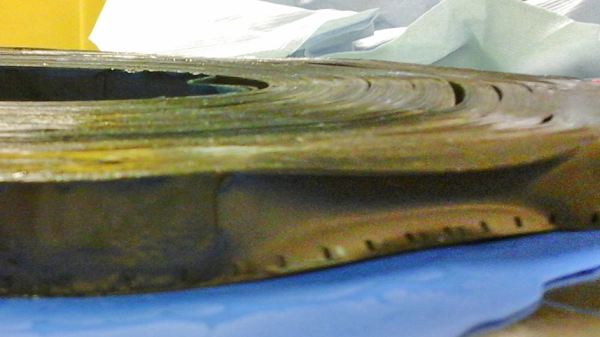
Do make duplicates, the BBC would film a television playing one of the videotapes. This film duplicate would be sent out to television stations around the world, rather than the tapes. The Morecambe and Wise film was found in the humid basement of a television station in Nigeria. Due to the conditions, the film was “diseased” and was in danger of decomposing into soup.

A series of hacks was used to restore the episodes from the rotting film stock. X-ray microtomography was used to scan a roll of film to see if this could be used. This worked because the film has a layer of silver oxide emulsion(the image) on one side and plastic (the film stock) on the other. A program was written so that the resulting voxels could be remapped into two dimensions in order to see the original frame. However, the volume that the machine could x-ray was small – using it on an item the size of a full roll of film would probably destroy the film, if it could be done. The next hack was to cut the film into small blocks using a laser cutter. This itself seems destructive but if you can either cut it up and scan it or let it turns into soup the choice is easy.

A second part of the story has been published, but the third article in the series hasn’t been yet, so we don’t know how the resulting film looks. But this is a pretty cool story involving scanning, x-rays, programming, and laser cutters — all hallmarks of the great hacks we see on Hackaday. Check out this article on the mechanics of film projection and this one on automatically scanning 8mm film for similar style hacks.

Electronics Workbench Goes Vertical With Pegboard Mounting

[JesusGomez] has certainly put work into his Vertical Laboratory concept. There’s a bit more to the idea than simply using 3D printed parts to move electronics from the desktop onto a metal pegboard, although that part is certainly nicely done. There are 3D models for securely mounting various hardware such as Raspberry Pi, Beaglebone, ESP32, cable management, breadboards, and other common parts to a metal pegboard. Instead of having parts and wires splayed across a workbench, it can be mounted and organized vertically. Having a project or prototype mounted on pegboard is easier to store, saves room, and frees up desk space in small work areas. It also makes for an organized and visually pleasing layout.

A clever piece of design is in the plastic mounts that he created. He wanted parts to remain securely mounted unless intentionally removed, allow different mounting orientations, and to never require access to the back side of the pegboard. To accomplish this, the parts use a combination of pegs that slide-lock with bendable sections that act as lock tabs. Once mounted, the parts stay put until the lock tabs are released by gently prying them out of position. Since mounting and removal can be done entirely from the front, wall mounted pegboards with inaccessible backs can be used.

Metal pegboard has its uses, even if the more common dead-tree version shows up more often in projects from DIY vacuforming to making a modular work surface for when space is at an absolute premium.

Flowing Light Art Inspired By Plankton

With today’s technology, art can be taken in directions that have never before been possible. Taking advantage of this, [teamlab] — an art collective from Japan — have unveiled an art installation that integrates the attendee into the spectacle. In the dark room of the piece ‘Moving Creates Vortices and Vortices Create Movement,‘ you are the brush that paints the flowing display.

Inspired by the movement of ocean plankton, this borrows your movement to create tapestries of light with mirrored walls to aggrandize the effect. As attendees walk about the room, their movements are tracked and translated into flowing patterns projected onto the ground. The faster the people move, the greater the resultant flow. Even those who have stopped to take in the scene are themselves still part of it; their idle forms mimic boulders in a river — as eddies would churn about the obstacle, so too does the light flow around the attendee.

Continue reading “Flowing Light Art Inspired By Plankton”

Sonoff Factory Tour Is A Lesson On Life In Shenzhen

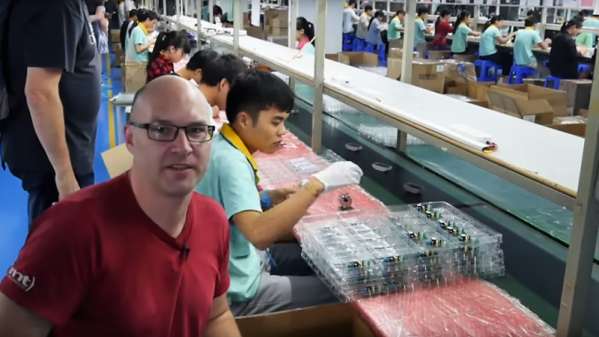
Judging by the popularity of “How It’s Made” and other shows of the genre, watching stuff being made is a real crowd pleaser. [Jonathan Oxer] from SuperHouse is not immune to the charms of a factory tour, so he went all the way to China to visit the factory where Sonoff IoT devices are made, and his video reveals a lot about the state of electronics manufacturing.

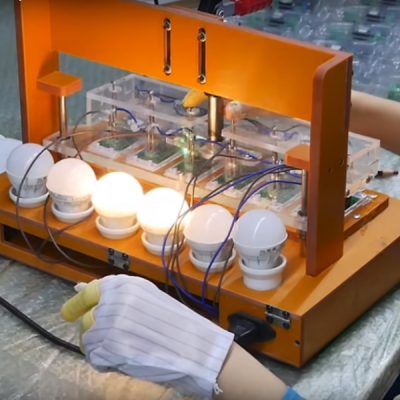
Test jig for six units at once

For those interested only in how Sonoff devices are manufactured, skip ahead to about the 7:30 mark. But fair warning — you’ll miss a fascinating discussion of how Shenzhen rose from a sleepy fishing village of 25,000 people to the booming electronics mecca of 25 million that it is today. With growth supercharged by its designation as a Special Economic Zone in the 1980s, Shenzhen is now home to thousands of electronics concerns, including ITEAD, the manufacturers of the Sonoff brand. [Jonathan]’s tour of Shenzhen includes a trip through the famed electronics markets where literally everything needed to build anything can be found.

At the ITEAD factory, [Jonathan] walks the Sonoff assembly line showing off an amazingly low-tech process. Aside from the army of pick and places robots and the reflow and wave soldering lines, Sonoff devices are basically handmade by a small army of workers. We lost count of the people working on final assembly, testing, and packaging, but suffice it to say that it’ll be a while before robots displace human workers in electronic assembly, at least in China.

We found [Jonathan]’s video fascinating and well worth watching. If you’re interested in Sonoff’s ESP8266 offerings, check out our coverage of reverse engineering them. Or, if Shenzhen is more your thing, [Akiba]’s whirlwind tour from the 2016 Superconference will get you started.

Continue reading “Sonoff Factory Tour Is A Lesson On Life In Shenzhen”

Amazon Echo Dot Upgraded To Retro Futuristic Look

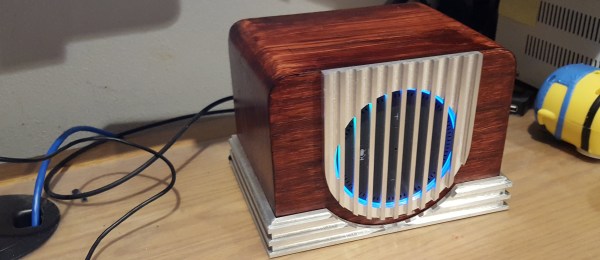
It takes a surprising amount of planning and work if you want something to look old. [vemeT5ak] wanted the Echo Dot sitting on his desk to fit a different aesthetic motivated by a 1940s Canadian radio. Armed with Solidworks, a Tormach CNC, and some woodworking tools at Sector67 hackerspace, he built a retro-futuristic case for the Amazon Alexa-enabled gadget. Future and past meet thanks to the design and material appearance of the metal grille and base molding wrapping the wood radio case. The finishing touch is of course the ring of blue light which still shines through from the Echo itself.

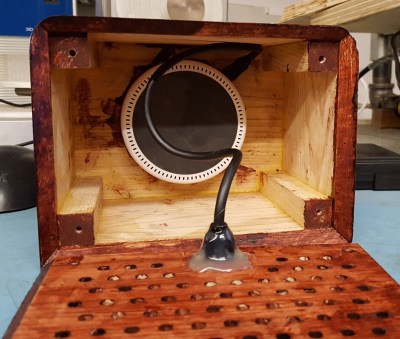
A short USB extension cable connects the Echo Dot to the back of the enclosure, and the cavernous inside plus ample holes provide a nice rich sound.

It took about 15 hours of modeling, scaling, and tweaking in Solidworks with an interesting design specification in mind: single-bit operation. This single-bit is not in the electrical sense, but refers to the CNC milling operation. All pieces are cut with a 1/4″ end mill, without any tool changes. Metal pieces were milled from 6061 aluminum and the hickory case (with burgundy stain) was mostly cut on a table saw, but the holes were CNC machined.

What looks like an otherwise perfect build has a single flaw that eats up [vemeT5ak]’s soul; the Echo Dot has a draft angle that wasn’t considered during modeling, and the hole is ever so slightly too wide, meaning it didn’t press fit perfectly flush. Fortunately it’s not noticeable behind the metal grill, and unless you knew (please help keep his dirty little secret), you would think everything turned out perfectly.

It turns out building a case for the Echo Dot is challenging for a few reasons; the rubbery material on the bottom doesn’t allow anything to stick to it, and the sides are smooth and featureless with a taper that makes it difficult to lock it in. Many cases resort to clipping over the top to hold it in place. Others install it into a fish or a furby.

Exploring Options For DIY Waterproofing

TL;DR — Don’t use silicone to pot electronics.

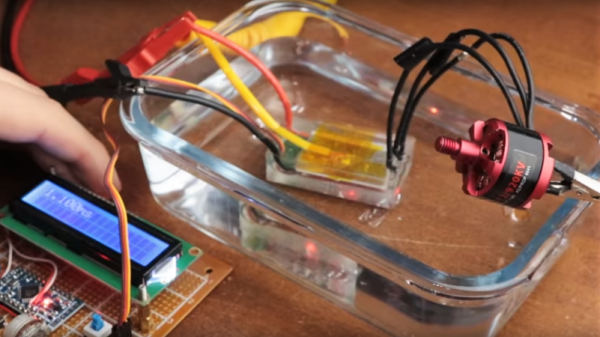
That’s the conclusion [GreatScott!] comes to after trying out several methods for waterproofing electronics. His efforts stem from a recent video in which he discovered that water and electricity sometimes actually do mix, as long as the water is distilled and the electronics in the drink are relatively simple. He found that the main problem was, unsurprisingly, electrolytic corrosion, so he set out to experiment with various waterproofing coatings. In a series of careful experiments he goes through the pros and cons of both conformal coatings and potting compounds. The conformal tests used simple clear nail polish on an ESC board; that worked pretty well, but it was a little hard to reach all the nooks and crannies. He also tried potting with a thick black silicone compound, but that ended up never really curing in the middle. A final attempt with legitimate two-part epoxy potting compound sealed up the ESC tight, although we doubt the resulting brick would perform well on a quadcopter.

If you want to explore potting a bit further, check out this introduction to the basics.

Continue reading “Exploring Options For DIY Waterproofing”