37C3: When Apple Ditches Lightning, Hack USB-C

[Thomas Roth], aka [Ghidraninja], and author of the [Stacksmashing] YouTube channel, investigated Apple’s Lightning port and created a cool debugging tool that allowed one to get JTAG on the device. Then, Apple went to USB-C for their new phones, and all his work went to waste. Oh well, start again — and take a look at USB-C.

Turns out, though, that the iPhone 15 uses the vendor-defined messages (VDM) capability of USB-PD to get all sorts of fun features out. Others had explored the VDM capabilities on Mac notebooks, and it turns out that the VDM messages on the phone are the same. Some more fiddling, and he got a serial port and JTAG up and running. But JTAG is locked down in the production devices, so that will have to wait for an iPhone 15 jailbreak. So he went poking around elsewhere.

He found some other funny signals that turned out to be System Power Management Interface (SPMI), one of the horribly closed and NDA-documented dialects owned by the MIPI Alliance. Digging around on the Interwebs, he found enough documentation to build an open-source SPMI plugin that he said should be out on his GitHub soon.

The end result? He reworked his old Lightning hardware tool for USB-C and poked around enough in the various available protocols to get a foothold on serial, JTAG, and SPMI. This is just the beginning, but if you’re interested in playing with the new iPhone, this talk is a great place to start. Want to know all about USB-C? We’ve got plenty of reading for you.

Hackaday Podcast Episode 250: Trains, RC Planes, And EEPROMS In Flames

This week in the Podcast, Elliot Williams is off at Chaos Communication Congress, hearing tales of incredible reverse engineering that got locomotives back up and running, while Al Williams is thinking over what happened in 2023. There’s a lot of “how things work” in this show, from data buoys to sewing machines to the simulated aging of ICs.

Whether you’re into stacking bricks, stacking Pi Picos, or stacking your 3D prints to make better use of precious bed space, this episode is for you. Enjoy.

This is your last chance to download a new podcast this year. Take it!

Continue reading “Hackaday Podcast Episode 250: Trains, RC Planes, And EEPROMS In Flames”

Unbricking Trains, Uncovering Shady Behavior

The first clue was that a number of locomotives started malfunctioning with exactly 1,000,000 km on the odometer. And when the company with the contract for servicing them couldn’t figure out why, they typed “Polish hackers” into a search engine, and found our heroes [Redford], [q3k], and [MrTick]. What follows is a story of industrial skullduggery, CAN bus sniffing, obscure reverse engineering, and heavy rolling stock, and a fantastically entertaining talk.

Cutting straight to the punchline, the manufacturer of the engines in question apparently also makes a lot of money on the service contracts, and included logic bombs in the firmware that would ensure that revenue stream while thwarting independent repair shops. They also included “cheat codes” that simply unlocked the conditions, which the Polish hackers uncovered as well. Perhaps the most blatant evidence of malfeasance, though, was that there were actually checks in some versions of the firmware that geofenced out the competitors’ repair shops.

We shouldn’t spoil too much more of the talk, and there’s active investigation and legal action pending, but the smoking guns are incredibly smoky. The theme of this year’s Chaos Communication Congress is “Unlocked”, and you couldn’t ask for a better demonstration of why it’s absolutely in the public interest that hackers gotta hack. Of course, [Daniel Lange] and [Felix Domke]’s reverse engineering of the VW Dieselgate ECU shenanigans, another all-time favorite, also comes to mind.

Polish Train Manufacturer Threatens Hackers Who Unbricked Their Trains

A week ago we covered the story of a Polish train manufacturer who was caught using software to brick their products after they had been repaired by in independent railway workshop. Now 404 Media has a follow-up story with more information, including the news that the hackers responsible for the discovery are now being threatened by the manufacturer.

The more we learn about this story the more interesting it becomes, as the Newag trains in question began failing after service as far back as 2021. In desperation after services were affected by the number of non-functional units, an employee searched online for Polish hackers and found a group called Dragon Sector. The group was able to find the issue, and are now being threatened with legal action by the manufacturer, who are citing possible safety issues.

It’s clear from where we are standing that Newag have been caught red-handed in some extremely dubious practices, and seem to have little sense of how their actions might not be the best in terms of protecting their reputation. We are guessing that the European regulators will become very interested in this case, and that meanwhile the order books of a company which puts DRM in its trains will start to look very empty indeed. You can catch our original coverage as the story broke, here.

Thanks [JohnU] for the tip.

Oddball LCDs Reverse Engineered Thanks To Good Detective Work

Is there anything more discouraging to the reverse engineer than to see a black blob of epoxy applied directly to a PCB? We think not, because that formless shape provides no clue as to what chip lies beneath, and that means a lot of detective work if you’re going to figure out how to use this thing.

[Sudhir Chandra]’s detective story starts with a bunch of oddball LCDs, slim 1×32 character units rather than the more familiar 2×16 displays. Each bore the dreaded black COB blob on the back, as well as a handful of SMD components and not much else. Googling revealed no useful documentation, and the manufacturer wasn’t interested in fielding calls from a hobbyist. Reasoning that most manufacturers wouldn’t spin up a custom chip for every display, [Sudhir] assumed there was an ST7066, a common LCD driver chip, underneath the blob, especially given the arrangement of external components. But a jumper set was bodged together under this assumption didn’t get the display going.

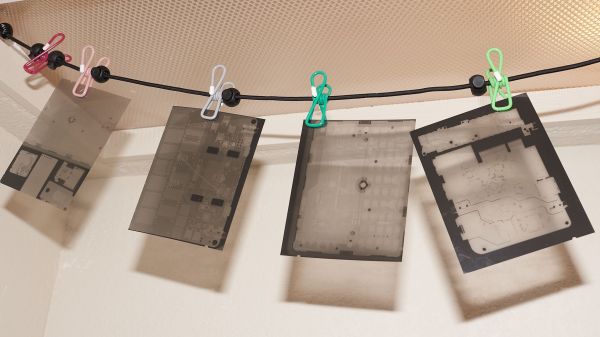
Next up were more destructive methods, to decap the COB and see what kind of numbers might be on the chip. Sandpaper worked at first, but [Sudhir] eventually turned to the “Chips a la [Antoine]” method of decapping, which uses heat and brute force to get at the goods. This got down to the chip, but [Sudhir]’s microscope wasn’t up to the task of reading the die markings.

What eventually cracked the case was tracing out the voltages across the various external resistors and matching them up to other chips in the same family as the ST7066, plus the realization that the long, narrow epoxy blob probably covered a similarly shaped chip, which led to the culprit: an ST7070. This allowed [Sudhir] to build an adapter PCB for the displays, with plans for a custom Arduino library to talk to the displays.

This was a great piece of reverse engineering and a good detective story to boot. Hats off to [Sudhir] for sticking with it.

The Deere Disease Spreads To Trains

If the right-to-repair movement has a famous story, it’s the familiar green and yellow John Deere tractor. Farmers and mechanics have done their own repairs as long as there have been tractors, but more recent Deeres have been locked down such that only Deere-authorised agents can fix them. It’s a trend that has hurt the value of a second-had Deere, but despite that it appears to be spreading within the machinery world. Now there’s a parallel on Polish railways, as Polish-made Newag electric passenger trains have been found to give errors when serviced by non-Newag workshops.

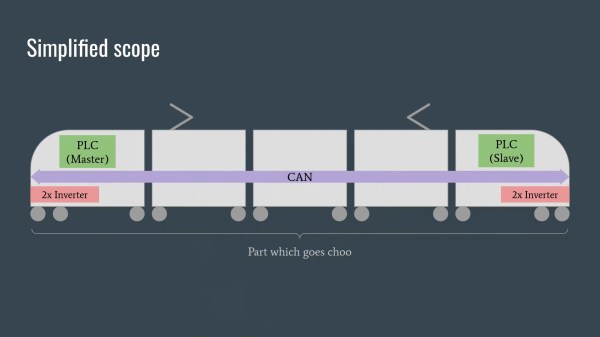
At the heart of the problem are the PLCs which control all aspects of a modern rail traction system, which thanks to a trio of Poland and Germany based researchers have been found to play a range of nasty tricks. They’ll return bogus error codes after a set date which would presumably be reset by the official service, if the train has been laid up for a while, or even if they are detected via GPS to have visited a third-party workshop. Their work will be the subject of a talk at 37C3 which should be worth watching out for.

It will be especially interesting to juxtapose the reaction to this revelation with cases such as the Deere tractors, because of course Poland is part of the European Union. We’re not specialist EU competition lawyers, but we know enough to know that the EU takes a dim view of these types of practices and has been strong on the right to repair. Who knows, Polish trains may contribute further to the rights of all Europeans.

Big Red Button Puts Toddler In Command Of Chromecast

Controversial position: the world needs more buttons. We’ve gotten so far away from physical interfaces like buttons, knobs, and switches in favor of sleek but sterile touch-screen “controls” that when we see something like this big red button so toddlers can start a TV show, we just have to latch onto the story and see what it’s all about.

As it turns out, the big red button itself is probably the least interesting part of [Mads Chr. Olesen] build. The real meat of the project is the reverse engineering effort needed to get Chromecast to start the show. As [Mads] explains, once upon a time a simple GET request to a URL was all it took to do so, but no more; Google has repeatedly nerfed the Chromecast API over the years, enough that [Mads] had some digging to do.

Luckily, pyChromecast is a thing, but using it for DRTV, a streaming service of the Danish Broadcasting Corporation, required figuring out the AppID of the DRTV app. It looks like [Mads] used Wireshark to sniff traffic to and from the Chromecast, and netlog-viewer to analyze the capture. That and a little Developer Tools action in Chrome led to all the information needed to modify pyChromecast to support DRTV. The rest of the project consisted of building a box for the huge red arcade button and wiring it up to a Wemos D1. A Raspberry Pi actually talks to the Chromecast, and now the toddler is able to call up his favorite show and pause and restart it at will, no parent required.

We appreciate the reverse engineering heroics [Mads] displays here, which provide good general lessons for other purposes. It’s been a while since we’ve seen a Chromecast physical interface build, too, so we appreciate the refresher.