Cart Cruises Abandoned California Rail

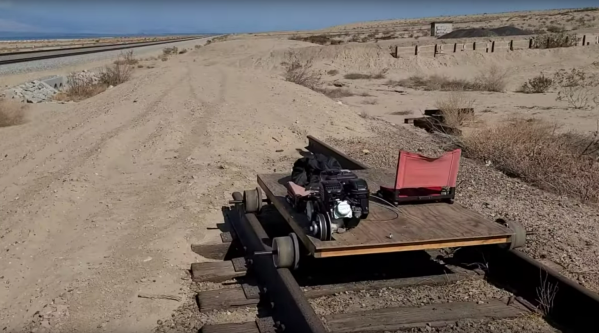
Southern California is known for its nearly perfect year-round climate, excellent surf, and extremely high cost of living, but once you get away from the coast things are radically different. Rural California has huge tracts of land run by the Bureau of Land Management (BLM), which is publicly accessible to anyone willing to venture into the deserts. There’s not much in the way of infrastructure out there, but [Ryan] does have a unique way of traveling through it using abandoned railroad lines and this custom rail cart.

The frame of this cart is simple enough, it’s little more than 2×3 framing with a plywood deck. Some extra support is added for the motor mount and for the seating location. It uses slightly longer go-kart axles to accommodate the width of the railroad, and a small six horsepower gas engine with a single gear to power the rear axle. There are no brakes other than the riders’ shoes, and while this all seems straightforward enough the real hack here is [Ryan]’s custom wheels. He found that steel or cast wheels were not particularly comfortable on long journeys so after a few attempts he has come up with a home-built polyurethane wheel which is cast in a mold around a steel go-cart wheel and then trimmed on a lathe.

For pure exploration, there’s almost no better place to go than the American west thanks to all the public BLM land available. In this cart, you can explore long distances using an extremely low-cost method of transportation. We’ve added another video of [Ryan] exploring this area below the break to show the cart being used, too, but if you’d like a more multipurpose vehicle to use on abandoned rail near you, take a look at this bicycle which is converted to operate on the railroad.

Continue reading “Cart Cruises Abandoned California Rail”

New Possibilities From Fading Lighting Technology

Like the incandescent bulb before it, the compact fluorescent (CFL) bulb is rapidly fading into obscurity as there are fewer and fewer reasons to use them over their LED successors. But there are plenty of things to do with some of the more interesting circuitry that made these relatively efficient light bulbs work, and [mircemk] is here to show us some of them.

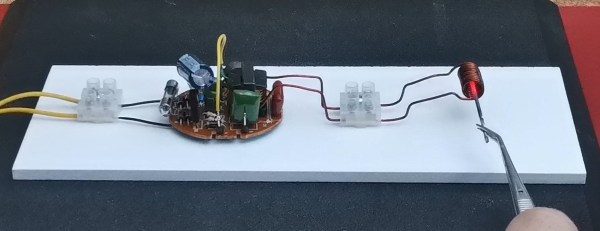
Fluorescent bulbs require a high voltage to work properly, and while this was easy enough for large ceiling installations, it was a while until this hardware could be placed inside a bulb-sized package. When removed, the high voltage driver from the CFL is used in this case to drive a small inductive heating coil circuit, which can then be used to rapidly heat metals and other objects. After some testing, [mircemk] found that the electronics on the CFL circuit board were able to easily handle the electrical load of its new task.

When old technology fades away, there are often a lot of interesting use cases just waiting to be found. [mircemk] reports that he was able to find these light bulbs at an extremely low price due to low demand caused by LEDs, so anyone needing a high voltage driver board for something like a small Tesla coil might want to look at a CFL first.

Pi Pico Calculates Water Usage

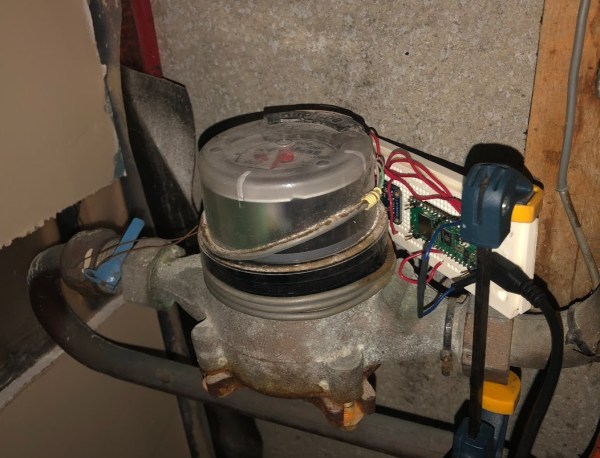
Modern WiFi-enabled microcontrollers have made it affordable and easy to monitor everything from local weather information to electricity usage with typically no more than a few dollars worth of hardware and a little bit of programming knowledge. Monitoring one’s own utility data can be a little bit more difficult without interfering with the metering equipment, but we have seen some clever ways of doing this over the years. The latest is this water meter monitoring device based on a Raspberry Pi Pico.

The clever thing here isn’t so much that it’s based on the tiniest of Raspberry Pis, but how it keeps track of the somewhat obscured water flow information coming from the meter. Using a magnetometer placed close to the meter, the device can sense the magnetic field created as water flows through the meter’s internal sensors. The magnetic field changes in a non-obvious way as water flows through it, so the program has to watch for specific peaks in the magnetic field. Each of these specific waveforms the magnetometer detects counts to 0.0657 liters of water, which is accurate for most purposes.

For interfacing with a utility meter, this is one of the more efficient and elegant hacks we’ve seen in a while. There have, of course, been other attempts to literally read the meter using web cams and computer vision software, but the configuration for these builds is much more complex than something like this. You can interface with plenty of utility meters other than water meters, too, regardless of age.

Pushing Crates In 8-bit Color

Moore’s law isn’t strictly holding anymore, but it is still true that most computing systems are at least trending towards lower cost over time, if not also slightly smaller size. This means wider access to less expensive hardware, even if that hardware is still an 8-bit microcontroller. While some move on to more powerful platforms as a result of this trend, there are others still fighting to push these platforms to the edge. [lcamtuf] has been working to this end, stretching a small AVR microcontroller to not only play a classic video game, but to display it on a color display. Continue reading “Pushing Crates In 8-bit Color”

Hunting For Space Pirates

Ever since the first artificial satellite was launched into orbit, radio operators around the world have been tuning in to their space-based transmissions. Sputnik 1 only sent back pulses of radio waves, but in the decades to follow ever more advanced radio satellites were put into service that could support two-way communications from Earth to space and back again.

Some of these early satellites were somewhat lacking in security, though, and have been re-purposed by various pirates around the world for their own ends. [Gabe] aka [saveitforparts] is here to show us how to hunt for those pirates and listen in on their radio traffic.

Pirates on these satellites have typically used them for illicit activities, and it is still illegal to use them for non-governmental or non-military purposes, so [Gabe] notes that he will only be receiving, not transmitting. The signals he is tuning in to are VHF transmissions, specifically around 220 MHz. That puts them easily within the reach of the RTL-SDR and common ham radio equipment, but since they are coming from space a more directional antenna is needed. [Gabe] quickly builds a Yagi antenna from scrap, tuned specifically to 255 MHz, and mounts it to an old remote-controlled security camera mount which allows him to point it exactly at the satellite and monitor transmissions.

From there he is able to pick up what looks like a few encrypted and/or digital transmissions, plus analog transmissions of likely pirates speaking a language he guesses to be Portuguese. He also hears what he thinks is a foreign TV broadcast, but oddly enough turns out to be NPR. These aren’t the only signals in space to tune to, either. There are plenty of purpose-built ham radio satellites available for any licensed person to use, and we’ve also seen this other RTL-SDR configured to snoop on Starlink signals.

Continue reading “Hunting For Space Pirates”

A Linux Distro For All Your Ham Needs

For anyone new to the world of ham radio, one of the things that takes a little getting used to is visiting the websites of authoritative experts in various fields and feeling like you’ve traveled back to the Internet of 1999. As a hobby that lends itself to extremely utilitarian amateurs, the software side can feel a little left behind like that. [Andy] aka [KB1OIQ], on the other hand, is also a Linux enthusiast and has been putting together a complete Linux distribution with everything needed to operate a radio in the modern era.

While most ham radio software seems to be developed for Windows, there is a lot available for Linux. It just takes a bit of tinkering and experimentation to get everything configured just right. Andy’s Ham Radio Linux, or AHRL, takes a lot of the guesswork out of this. The distribution includes everything from contact logging software to antenna modeling, propagation forecasting, and electronic design. While tools like this are largely optional for operating radios themselves, there are also tools included to allow the user to operate various digital modes as well, which require some sort of computer interface to use.

The other design consideration [Andy] made was something that most hams consider when choosing software, which is that it should be able to run on extremely modest hardware. To that end, the distribution is based around Xubuntu and can run on ten-year-old machines with as little as 2 GB of RAM. And, for those interested more in software-defined radio specifically, there is another Debian-based Linux distribution called DragonOS that we’ve featured a few other times as well which is also worth checking out.

Continue reading “A Linux Distro For All Your Ham Needs”

Digital Replica Of Antique Weather Monitoring Instrument

Computers and digital sensors have allowed for the collection and aggregation of data barely possible to imagine to anyone in the instrumentation scene even sixty years ago. Before that, things like weather stations, seismometers, level sensors, and basically any other way of gathering real data about the world would have been performed with an analog device recording the information on some sort of spool of paper. This was much more tedious but the one thing going for these types of devices was their aesthetic. [mircemk] is back to bring some of that design inspiration to a digital barometric display.

The barometer is based around an Arduino Arduino Nano and a relatively large I2C display to display the captured data. It also uses a BME 280 pressure sensor board, but the technical details of this project are not the focal point here. Instead, [mircemk] has put his effort in recreating the old analog barographs, which display barometric data on a spool of paper over time, on the I2C display. As the device measures atmospheric pressure, it adds a bar to the graph, displaying the data over time much as the old analog device would have.

We’ve discussed plenty of times around here that old analog meters and instrumentation like this recreation of a VU meter are an excellent way of getting a more antique aesthetic than is typically offered by digital replacements. Adding in a little bit of style to a project like this can go a long way, or you can simply restore the original antique instead.