Rolling Old School With Copy Protection From The 1980s

Oh, for the old days when sailing the seas of piracy was as simple as hooking a couple of VCRs together with a dubbing cable. Sure, the video quality degraded with each generation, but it was so bad to start out with that not paying $25 for a copy of “Ghostbusters” was a value proposition. But then came The Man with all his “rules” and “laws” about not stealing, and suddenly tapes weren’t so easy to copy.

If you’ve ever wondered how copy protection worked in pre-digital media, wonder no more. [Technology Connections] has done a nice primer on one of the main copy protection scheme from the VHS days. It was dubbed “Analog Protection System” or “Analog Copy Protection” by Macrovision, the company that developed it. Ironically, Macrovision the company later morphed into the TiVo Corporation.

The idea for Macrovision copy protection was to leverage the difference between what a TV would accept as a valid analog signal and what the VCR could handle. It used the vertical blanking interval (VBI) in the analog signal, the time during which the electron beam returns to the top of the frame. Normally the VBI has signals that the VCR uses to set its recording levels, but Macrovision figured out that sending extra signals in the VBI fooled the VCR’s automatic gain controls into varying the brightness of the recorded scenes. They also messed with the vertical synchronization, and the effect was to make dubbed tapes unwatchable, even by 1985 standards.

Copy protection was pretty effective, and pretty clever given the constraints. With Digital Rights Management, it’s easier to put limits on almost anything — coffee makers, arcade games, and even kitty litter all sport copy protection these days. It almost makes us nostalgic for the 80s.

Continue reading “Rolling Old School With Copy Protection From The 1980s”

Vintage Organ Donates Parts For Two New Instruments

It’s often hard to know what to do with a classic bit of electronics that’s taking up far too much of the living room for its own good. But when the thing in question is an electronic organ from the 1970s, the answer couldn’t be clearer: dissect it for its good parts and create two new instruments with them.

Judging by [Charlie Williams]’ blog posts on his Viscount Project, he’s been at this since at least 2014. The offending organ, from which the project gets its name, is a Viscount Bahia from the 1970s that had seen better days, apparently none of which included a good dusting. With careful disassembly and documentation, [Charlie] took the organ to bits. The first instrument to come from this was based on the foot pedals. A Teensy and a custom wood case turned it into a custom MIDI controller; hear it in action below. The beats controller from the organ’s keyboard was used for the second instrument. This one appears far more complex, not only for the beautiful, hand-held wooden case he built for it, but because he reused most of the original circuitry. A modern tube amp was added to produce a little distortion and stereo output from the original mono source, with the tip of the tube just peeking above the surface of the instrument. We wish there were a demo video of this one, but we’ll settle for gazing at the craftsmanship.

In a strange bit of timing, [Elliot Williams] (no relation, we assume) just posted an Ask Hackaday piece looking for help with a replacement top-octave generator for another 1970s organ. It’s got a good description of how these organs worked, if you’re in the mood to learn a little more.

Continue reading “Vintage Organ Donates Parts For Two New Instruments”

A Nicely Crafted POV Lightsaber

We need to have a talk. As tough a pill as it is to swallow, we have to face that fact that some of the technology promised to us by Hollywood writers and prop makers just isn’t going to come true. We’re never going to have a flux capacitor, actual hoverboards aren’t a real thing, and nobody is going to have sword fights with laser beams.

But just because we can’t have real versions of these devices doesn’t mean we can’t make our own prop versions with a few value-added features, like this cool persistence-of-vision lightsaber. [Luni], better known around these parts as [Bitluni] and for his eponymous YouTube channel where he performs wizardry like turning an ESP32 into a software-defined television station, shows he’s no slouch at more mechanical builds either. The hardware is standard POV fare, with a gyro to sense the position of the lightsaber hilt and an ESP32 to run the long Neopixel strip in the blade. There’s also a LiPo pack and a biggish DC-DC converter; the latter contributes mightily to the look of the prop, with its large heatsinks that stick out from the end of the aluminum tubing hilt. There’s also a small speaker and amp for the requisite sound effects on startup and shutdown, and the position-sensitive thrumming is a nice touch too. Check out the POV action in the video below.

What’s that you say? You recall seeing a real lightsaber here before? Well, sort of, but that’s pushing things a bit. Or perhaps you’ve got this more destructive version in mind.

Continue reading “A Nicely Crafted POV Lightsaber”

DIY Submersible Aims For Low Cost, Ease Of Operation

If you’re like us, a body of water is a source of wonder and awe. The wonder comes from imagining what lies hidden below the surface, and the awe is from the fear of trying to find out and becoming one of those submerged objects on a permanent basis. So if you want to explore the depths in relative comfort and safety, a DIY remotely operated underwater vehicle might be the thing you need to build.

Most ROV builds these days seem to follow more or less similar designs, which is probably because they all share project goals similar to those of [dcolemans]: build something to take a look around under the water, make it easy to operate, and don’t spend a ton of money. To achieve that, he used 1/2″ PVC pipe and fittings to build the frame and painted it yellow for visibility. A dry tube for the electronics was fashioned from 4″ ABS pipe. The positive buoyancy provided by the dry tube is almost canceled out by the water flooding the frame through weep holes and the lead shot ballast stored in the landing skids. Propulsion is provided by bilge pump cartridges with 3D-printed ducted propellers. A nice touch is a separate topside control box with a screen for the ROV’s camera that talks to a regular RC controller, along with simplified controls and automatic station keeping. Check out the recent swimming pool test in the video below.

There’s a lot going on under the sea, and plenty of ways to explore it. You could deploy sensors shaped like clams, zap underwater lice with lasers, or even glide your way to a Hackaday Prize.

Continue reading “DIY Submersible Aims For Low Cost, Ease Of Operation”

Wireless Charger Gives A Glimpse Into Industrial Design Process

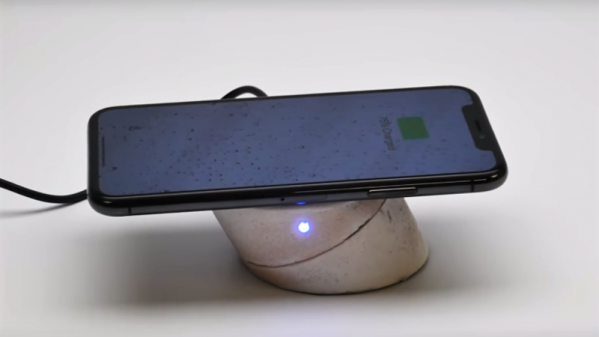
Almost every product on the market has been through the hands of an industrial designer at some point in its development. From the phone in your pocket to the car in your driveway or the vacuum in your closet, the way things look and work is the result of a careful design process. Taking a look inside that process, like with this wireless phone charger concept, is fascinating and can yield really valuable design insights.

We’ve featured lots of [Eric Strebel]’s work before, mainly for the great fabrication tips and tricks he offers, like how to get a fine painted finish or the many uses of Bondo. But this time around, he walks us through a condensed version of his design process for a wireless phone charger and stand. His client had specific requirements, like being able to have the phone held up in landscape or portrait mode, so he started with pen and paper and sketched some ideas. A swiveling cylinder seemed to fit the bill, and after a quick mockup in PVC pipe, he started work on a full-size prototype in urethane foam. There are some great fabrication tips in the video below, mainly centered on dealing with not owning a lathe.

The thing for us with all of [Eric]’s videos, but especially this one, is seeing the design process laid out, from beginning to (almost) the end. He sure makes industrial design look like a cool gig, one that would appeal to the Jacks- and Jills-of-all-trades who hang out around here.

Continue reading “Wireless Charger Gives A Glimpse Into Industrial Design Process”

Linear Clock Is A Different Way To Look At Time

There are usually two broad user interfaces for clocks. On the one hand you’ve got the dial clock, the default display for centuries, with its numbered face and spinning hands. The other mode is some form of digital clock, where the current time is displayed directly as alphanumeric characters. They’re both useful representations of time, but they both have their limits.

Here’s a third model — the linear clock. [Jan Derogee] came up with it thanks to the inspiration of somewhat dubious run-ins with other kinds of clocks; we feel like this introductory video was made with tongue firmly planted in cheek. Whatever the inspiration, we find this idea clever and well executed. The running gear of the clock is just a long piece of M6 threaded rod and a stepper motor. A pointer connected to a nut rides on the rod, moving as the stepper rotates it. There are scales flanking the vertical rod, with the morning hours going up the left side and afternoon hours coming down the right. The threaded rod rotates one way for twelve hours before switching to the other direction; when the rotation changes, the pointer automatically swivels to the right scale. For alarms, [Jan] has brass rods running along each scale that make contact with the pointer; when they encounter a sliding plastic insulator to break the contact, it triggers an alarm. An ESP8266 controls everything and plays the audio files for the alarm.

Unusual clocks seem to be a thing with [Jan]. His other builds include this neat phosphorescent clock and YouTube subs counter, which is sure to turn heads along with this clock.

Continue reading “Linear Clock Is A Different Way To Look At Time”

Hacking When It Counts: The Pioneer Missions

If the heady early days of space exploration taught us anything, it was how much we just didn’t know. Failure after failure mounted, often dramatic and expensive and sometimes deadly. Launch vehicles exploded, satellites failed to deploy, or some widget decided to give up the ghost at a crucial time, blinding a multi-million dollar probe and ending a mission long before any useful science was done. For the United States, with a deadline to meet for manned missions to the moon, every failure in the late 1950s and early 1960s was valuable, though, at least to the extent that it taught them what not to do next time.

For the scientists planning unmanned missions, there was another, later deadline looming that presented a rare opportunity to expand our knowledge of the outer solar system, a strange and as yet unexplored wilderness with the potential to destroy anything humans could build and send there. Before investing billions in missions to take a Grand Tour of the outer planets, they needed more information. They needed to send out some Pioneers.

Continue reading “Hacking When It Counts: The Pioneer Missions”