Ted Dabney, Atari, And The Video Game Revolution

It may be hard for those raised on cinematic video games to conceive of the wonder of watching a plain white dot tracing across a black screen, reflecting off walls and bounced by a little paddle that responded instantly to the twist of a wrist. But there was a time when Pong was all we had, and it was fascinating. People lined up for hours for the privilege of exchanging a quarter for a few minutes of monochrome distraction. In an arcade stuffed with noisy pinball machines with garish artwork and flashing lights, Pong seemed like a calm oasis, and you could almost feel your brain doing the geometry to figure out where to place the paddle so as not to miss the shot.

As primitive as it now seems, Pong was at the forefront of the video game revolution, and that little game spawned an industry that raked in $108 billion last year alone. It also spawned one of the early success stories of the industry, Atari, a company founded in 1972. Just last week, Ted Dabney, one of the co-founders of Atari, died at the age of 81. It’s sad that we’re getting to the point where we’re losing some of the pioneers of the industry, but it’s the way of things. All we can do is reflect on Dabney’s life and legacy, and examine the improbable path that led him to be one of the fathers of the video game industry.

Continue reading “Ted Dabney, Atari, And The Video Game Revolution”
Drifting Instrument Presents Opportunity To Learn About Crystal Oscillators

Sure, we all love fixing stuff, but there’s often a fine line between something that’s worth repairing and something that’s cheaper in the long run to just replace. That line gets blurred, though, when there’s something to be learned from a repair.

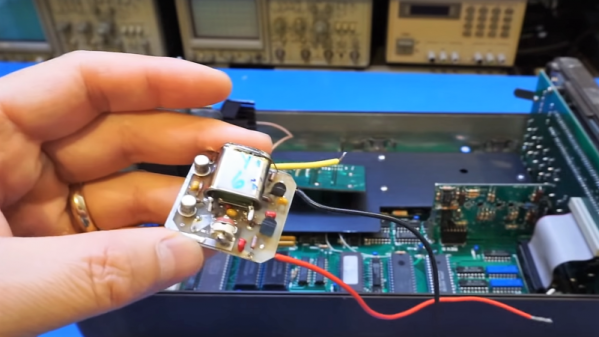
This wonky temperature-compensated crystal oscillator is a good example of leaning toward repair just for the opportunity to peek inside. [Kerry Wong] identified it as the problem behind a programmable frequency counter reading significantly low. A TCXO is supposed to output a fixed frequency signal that stays stable over a range of temperatures by using a temperature sensor to adjust a voltage-controlled oscillator that corrects for the crystal’s natural tendency to vary its frequency as it gets hotter or colder. But this TCXO was pretty old, and even the trimmer capacitor provided was no longer enough to nudge it back in range. [Kerry] did some Dremel surgery on the case and came to the conclusion that adding another trim cap between one of the crystal’s leads and ground would help. This gave him a much wider adjustment range and let him zero in on the correct 10-MHz setting. [Mr. Murphy] still runs the show, though – after he got the TCXO buttoned up with the new trimmer inaccessible, he found that the frequency was not quite right. But going from 2 kHz off to only 2 Hz is still pretty good.

Whether it’s the weird world of microwave electronics or building a whole-house battery bank, it’s always fun to watch [Kerry]’s videos, and we usually end up learning a thing or two.

Continue reading “Drifting Instrument Presents Opportunity To Learn About Crystal Oscillators”

A 100th Birthday Celebration For The Flip Flop

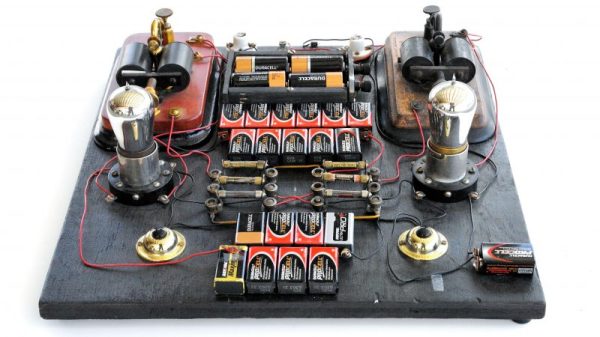
It’s easy to get caught up in the excitement of creation as we’re building our latest widget. By the same token, it’s sometimes difficult to fully appreciate just how old some of the circuits we use are. Even the simplest of projects might make use of elements that were once a mess on some physicist’s or engineer’s lab bench, with components screwed to literal breadboards and power supplied by banks of wet-cell batteries.

One such circuit turns 100 years old in June, which is surprising because it literally is the building block of every computer. It’s the flip-flop, and while its inventors likely couldn’t have imagined what they were starting, their innovation became the basic storage system for the ones and zeros of the digital age.

Continue reading “A 100th Birthday Celebration For The Flip Flop”

Trashed Vector Game Console Revived With Vintage IBM Monitor

We’ve all had the heartbreak of ordering something online, only to have it arrive in less than mint condition. Such are the risks of plying the global marketplace, only more so for used gear, which seems to be a special target for the wrath of sadistic custom agents and package handlers all along the supply chain.

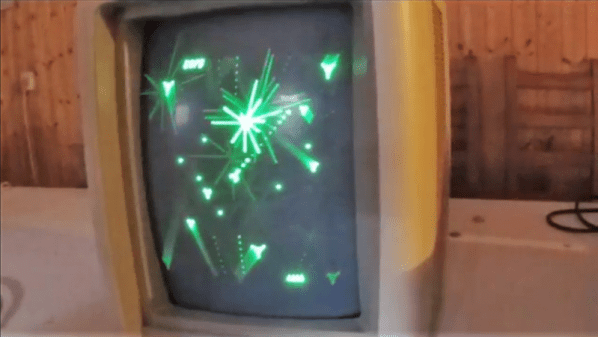
This cruel fate befell a vintage Vectrex game console ordered by [Senile Data Systems]; the case was cracked and the CRT was an imploded mass of shards. Disappointing, to say the least, but not fatal, as he was able to make a working console from the remains of the Vectrex and an old IBM monitor. The Google translation is a little rough, but from what we can gather, the Vectrex, a vector-graphics console from the early 80s with such hits as MineStorm, Star Castle, and Clean Sweep, was in decent shape apart from the CRT. So with an old IBM 5151 green phosphor monitor, complete with a burned-in menu bar, was recruited to stand in for the damaged components. The Vectrex guts, including the long-gone CRT’s deflection yoke assembly, were transplanted to the new case. A little room was made for the original game cartridges, a new controller was fashioned from a Nintendo candy tin, and pretty soon those classic games were streaking and smearing across the long-persistence phosphors. We have to admit the video below looks pretty trippy.

If arcade restorations are your thing, display replacements like this are probably part of the fun. Here’s a post about replacing an arcade display with a trash bin CRT TV, an important skill to have is this business.

Continue reading “Trashed Vector Game Console Revived With Vintage IBM Monitor”

Autonomous Spaceplane Travels To 10 Km, Lands Safely 200 Km Away

Space balloons, where one sends instrument packages to the edge of space on a weather balloon, are a low-cost way to scratch the space itch. But once you’ve logged the pressure and temperature and tracked your balloon, what’s the next challenge? How about releasing an autonomous glider and having it return itself to Earth safely?

That’s what [IzzyBrand] and his cohorts did, and we have to say we’re mightily impressed. The glider itself looks like nothing to write home about: in true Flite Test fashion, it’s just a flying wing made with foam core and Coroplast reinforced with duct tape. A pair of servo-controlled elevons lies on the trailing edge of the wings, while inside the fuselage are a Raspberry Pi and a Pixhawk flight controller along with a GPS receiver. Cameras point fore and aft, a pair of 5200 mAh batteries provide the juice, and handwarmers stuffed into the avionics bay prevent freezing.

After a long series of test releases from a quadcopter, flight day finally came. Winds aloft prevented a full 30-kilometer release, so the glider was set free at 10 kilometers. The glider then proceeded to a pre-programmed landing zone over 80 kilometers from the release point. At one point the winds were literally pushing the glider backward, but the little plane prevailed and eventually spiraled down to a perfect landing.

We’ve been covering space balloons for a while, but take a moment to consider the accomplishment presented here. On a shoestring budget, a team of amateurs hit a target the size of two soccer fields with an autonomous aircraft from a range of almost 200 kilometers. That’s why we’re impressed, and we can’t wait to see what they can do after a release from the edge of space.

Continue reading “Autonomous Spaceplane Travels To 10 Km, Lands Safely 200 Km Away”

Monitoring Air Quality, One Sleepy Meeting At A Time

To those of us in the corporate world, the conference room is where hope goes to die. Crammed into a space too small for the number of invitees, the room soon glows with radiated body heat and the aromas of humans as the time from their last shower gradually increases. To say it’s not a recipe for productivity is an understatement at best.

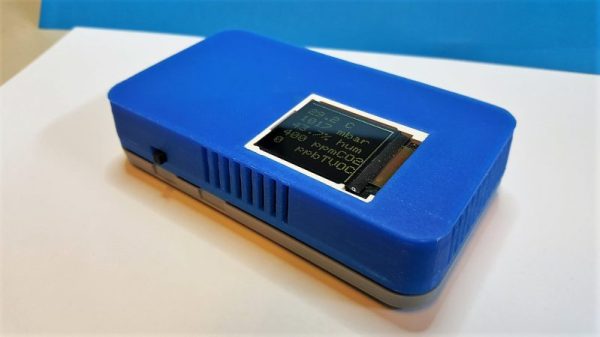
Having suffered through too many of these soporific situations, [Charles Ouweland] took matters into his own hands and built this portable air quality meter for meetings. With an OLED display on top and sensors inside, it displays not only the temperature, humidity, and barometric pressure, but also the CO₂ concentration and the levels of volatile organic compounds (VOC), noxious substances sometimes off-gassed from building materials, furniture upholstery, and coworkers alike.

The monitor quantifies his meeting misery, which we’re sure wins him points with his colleagues. For our part, though, what we find interesting is his design process. He started where many of us would, with an Arduino Uno. The sensor modules, a CCS811 for VOC and CO₂ as well as a BME280 for temperature, humidity, and pressure, both needed 3.3 volts, so he added a regulator to knock the Arduino’s 5-volt supply into range and some MOSFETs for level matching. Things were getting bulky, though, so he set about reducing the component count. The Uno went by stripping out its already programmed MCU. That killed the need for the regulator and MOSFETs, since everything would be happy with 3.3 volts. A few more rounds of optimization led to the final product, compact enough to run on a pair of AA batteries.

This is a great lesson in going from prototype to product. And it’s so compact, it could even ride on top of a Roomba to map the conference room’s floor-level air quality.

This Mostly 3D-Printed Discone Antenna Is Ready For Broadband Duty

For hams and other radio enthusiasts, the best part of the hobby is often designing antennas. Part black magic, part hard science, and part engineering, antenna design is an art. And while the expression of that art often ends up boiling down to pieces of wire cut to the correct length, some antennas have a little more going on in the aesthetics department.

Take the discone antenna, for example. Originally designed as a broadband antenna to sprout from aircraft fuselages, the discone has found a niche with public service radio listeners. But with a disk stuck to the top of a cone, the antennas have been a little hard to homebrew, at least until [ByTechLab] released this mostly 3D-printed discone. A quick look at the finished product, resembling a sweater drying rack more than a disc on top of a cone, reveals that the two shapes can be approximated by individual elements instead of solid surfaces. This is the way most practical discones are built, and [ByTechLab]’s Thingiverse page has the files needed to print the parts needed to properly orient the elements, which are just 6-mm aluminum rods. The printed hub pieces sandwich a copper plate to tie the elements together electrically while providing a feedpoint for the antenna as well as a sturdy place to mount it outdoors. This differs quite a bit from the last 3D-printed discone we featured, which used the solid geometry and was geared more for indoor use.

Interested in other antenna designs? Who can blame you? Check out the theory behind the Yagi-Uda beam antenna, or how to turn junk into a WiFi dish antenna.

[via RTL-SDR.com]