FDA Approves Ventilator Designed By NASA’s Jet Propulsion Laboratory

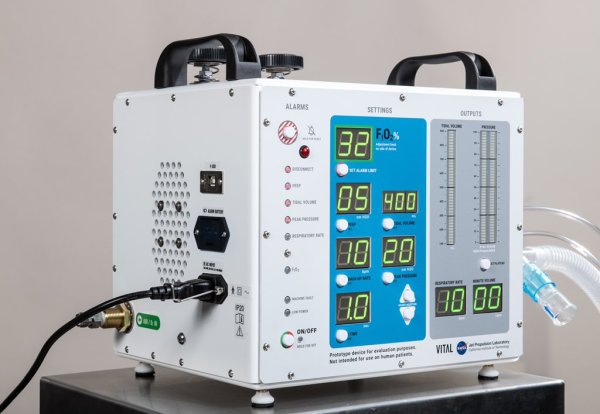
Yesterday NASA’s Jet Propulsion Laboratory announced that their ventilator design has received Emergency Use Authorization from the US Food and Drug Administration. This paves the way for the design to be manufactured for use in the treatment of COVID-19 patients.

JPL, which is tightly partnered with the California Institute of Technology, designed the ventilator for rapid manufacturing to meet the current need for respiratory tools made scarce by the pandemic. The design process took only 37 days and was submitted for FDA approval around April 23rd. They call it VITAL — Ventilator Intervention Technology Accessible Locally — a nod to NASA’s proclivity for acronyms.

Continue reading “FDA Approves Ventilator Designed By NASA’s Jet Propulsion Laboratory”

This Week In Security: Firewall 0-day, Apple’s Response, And An Android Bluetooth Bug

Sophos firewall appliances are actively being attacked by a 0-day exploit chain that originates with a SQL injection. That injection is a nasty one, as it can be launched from the WAN user portal. The observed attack used that vulnerability to inject a shell command into the device database, where it would eventually be run automatically. If you have an affected Sophos device, go check that the hotfix was automatically installed.

While the vulnerability was a bad one, Sophos’ response here is laudable. They publicly disclosed the attack less than 24 hours after they were notified of it’s existence in the wild, and began rolling a fix out within three days. Additionally, Sophos engineers did a really detailed write-up (linked above) giving us all the details of the attack. The hotfix that closes the vulnerability also attempts to clean up the infection, although there are some additional manual steps that are suggested if your device was compromised. Continue reading “This Week In Security: Firewall 0-day, Apple’s Response, And An Android Bluetooth Bug”

Wolfram Physics Project Seeks Theory Of Everything; Is It Revelation Or Overstatement?

Stephen Wolfram, inventor of the Wolfram computational language and the Mathematica software, announced that he may have found a path to the holy grail of physics: A fundamental theory of everything. Even with the subjunctive, this is certainly a powerful statement that should be met with some skepticism.

What is considered a fundamental theory of physics? In our current understanding, there are four fundamental forces in nature: the electromagnetic force, the weak force, the strong force, and gravity. Currently, the description of these forces is divided into two parts: General Relativity (GR), describing the nature of gravity that dominates physics on astronomical scales. Quantum Field Theory (QFT) describes the other three forces and explains all of particle physics. Continue reading “Wolfram Physics Project Seeks Theory Of Everything; Is It Revelation Or Overstatement?”

NASA Readies New Electric X-Plane For First Flight

Since 1951, NASA (known in those pre-space days as NACA) and the United States Air Force have used the “X” designation for experimental aircraft that push technological boundaries. The best known of these vehicles, such as the X-1 and X-15, were used to study flight at extreme altitude and speed. Several fighter jets got their start as X-planes over the decades, and a number of hypersonic scramjet vehicles have flown under the banner. As such, the X-planes are often thought of as the epitome of speed and maneuverability.

So the X-57 Maxwell, NASA’s first piloted X-plane in two decades, might seem like something of a departure from the blistering performance of its predecessors. It’s not going to fly very fast, it won’t be making any high-G turns, and it certainly won’t be clawing its way through the upper atmosphere. The crew’s flight gear won’t even be anything more exotic than a polo and a pair of shorts. As far as cutting-edge experimental aircraft go, the X-57 is about as laid back as it gets.

But like previous X-planes, the Maxwell will one day be looked back on as a technological milestone of its own. Just as the X-1 helped usher in the era of supersonic flight, the X-57 has been developed so engineers can better understand the unique challenges of piloted electric aircraft. Before they can operate in the public airspace, the performance characteristics and limitations of electric planes must be explored in real-world scenarios. The experiments performed with the X-57 will help guide certification programs and government rule making that needs to be in place before such aircraft can operate on a large scale.

Continue reading “NASA Readies New Electric X-Plane For First Flight”

Greatest Keycaps And Where To Find Them

Look at your keyboard. Do the keycaps excite you? That’s what we thought. You pound on that thing day in and day out. Shouldn’t it at least be attractive? Or even happiness-inducing? You don’t necessarily have to replace every single keycap to spark joy. When it comes to artisan keycaps, the point is to have something that stands out.

How about an Escape key that looks like a tall stack of flapjacks or a tiny, intricate cream puff? From a practical standpoint, how about a spiky Escape key that makes you think twice about rage quitting?

If you’re into games or anime, chances are good that there are more than enough artisan keycaps out there to keep you cash-poor for a while. The same goes for scrumptious foodstuffs with Cherry MX-compatible stems.

In this day and age, you can get just about any type of keycap you want, especially those encapsulating pop culture phenomena and fads. Yes there’s a fidget spinner keycap, and it’s adorable.

Continue reading “Greatest Keycaps And Where To Find Them”

Teardown: VTech Whiz Kid Luggable Computer

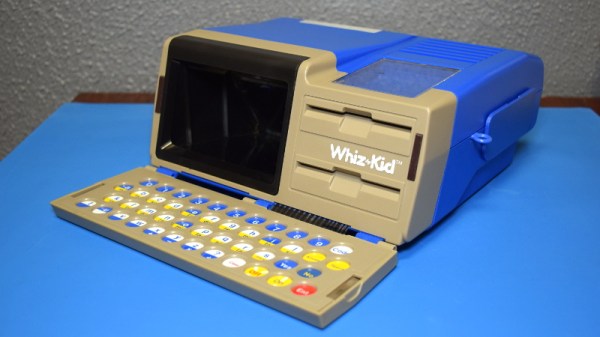
Back in the early 1980s, hotshot business types on the go would have used what were referred to at the time as portable computers from companies like Osborne or Kaypro. Due to the technical limitations of the era these so-called “luggables” were only slightly smaller and lighter than contemporary desktop computers, but they had integrated displays and keyboards so they were a bit easier to move around. A few years later the first generation of laptops would hit the market, and the portables predictably fell out of favor. Today they’re relatively rare collectors items; a largely forgotten first step in the steady march towards true mobile computing.

Which makes the 1984 edition of VTech’s “Whiz Kid” educational computer an especially unique specimen. The company’s later entries into the series of popular electronic toys would adopt (with some variations) the standard laptop form factor, but this version has the distinction of being what might be the most authentic luggable computer ever made for children. When this toy was being designed it would have been a reflection of the cutting edge in computer technology, but today, it’s a fascinating reminder that the latest-and-greatest doesn’t always stick around for very long.

The classic luggable hallmarks are all here. The flip down keyboard, the small and strangely offset display, there’s even lugs on the side to attach an included strap so the youngster can sling it over their shoulder. On the other hand, the fact that it’s just a toy allowed for some advantages over the real thing: it can actually run on battery power, and is quite lightweight relative to its size.

When we last took a peek inside one of VTech’s offerings, we found a surprisingly powerful Z80 machine that was more than deserving of its PreComputer moniker. But that BASIC-compatible design hailed from the late 80s, and was specifically marketed as a trainer for the next generation of computer owners. Will the 1984 Whiz Kid prove to have a similar relationship to its adult counterparts, or does the resemblance only go skin deep? Let’s find out.

Continue reading “Teardown: VTech Whiz Kid Luggable Computer”

ReactOS: Dipping A Toe In A Millennium-era Open Source Dream

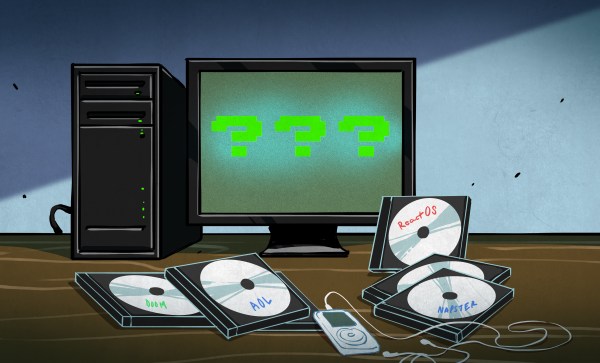
Do you remember when trying a new OS meant burning a CD? Not merely downloading an ISO and mounting it on a USB drive, but taking a circle of polycarbonate and hoping you didn’t get a buffer underrun as the file you’d spent an entire day downloading was burned onto it. A couple of decades ago that was how we’d take a look at a new Linux distro, and at the time we considered it to be nothing short of incredible that such a thing was possible. One of the ISOs I remember downloading back then was an early version of ReactOS, a project with the lofty aim of creating an open-source equivalent of Windows NT. You might think that in the nearly two decades since then it would have become an irrelevance and its contributors moved on to other work, but no. ReactOS is very much still with us, and indeed has just seen a new release. Version 0.4.13 is the latest in a long line of incremental updates, and remembering those early ReactOS ISOs when I saw their announcement, I thought I’d give it a spin. The result was both a peek at the current state of the project, and a chance to think about the place of a Windows clone in 2020. Continue reading “ReactOS: Dipping A Toe In A Millennium-era Open Source Dream”