RGB Sensor’s New Job: Cryptocurrency Trade Advisor

[XenonJohn] dabbles in cryptocurrency trading, and when he saw an opportunity to buy an RGB color sensor, his immediate thought — which he admitted to us would probably not be the immediate thought of most normal people — was that he could point it to his laptop screen and have it analyze the ratio of green (buy) orders to red (sell) orders being made for crypto trading. In theory, if at a given moment there are more people looking to buy than there are people looking to sell, the value of a commodity could be expected to go up slightly in the short-term. The reverse is true if a lot of sell orders coming in relative to buy orders. Having this information and possibly acting on it could be useful, but then again it might not. Either way, as far as out-of-left-field project ideas go, promoting an RGB color sensor to Cryptocurrency Trading Advisor is a pretty good one.

Since the RGB sensor only sees what is directly in front of it, [XenonJohn] assembled a sort of simple light guide. By enclosing the area of the screen that contains orders in foil-lined cardboard, the sensor can get a general approximation of the amount of red (sell orders) versus green (buy orders). The data gets read by an Arduino which does a simple analysis and sends alerts when a threshold is crossed. He dubbed it the Crypto-Eye, and a video demo is embedded below.

Continue reading “RGB Sensor’s New Job: Cryptocurrency Trade Advisor”

Colorchord steampunk dead bug device

Electronic ColorChord Turns Color Into Sound

[Dr. Cockroach] has delighted us again with another of his circuits on cardboard. He calls it steampunk inspired, and while we guess we can see what he’s getting at, it’s more like a sweet example of artful dead bug construction. He calls it the ColorChord. Point its photo cells at a color and it’ll play a tone or a combination of tones specific to that color.

Three 555-centric boards use thumbtacks as connection points which he solders to, the same technique he used for his cardboard computer. They provide simple tones for red, green, and blue and a mix for any other color. However, he found that the tones weren’t distinguishable enough for similar colors like a bright sun yellow and a reddish yellow. So he ended up pulsing them using master oscillator, master-slave flip-flop, and sequencer circuits, all done dead bug style.

We’re not sure how practical it is but the various pulsed tones remind us of the B space movies of the 1950s and 60s. And as for the look of it, well it’s just plain fun to look at. Hear and see it for yourself in the video below.

And if you want to see some dead bug circuitry as high art then check out this awesome LED ring, this sculptural nixie clock, and perhaps the most wondrous of all, The Clock.

Continue reading “Electronic ColorChord Turns Color Into Sound”

Casting Tour-De-Force Results In Swashplate For Scale Helicopter

While quadcopters seem to attract all the attention of the moment, spare some love for the rotary-wing aircraft that started it all: the helicopter. Quads may abstract away most of the aerodynamic problems faced by other rotorcraft systems through using software, but the helicopter has to solve those problems mechanically. And they are non-trivial problems, since the pitch of the rotors blades has to be controlled while the whole rotor disk is tilted relative to its axis.

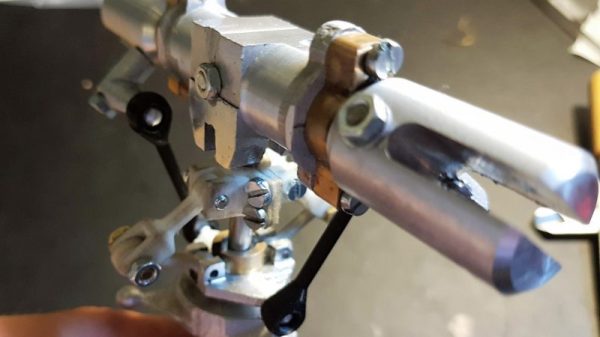
The device that makes this possible is the swashplate, and its engineering is not for the faint of heart. And yet [MonkeyMonkeey] chose not only to build a swashplate from scratch for a high school project, but since the parts were to be cast from aluminum, he had to teach himself the art of metal casting from the ground up. That includes building at least three separate furnaces, one of which was an electric arc furnace based on an arc welder with carbon fiber rods for electrodes (spoiler alert: bad choice). The learning curves were plentiful and steep, including getting the right sand mix for mold making and metallurgy by trial and error.

With some machining help from his school, [MonkeyMonkeey] finally came up with a good design, and we can’t wait to see what the rest of the ‘copter looks like. As he gets there, we’d say he might want to take a look at this series of videos explaining the physics of helicopter flight, but we suspect he’s well-informed on that topic already.

[via r/DIY]

An E-Bike Battery Pack Without Spot Welding

In somewhat of a departure from their normal fare of heavy metal mods, [Make It Extreme] is working on a battery pack for an e-bike that has some interesting design features.

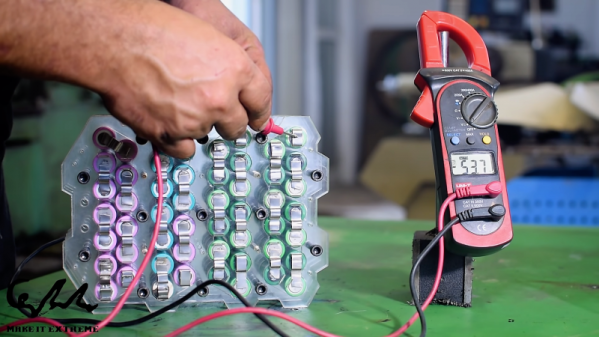
The guts of the pack are pretty much what you’d expect – recovered 18650 lithium-ion cells. They don’t go into details, but we assume the 52 cells were tested and any duds rejected. The arrangement is 13S4P, and the cells are held in place with laser-cut acrylic frames. Rather than spot weld the terminals, [Make It Extreme] used a series of strategically positioned slots to make contacts from folded bits of nickel strip. Solid contact is maintained by cap screws passing between the upper and lower contact frames. A forest of wires connects each cell to one of four BMS boards, and the whole thing is wrapped in a snappy acrylic frame. The build and a simple test are in the video below.

While we like the simplicity of a weld-less design, we wonder how the pack will stand up to vibration with just friction holding the cells in contact. Given their previous electric transportation builds, like this off-road hoverbike, we expect the pack will be put to the test soon, and in extreme fashion.

Continue reading “An E-Bike Battery Pack Without Spot Welding”

Sunny Custom Keyboard Illuminates The Past

Ever wonder why keyboard number pads and telephone dials have reversed layouts? Theories abound, but the most plausible one is that, shrug, it just happened that way. And now we’re stuck with it.

Well, that answer’s not good enough for [Jesse], so he punched up his own keyboard design that combines the golden years of function-rich Sun and IBM keyboards with Ma Bell’s DTMF number arrangement. That’s right, Sundial has 24 function keys total, and the number pad matches Ma Bell’s all the way down to the asterisk/zero/octothorpe pattern on the bottom row. How do we know what the unlabeled ones are, you ask? It’s all mapped out in this layout editor. We love that it has all the key lock indicator lights, because that practice should’ve never faded out in the first place.

Though inspired by this beautiful unicorn of an Arduino keyboard we covered a few months ago, the Sundial uses a Teensy 2.0 to translate [Jesse]’s Cherry MX clone-driven wishes into software commands. It’s also painstakingly hand-wired, so here’s the build log for you to drool over. Just cover up your keyboard first.

Smelting aluminum in a microwave oven

A Different Use For Microwave Oven: Melting Aluminum

Microwave ovens are a treasure trove of useful parts: transformers, an HV capacitor, a piezo speaker, and a high torque motor, to name just a few. In a new twist, [Rulof Maker] strips all that out and uses just the metal case to make a furnace for melting aluminum, copper and bronze.

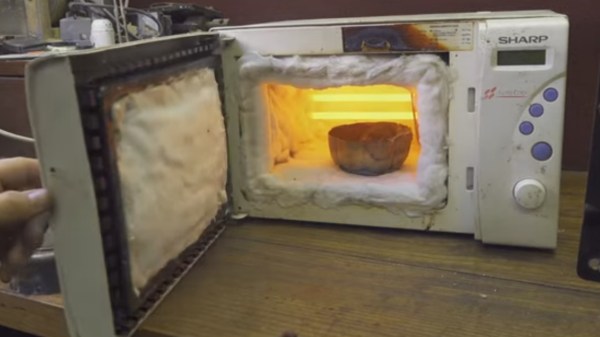
His heat source is a quartet of 110 volt, 450 watt quartz heating elements which he mounts inside in the back. To reduce heat loss, he lines the walls with ceramic fiber insulation. Unfortunately, that includes covering the inside of the window, so there’s no pressing your nose against the glass while you watch the aluminum pieces turn to liquid. If you’re going to try making one of these yourself then you may want to consider adding a fuse.

It does the job though. In around nine minutes he melts enough scrap aluminum in a stainless steel bowl to pour into a mold for a test piece. But don’t take our word for it, see for yourself in the video below.

If want more information on what useful parts are inside then check out this primer. Or you can leave the parts in and use the oven as is for melting lead, but keep a fire extinguisher handy.

Continue reading “A Different Use For Microwave Oven: Melting Aluminum”

TL084 die blocks

Ken Shirriff Found Butterflies In His Op-Amp

In 1976, Texas Instruments came out with the TL084, a four JFET op-amp IC each with similar circuitry to Fairchild’s very popular single op-amp 741. But even though the 741 has been covered in detailed, when [Ken Shirriff] focused his microscope on a TL084, he found some very interesting things.

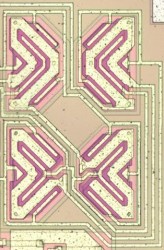
JFETs on the TL084 op-amp

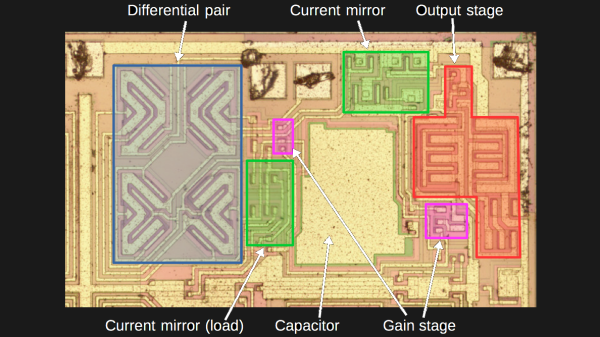
To avoid using acid to get at the die, he instead found a ceramic packaged TL084 and pried off the cover. The first things he saw were four stabilizing capacitors, by far the largest structures on the die and visible to the naked eye.

When he peered into his microscope he next saw butterfly shapes which turned out to be pairs of input JFETs. The wide strips are the gates and the narrower strip surrounded by each gate is the source. The drain is the narrow strip surrounding each gate. Why arrange four JFETs like this? It’s possible to have temperature gradients in the IC, one side being hotter than the other. These gradients can affect the JFET’s characteristics, unbalancing the inputs. Look closely at the way the JFETs are connected and you’ll see that the top-left one is connected to the bottom-right one, and similarly for the other two. This diagonal cross-connecting cancels out any negative effects.

[Ken’s] analysis in his article doesn’t stop there though. Not only does he talk more about these JFETs but he goes over the rest of the die too. It’s well worth the read, as is his write-up about the 741 which we’ve also covered.