Make An Impression At The Bar With A CNC Coaster Plotter

If you’re anything like us, your success with the opposite sex at the bar wasn’t much to brag about. But imagine if you had only had this compact CNC polar plotter and could have whipped up a few custom coasters for your intended’s drink. Yeah, that definitely would have helped.

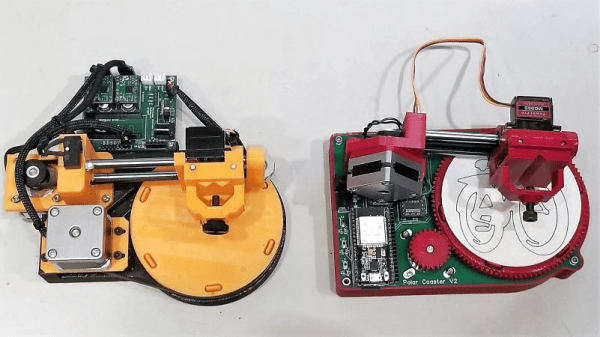
Or not, but at least it would have been fun to play with. This is actually an improved version of [bdring]’s original “Polar Coaster”. Version 2 is really just a more compact and robust version of the original. The new one has a custom controller for the steppers and pen-lift servo, and everything is mounted neatly to the main PCB. Where the original used a timing belt to drive the platter, the new one uses 3D-printed helical gears, and the steppers have been replaced by slimmer motors. It even has an SD card and smartphone UI, and the coasters look pretty good.

There’s no video of the new one, but you can see its predecessor in action below and imagine the possibilities. Snap a picture and have a line art rendition of someone plotted while you’re waiting for drinks? Just remember not to take any laser engraved wooden nickels.

Continue reading “Make An Impression At The Bar With A CNC Coaster Plotter”
Dozens Of Servos Flip The Segments Of This 3D-Printed Digital Clock

A digital clock based on seven-segment displays? Not exciting. A digital clock with seven-segment displays that’s really big and can be read across a football field? That’s a little more interesting. A large format digital clock that uses electromechanical seven-segment displays? Now that’s something to check out.

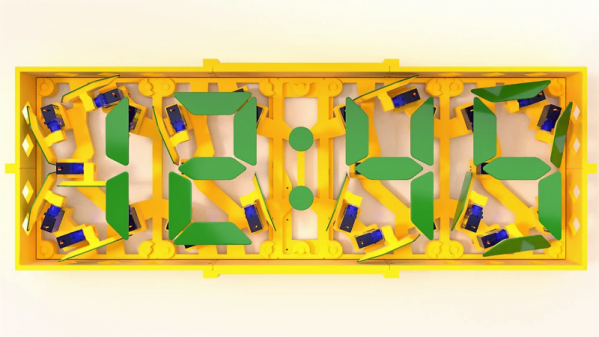
This clock comes to us by way of [Otvinta] and is a nice example of what you can do with 3D-printing and a little imagination. Each segment of the display is connected to a small hobby servo which can flip it 90°. Mounted in a printed plastic frame, the segments are flipped in and out of view as needed to compose the numerals needed to display the time. The 28 servos need two Pololu controller boards, which talk to a Raspberry Pi running Windows IoT, an interesting design choice that we don’t often see. You’d think that 28 servos clattering back and forth might be intolerable, but the video below shows that the display is actually pretty quiet. We’d love to see this printed all in black with white segment faces, or even a fluorescent plastic; how cool would that look under UV light?

We’re not saying this is the only seven-segment servo clock we’ve seen, but it is a pretty slick build. And of course there’s more than one way to use servos to tell the time.

Continue reading “Dozens Of Servos Flip The Segments Of This 3D-Printed Digital Clock”

Already Impressive CNC Router Gets An Extra Axis

The type of CNC machine within the financial reach of most DIYers is generally a three-axis affair, with a modest work envelope and a spindle that never quite seems powerful enough. That’s not to say that we don’t covet such a machine for our own shop of course, but comparing small machines with the “big boy” five-axis tools might leave the home-gamer feeling a tad inadequate.

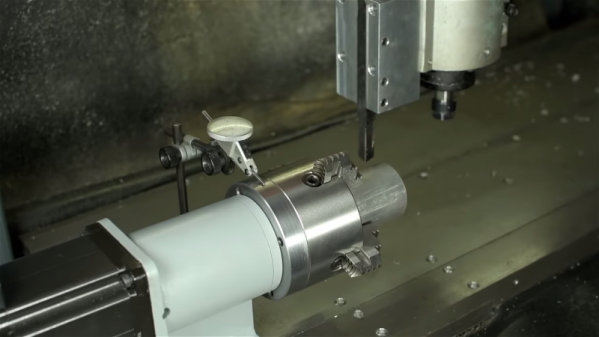
Luckily, there’s a fix that won’t necessarily break the bank: adding a fourth axis to your CNC router. [This Old Tony] tore into his CNC router – a build we’ve featured before and greatly admire – to add a machine spindle that lets him work with the machine much as if it was a CNC lathe. The first video below covers the mechanical part of the build, which involves welding and machining a sturdy assembly to hold a spindle connecting a four-jaw chuck to a Lexium MDrive, a stepper motor with integrated driver and feedback that makes it act more like a servo. [Old Tony] covered integrating the drive into Mach4 in a previous video.

The assembled machine spindle is a beefy looking affair that can smoothly ramp up to 3000 rpm and has decent enough holding torque to allow it to act as an indexing head in addition to a lathe. The second video below shows some tests turning aluminum and steel; we were surprised by how aggressive the cuts can be before stalling the spindle.

No, it’s not a Tormach or Haas or even a Pocket NC, but it’s a great addition to an already capable machine, and we’re looking forward to what [Old Tony] cranks out with it.

Continue reading “Already Impressive CNC Router Gets An Extra Axis”

Tilt-Rotor Plane Needs Flight Controller Hack To Get Airborne

Part of the charm of quadcopters is the challenge that building and flying them presents. In need of complex sensors and computational power to just get off the ground and under tremendous stresses thanks to their massively powerful motors, they often seem only barely controlled in flight. Despite these challenges, quadcopter flight has been reduced to practice in many ways, leaving hobbyists in search of another challenge.

[Tom Stanton] is scratching his creative itch with this radio-controlled tilt-rotor airplane that presents some unique problems and opportunities. Tilt-rotor planes are, as the name implies, able to swivel their propellors and transition them from providing forward thrust to providing verticle lift. With the rotors providing lift, the aircraft is able to hover and perform vertical take-off and landing (VTOL); switched to thrust mode, wings provide the lift for horizontal flight.

[Tom]’s realization of this design seems simple – a spar running through the wing holding BLDC motors and props is swiveled through 90° by a servo to transition the aircraft. Standard control surfaces on the wings and tail take care of horizontal flight. Actually getting an off-the-shelf flight controller to deal with the transitions was tricky. [Tom] ended up adding an Arduino to intercept the PWM signals the flight controller normally sends directly to the servos and speed controls to provide the coordination needed for a smooth transition. Full details in the video below, and some test flights which show that an RC VTOL is anything but a beginner’s plane.

[Tom] is proving himself to be quite the Renaissance man these days. Between air-powered piston engines, over-balance trebuchets, and popping the perfect wheelie, he seems to have covered all the bases and done his best to keep our tip line stocked.

Continue reading “Tilt-Rotor Plane Needs Flight Controller Hack To Get Airborne”

Save A Few Steps On Your Next Build With These Easy Linear Actuators

A lot of projects require linear motion, but not all of them require high-accuracy linear slides and expensive ball screws. When just a little shove for a door or the ability to pop something up out of an enclosure is all you need, finding just the right actuator can be a chore.

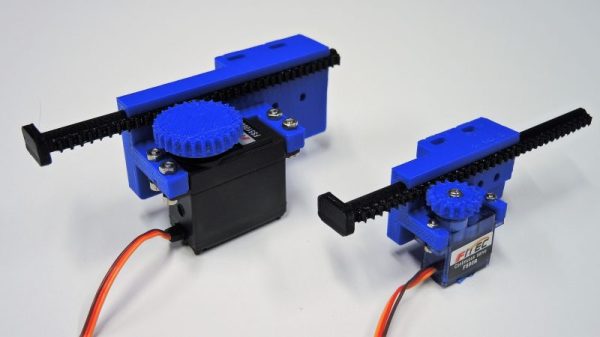
Unless someone has done the work for you, of course. That’s what [Ali] from PotentPrintables did with these 3D-printed linear actuators. It’s a simple rack-and-pinion design that’s suitable for light loads and comes in two sizes, supporting both the 9-g micro servos and the larger, more powerful version. Each design has a pinion that has to be glued to a servo horn, and a selection of rack lengths to suit your needs. The printed parts are nothing fancy, but seem to have material in the right places to bear the loads these actuators will encounter. [Ali] has included parts lists and build instructions in with the STL files, as well as sample Arduino code to get you started. The video below shows the actuators in action.

We’re heartened to learn that [Ali] was at least partly inspired to undertake this design by a previous Hackaday post. And we’re glad he decided to share his version; it might save us a few steps on our next build.

Continue reading “Save A Few Steps On Your Next Build With These Easy Linear Actuators”

Robot + Trumpet = Sad Trombone.mp3

[Uri Shaked] is really into Latin music. When his interest crescendoed, he bought a trumpet in order to make some energetic tunes of his own. His enthusiasm flagged a bit when he realized just how hard it is to get reliably trumpet-like sounds out of the thing, but he wasn’t about to give up altogether. Geekcon 2018 was approaching, so he thought, why not make a robot that can play the trumpet for me?

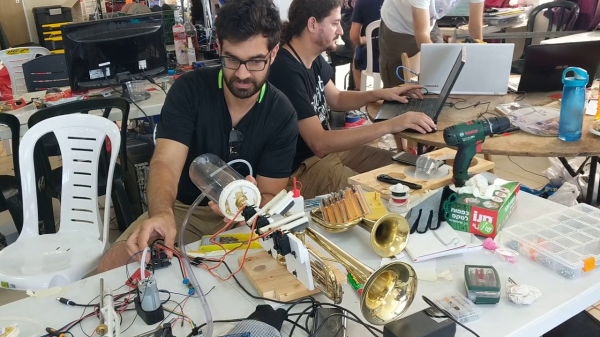
He scoured the internet and found that someone else had taken pains 20 years ago to imitate embouchure with a pair of latex lips (think rubber glove fingers filled with water). Another soul had written about measuring air flow with regard to brass instruments. Armed with this info, [Uri] and partners [Ariella] and [Avi] spent a few hours messing around with air pumps, latex, and water and came up with a proof of concept that sounds like—and [Uri]’s description is spot-on—a broken robotic didgeridoo. It worked, but the sound was choppy.

Fast forward to Geekcon. In a flash of brilliance, [Avi] thought to add capacitance to the equation. He suggested that they use a plastic box as a buffer for air, and it worked. [Ariella] 3D printed some fingers to actuate the valves, but the team ultimately ended up with wooden fingers driven by servos. The robo-trumpet setup lasted just long enough to get a video, and then a servo promptly burned out. Wah wahhhh. Purse your lips and check it out after the break.

If [Uri] ever gets fed up with the thing, he could always turn it into a game controller a la Trumpet Hero.

Continue reading “Robot + Trumpet = Sad Trombone.mp3”

Laser Cut Cardboard Robot Construction Kit Eases Learning And Play

It has never been easier to put a microcontroller and other electronics into a simple project, and that has tremendous learning potential. But when it comes to mechanical build elements like enclosures, frames, and connectors, things haven’t quite kept the same pace. It’s easier to source economical servos, motors, and microcontroller boards than it is to arrange for other robot parts that allow for cheap and accessible customization and experimentation.

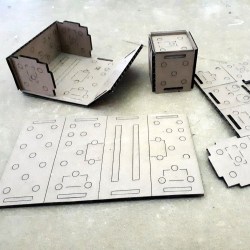
That’s where [Andy Forest] comes in with the Laser Cut Cardboard Robot Construction Kit, which started at STEAMLabs, a non-profit community makerspace in Toronto. The design makes modular frames, enclosures, and basic hardware out of laser-cut corrugated cardboard. It’s an economical and effective method of creating the mechanical elements needed for creating robots and animatronics while still allowing easy customizing. The sheets have punch-out sections for plastic straws, chopstick axles, SG90 servo motors, and of course, anything that’s missing can be easily added with hot glue or cut out with a knife. In addition to the designs being open sourced, there is also an activity guide for educators that gives visual examples of different ways to use everything.

Cardboard makes a great prototyping material, but what makes the whole project sing is the way the designs allow for easy modification and play while being easy to source and produce.