DIY Metal Detector Gives You The Mettle To Find Some Medals

Hurricane season is rapidly approaching those of us who live in the northern hemisphere. While that does come with a good deal of stress for any homeowners who live in the potential paths of storms it also comes with some opportunities for treasure hunting. Storms tend to wash up all kinds of things from the sea, and if you are equipped with this DIY metal detector you could be unearthing all kinds of interesting tchotchkes from the depths this year.

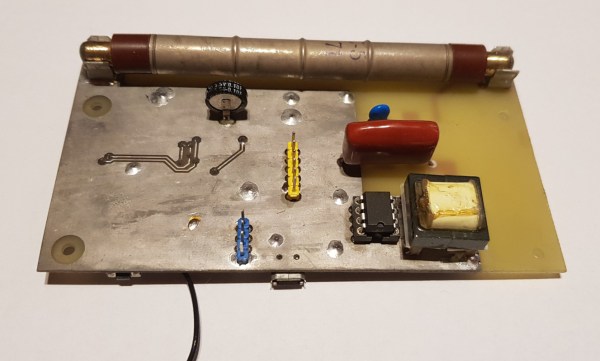
The metal detector comes to us from [mircemk] who is known for building simple yet effective metal detectors. Unlike his previous builds, this one uses only a single integrated circuit, the TL804 operational amplifier. It also works on the principle of beat-balance which is an amalgamation of two unique methods of detecting metal.  When the wire coils detect a piece of metal in the ground, the information is fed to an earpiece through an audio jack which rounds out this straightforward build.

[mircemk] reports that this metal detector can detect small objects like coins up to 15 cm deep, and larger metal objects up to 50 cm. Of course, to build this you will also need the support components, wire, and time to tune the circuit. All things considered, though it’s a great entryway into the hobby.

Want to learn more about metal detecting? Check out this similar-looking build which works on the induction balance principle.

Continue reading “DIY Metal Detector Gives You The Mettle To Find Some Medals”

All-In-One Automated Plant Care

Caring for a few plants, or even an entire farm, can be quite a rewarding experience. Watching something grow under and then (optionally) produce food is a great hobby or career, but it can end up being complicated. Thanks to modern technology we can get a considerable amount of help growing plants, even if it’s just one plant in a single pot.

Plant Bot from [YJ] takes what would normally be a wide array of sensors and controllers and combines them all into a single device. To start, there is a moisture sensor integrated into the housing so that when the entire device is placed in soil it’s instantly ready to gather moisture data. Plant Bot also has the capability to control LED lighting if the plant is indoors.  It can control the water supply to the plant, and it can also communicate information over WiFi or Bluetooth.

The entire build is based around an ESP32 which is integrated into the PCB along with all of the other sensors and components needed to monitor a single plant. Plant Bot is an excellent all-in-one solution for caring for a plant automatically. If you need to take care of more than one at a time take a look at this fully automated hydroponic mini-farm.

Mini MIDI Synth Uses Minimum Number Of Parts

The 80s were the golden age of synthesizers in pop music. Hugely complicated setups that spared no expense were the norm, with synths capable of recreating anything from pianos and guitars to percussion, strings, and brass. These types of setups aren’t strictly necessary if you’re looking to make music, though, especially in the modern age of accessible microcontrollers. This synthesizer from [Folkert] with MIDI capabilities, for example, creates catchy tunes with only a handful of parts.

This tiny synth is built around an ESP32 and works by generating PWM signals normally meant for LEDs. In this case, the PWM signals are sent through a rudimentary amplifier and then on to an audio output device.  That could be a small speaker, an audio jack to another amplifier, or a capture device.

The synth’s eight channels use up most of the ESP32’s I/O and provide a sound that’s reminiscent of the eight-bit video game era. The total parts count for this build is shockingly small with only a handful of resistors, the ESP, an optocoupler, and a few jacks.

For those wishing to experiment with synthesizers, a build like this is attractive because it’s likely that all the parts needed are already sitting around in a drawer somewhere with possibly the exception of the 5 pin DIN jacks needed for MIDI capabilities. Either way, [Folkert] has made all of the schematics available on the project page along with some sample mp3 files. For those looking to use parts from old video game systems sitting in their parts drawer, though, take a look at this synthesizer built out of a Sega Genesis.

Learn Sign Language Using Machine Vision

Learning a new language is a great way to exercise the mind and learn about different cultures, and it’s great to have a native speaker around to improve the learning experience. Without one it’s still possible to learn via videos, books, and software though. The task does get much more complicated when trying to learn a language that isn’t spoken, though, like American Sign Language. This project allows users to learn the ASL alphabet with the help of computer vision and some machine learning algorithms.

The build uses a computer vision model in MobileNetV2 which is trained for each sign in the ASL alphabet. A sign is shown to the user on a screen, and the user needs to demonstrate the sign to the computer in order to progress. To do this, OpenCV running on a Raspberry Pi with a PiCamera is used to analyze the frames of the user in real-time. The user is shown pictures of the correct sign, and is rewarded when the correct sign is made.

While this only works for alphabet signs in ASL currently, the team at the University of Glasgow that built this project is planning on expanding it to include other signs as well. We have seen other machines built to teach ASL in the past, like this one which relies on a specialized glove rather than computer vision.

Continue reading “Learn Sign Language Using Machine Vision”

Aimbot Does It In Hardware

Anyone who has played an online shooter game in the past two or three decades has almost certainly come across a person or machine that cheats at the game by auto-aiming. For newer games with anti-cheat, this is less of a problem, but older games like Team Fortress have been effectively ruined by these aimbots. These types of cheats are usually done in software, though, and [Kamal] wondered if he would be able to build an aim bot that works directly on the hardware instead.

First, we’ll remind everyone frustrated with the state of games like TF2 that this is a proof-of-concept robot that is unlikely to make any aimbots worse or more common in any games. This is mostly because [Kamal] is training his machine to work in Aim Lab, a first-person shooter training simulation, and not in a real multiplayer videogame. The robot works by taking a screenshot of his computer in Python and passing the information through a computer vision algorithm which recognizes high-contrast targets. From there a PID controller is used to tell a series of omniwheels attached to the mouse where to point, and when the cursor is in the hitbox a mouse click is triggered.

While it might seem straightforward, building the robot and then, more importantly, tuning the PID controller took [Kamal] over two months before he was able to rival pro-FPS shooters at the aim trainer. It’s an impressive build though, and if one of his omniwheel motors hadn’t burned out it may have exceeded the top human scores on the platform. If you would like a bot that makes you worse at a game instead of better, though, head over to this build which plays Valorant by using two computers to pass game information between.

Continue reading “Aimbot Does It In Hardware”

Motorcycle Voltage Regulator Uses MOSFETs

For how common motorcycles are, the designs and parts used in them tend to vary much more wildly than in cars and trucks. Sometimes this is to the rider’s advantage, like Honda experimenting with airbags or automatic transmissions. Sometimes it’s a little more questionable, like certain American brands holding on to pushrod engine designs from the ’40s. And sometimes it’s just annoying, like the use of cheap voltage regulators that fail often and perform poorly. [fvfilippetti] was tired of dealing with this on his motorcycle, so he built a custom voltage regulator using MOSFETs instead.

Unlike a modern car alternator, which can generate usable voltage even at idle, smaller or older motorcycle alternators often can’t. Instead they rely on a simpler but less reliable regulator that is typically no more than a series of diodes, but which can only deliver energy to the electrical system while the motor is running at higher speeds. Hoping to improve on this design, [fvfilippetti] designed a switched regulator from scratch out of MOSFETs with some interesting design considerations. It is capable of taking an input voltage between 20V and 250V, and improves the ability of the motorcycle to use modern, higher-power lights and to charge devices like phones as well.

In the video below, an LED was added in the circuit to give a visual indication that the regulator is operating properly. It’s certainly a welcome build for anyone who has ever dealt with rectifier- or diode-style regulators on older bikes before. Vehicle alternators are interesting beasts in their own right, too, and they can be used for much more than running your motorcycle’s electrical system.

Continue reading “Motorcycle Voltage Regulator Uses MOSFETs”

Recycling Plastic Into Filament

Plastic is a remarkable material in many ways. Cheap, durable, and versatile, it is responsible for a large percentage of the modern world we live in. As we all know, though, it’s not without its downsides. Its persistence in the environment is quite troubling, so any opportunity we can take to reduce its use is welcome. This 3D printed machine, although made out of plastic, is made out of repurposed water bottles that have been turned into the filament for the 3D printer.

While there’s not too much information available on the site, what we gather is that the machine cuts a specific type of plastic water bottle made out of PET plastic into strips, and then feeds the strips into a heated forming tool. The tool transforms the strips into the filament shape and spools them so they are ready to feed back into a 3D printer. As a proof of concept, it seems as though this machine was made from repurposed plastic, but it could also be made using whatever filament you happen to have on hand.

As far as recycling goes, this is a great effort to keep at least some of it out of landfills and oceans. Unfortunately, plastic can’t be recycled endlessly like metal, as it will eventually break down. But something like this could additionally save on some filament costs for those with access to these types of bottles. Other options for creating your own filament also include old VHS tapes, but you will likely need a separate machine for that.