The current COVID-19 pandemic is rife with problems that hackers have attacked with gusto. From 3D printed face shields and homebrew face masks to replacements for full-fledged mechanical ventilators, the outpouring of ideas has been inspirational and heartwarming. At the same time there have been many efforts in a different area: research aimed at fighting the virus itself.
Getting to the root of the problem seems to have the most potential for ending this pandemic and getting ahead of future ones, and that’s the “know your enemy” problem that the distributed computing effort known as Folding@Home aims to address. Millions of people have signed up to donate cycles from spare PCs and GPUs, and in the process have created the largest supercomputer in history.
But what exactly are all these exaFLOPS being used for? Why is protein folding something to direct so much computational might toward? What’s the biochemistry behind this, and why do proteins need to fold in the first place? Here’s a brief look at protein folding: what it is, how it happens, and why it’s important.
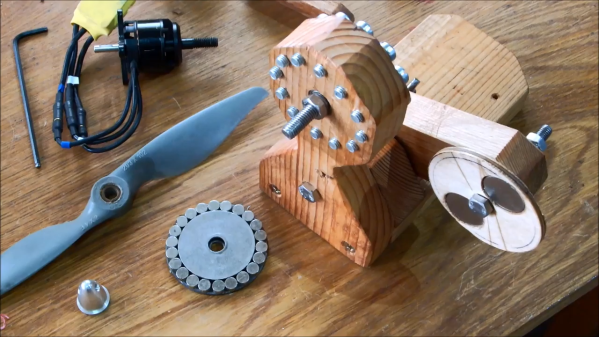
We’ve probably all used gears in our projects at one time or another, and even if we’re not familiar with the engineering details, the principles of transmitting torque through meshed teeth are pretty easy to understand. Magnetic gears, though, are a little less intuitive, which is why we appreciated stumbling upon this magnetic gear drivetrain demonstration project.
[William Fraser]’s demo may be simple, but it’s a great introduction to magnetic gearing. The stator is a block of wood with twelve bolts to act as pole pieces, closely spaced in a circle around a shaft. Both ends of the shaft have rotors, one with eleven pairs of neodymium magnets arranged in a circle with alternating polarity, and a pinion on the other side of the stator with a single pair of magnets. When the pinion is spun, the magnetic flux across the pole pieces forces the rotor to revolve in the opposite direction at a 12:1 ratio.
Watching the video below, it would be easy to assume such an arrangement would only work for low torque applications, but [William] demonstrated that the system could take a significant load before clutching out. That could even be a feature for some applications. We’ve got an “Ask Hackaday” article on magnetic gears if you want to dive a little deeper and see what these interesting mechanisms are good for.
Radio may be dead in terms of delivering entertainment, but it’s times like these when the original social network comes into its own. Being able to tune in stations from across the planet to get fresh perspectives on a global event can even be a life saver. You’ll need a good antenna to do that, which is where this homebrew loop antenna for the shortwave radio bands shines.
To be honest, pretty much any chunk of wire will do as an antenna for most shortwave receivers. But not everyone lives somewhere where it’s possible to string up a hundred meters of wire and get a good ground connection, which could make a passive loop antenna like this a good choice. Plus, loops tend to cancel the electrical noise that’s so part of life today, which can make it easier to pull in weak, distant stations.
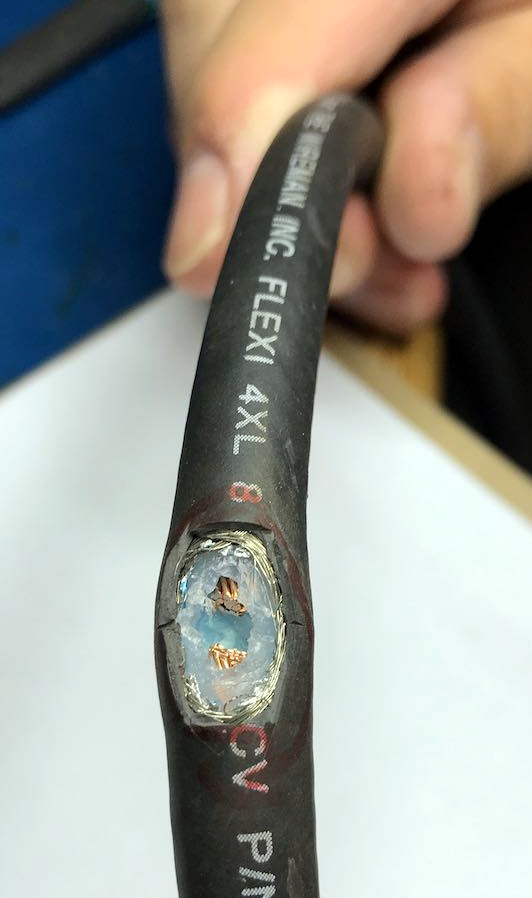
[Thomas]’s design is based on a length of coaxial cable, which should be stiff enough to give the loop some stability, like a low-loss RG-8 or RG-213. The coax braid and dielectric are exposed at the midpoint of the cable to create a feed point, while the shield and center conductor at the other ends are cross-connected. A 1:1 transformer is wound on a toroid core to connect to the feedpoint; [Thomas] calls it a balun but we tend to think it’s more of an unun, since both the antenna and feedline are unbalanced. He reports good results from the loop across the shortwave band.
The shortwave and ham bands are a treasure trove of information and entertainment just waiting to be explored. Check them out — you might learn something, and you might even stumble across spies doing their thing.
Anyone who worked in the tech field and lived through the Y2K bug era will no doubt recall it as a time seasoned with a confusing mix of fear and optimism and tempered with a healthy dose of panic, as companies rushed to validate that systems would pass the rollover of the millennium without crashing, and to remediate systems that would. The era could well have been called “the COBOL programmers full-employment bug,” as the coders who had built these legacy systems were pulled out of retirement to fix them. Twenty years on and a different bug — the one that causes COVID-19 — is having a similarly stimulative effect on the COBOL programmer market. New Jersey is one state seeking COBOL coders, to deal with the crush of unemployment insurance claims, which are killing the 40-year-old mainframe systems the state’s programs run on. Interestingly, Governor Phil Murphy has only put out a call for volunteers, and will apparently not compensate COBOL coders for their time. I mean, I know people are bored at home and all, but good luck with that.
In another throwback to an earlier time, “The Worm” is back. NASA has decided to revive its “worm” logo, the simple block letter logo that replaced the 50s-era “Meatball” logo, the one with the red chevron bracketing a starfield with an orbiting satellite. NASA switched to the worm, named for the sinuous shape of the letters and which honestly looks like a graphic design student’s last-minute homework assignment, in the 1970s, keeping it in service through the early 1990s when the meatball was favored again. Now it looks like both logos will see service as NASA prepares to return Americans to space on their own launch vehicles. Wait a minute, what happens when we stand this thing upright?
Looking for a little help advancing the state of your pandemic-related project? A lot of manufacturers are trying to help out as best they can, and many are offering freebies to keep you in the game. Aisler, for one, is offering free PCBs and stencils for COVID-19 prototypes. It looks like their rules are pretty liberal; any free and open-source project that can help with the pandemic in any way qualifies. Hats off to Aisler for doing their part.
And finally, history appears to have been made this week in the amateur radio world with the first direct transatlantic contact on the 70-cm band was made. It seems strange to think that it would take 120 years since transatlantic radio became reduced to practice by the likes of Marconi for this accomplishment to occur, but the 70-cm band is usually limited to line of sight, and transatlantic contacts at 430 MHz are usually done using a satellite as a relay. The contact was between stations FG8OJ on Guadaloupe Island in the Caribbean — who was involved in an earlier, similar record on the 2-meter band — and D4VHF on the Cape Verde Islands off the coast of Africa, and used the digital mode FT8. The 3,867-km contact was likely due to tropospheric ducting, where layers in the atmosphere form a refractive tunnel that can carry VHF and UHF signals much, much further than they usually go. While we’d love to see that record stretched a little more on each end, to make a truly transcontinental contact, it’s still quite an accomplishment, and we congratulate the hams involved.
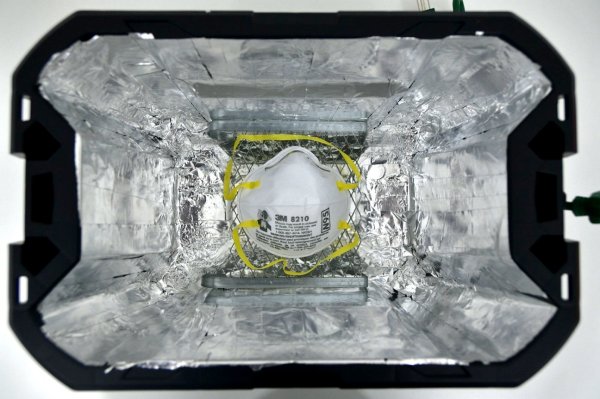
The current situation has given closet germaphobes the world over a chance to get out there and clean the hell out of everything. Some of it may be overdone; we ourselves can cop to a certain excess as we wipe down cans and boxes when returning from a run to the grocery store. But sometimes disinfection is clearly indicated, and having an easy way to kill the bugs on things like face masks can make a big difference by extending the life of something that would normally be disposable. That’s where this quick and easy UV-C germicidal cabinet really shines.
The idea behind [Deeplocal]’s “YouVee” is to be something that can be quickly cobbled together from parts that can be picked up at any big-box home store, thereby limiting the number of trips out. You might even have everything needed already, which would make this a super simple build. The business end is a UV-C germicidal fluorescent lamp, of the kind used in clarifiers for backyard ponds. A fluorescent droplight is modified to accept the lamp by snipping off a bit of plastic, and the lamp is attached to the inside of the lid of a sturdy black plastic tote. The interior of the tote is lined with aluminum tape and a stand for items to be disinfected is made from a paint roller screen. The clever bit is the safety interlock; to prevent exposure to UV, the lamp needs to be unplugged before removing the lid. Check out the full build tutorial for details.
Since the first of our ancestors discovered that banging a stick on a hollow log makes a jolly sound, we hominids have been finding new and unusual ways to make music. We haven’t come close to tapping out the potential for novel instruments, but then again it’s not every day that we come across a unique instrument and a new sound, as is the case with this string-plucking robot harp.
Named “Greg’s Harp” after builder [Frank Piesik]’s friend [Gregor], this three-stringed instrument almost defies classification. It’s sort of like a harp, but different, and sort of like an electric guitar, but not quite. Each steel string has three different ways to be played: what [Frank] calls “KickUps”, which are solenoids that strike the strings; an “eBow” coil stimulator; and a small motor with plastic plectra that pluck the strings. Each creates a unique sound at the fundamental frequency of the string, while servo-controlled hoops around each string serve as a robotic fretboard to change the notes. Sound is picked up by piezo transducers, and everything is controlled by a pair of Nanos and a Teensy, which takes care of MIDI duties.
Check out the video below and see if you find the sound both familiar and completely new. We’ve been featuring unique instruments builds forever, from not-quite-violins to self-playing kalimbas to the Theremincello, but we still find this one enchanting.
All this working from home that people have been doing has a natural but unintended consequence: revealing your dirty little domestic secrets on a video conference. Face time can come at a high price if the only room you have available for work is the bedroom, with piles of dirty laundry or perhaps the incriminating contents of one’s nightstand on full display for your coworkers.
There has to be a tech fix for this problem, and many of the commercial video conferencing platforms support virtual backgrounds. But [Florian Echtler] would rather air his dirty laundry than go near Zoom, so he built a machine-learning background substitution app that works with just about any video conferencing platform. Awkwardly dubbed DeepBackSub — he’s working on a better name — the system does the hard work of finding the person in the frame with Tensorflow Lite. After identifying everything in the frame that’s a person, OpenCV replaces everything that’s not with whatever you choose, and the modified scene is piped over a virtual video device to the videoconferencing software. He’s tested on Firefox, Skype, and guvcview so far, all running on Linux. The resolution and framerates are limited, but such is the cost of keeping your secrets and establishing a firm boundary between work life and home life.
[Florian] has taken the need for a green screen out of what’s formally known as chroma key compositing, which [Tom Scott] did a great primer on a few years back. A physical green screen is the traditional way to do this, but we honestly think this technique is great and can’t wait to try it out with our Hackaday colleagues at the weekly videoconference.



 To be honest, pretty much any chunk of wire will do as an antenna for most shortwave receivers. But not everyone lives somewhere where it’s possible to string up a hundred meters of wire and get a good ground connection, which could make a passive loop antenna like this a good choice. Plus, loops tend to cancel the electrical noise that’s so part of life today, which can make it easier to pull in weak, distant stations.