Radio Free Blockchain: Bitcoin From Space

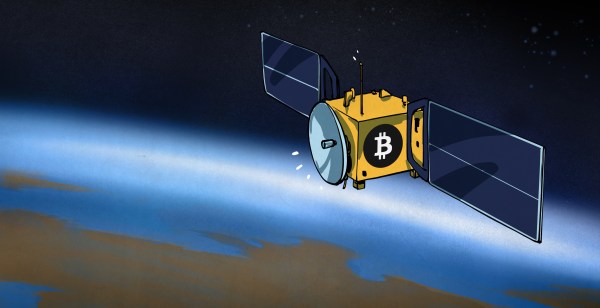
Cryptocurrencies: love them, hate them, or be baffled by them, but don’t think you can escape them. That’s the way it seems these days at least, with news media filled with breathless stories about Bitcoin and the other cryptocurrencies, and everyone from Amazon to content creators on YouTube now accepting the digital currency for payments. And now, almost everyone on the planet is literally bathed in Bitcoin, or at least the distributed ledger that makes it work, thanks to a new network that streams the Bitcoin blockchain over a constellation of geosynchronous satellites.

Continue reading “Radio Free Blockchain: Bitcoin From Space”

Components Cut In Half Reveal Their Inner Beauty

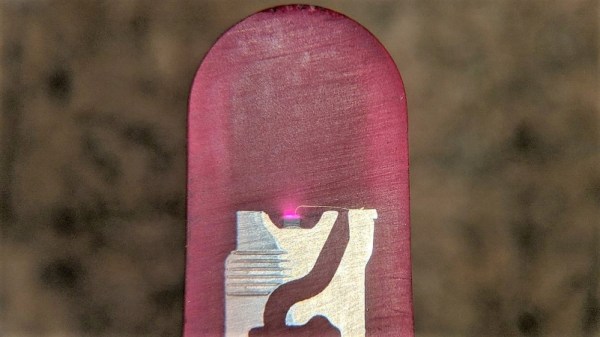
We rarely take a moment to consider the beauty of the components we use in electronic designs. Too often they are simply commodities, bought in bulk on reels or in bags, stashed in a drawer until they’re needed, and then unceremoniously soldered to a board. Granted, little scraps of black plastic with silver leads don’t exactly deserve paeans sung to their great beauty – at least not until you cut them in half to reveal the beauty within.

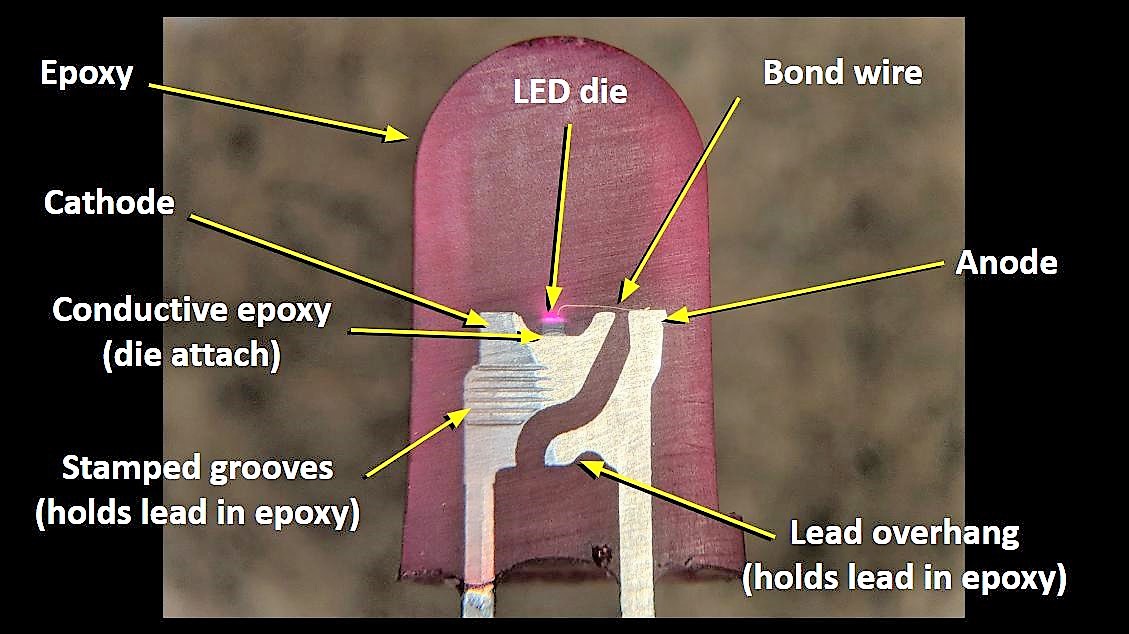
We’ve seen a little of what [Tube Time] has accomplished here; recall this lapped-down surface-mount inductor that [electronupdate] did a while back. The current work is more extensive and probably somewhat easier to accomplish because [TubeTime] focused mainly on larger through-hole components such as resistors and capacitors. It’s not clear how the sections were created, but it is clear that extreme care was taken to lap down the components with enough precision that the inner structures are clearly visible, and indeed, carefully enough that some, most notably the LED, still actually work. For our money, though, the best looking cross-sections are the capacitors, especially the electrolytic, for which [Tube Time] thoughtfully provides both radial and axial sections. The little inductor is pretty cool too. Some of the component diagrams are annotated, too, which makes for fascinating reading.

Honestly, we could look at stuff like this all day.

Thanks to [Stuart Rogers] for the tip.

Python And The Internet Of Things Hack Chat

Join us Wednesday at noon Pacific time for the Python and the Internet of Things Hack Chat!

Opinions differ about what the most-used programming language in right now is, but it’s hard to deny both the popularity and versatility of Python. In the nearly 30 years since it was invented it has grown from niche language to full-blown development environment that seems to be everywhere these days. That includes our beloved microcontrollers now with MicroPython, and Adafruit’s CircuitPython, greatly lowering the bar for entry-level hackers and simplifying and speeding development for old hands and providing a path to a Python-powered Internet of Things.

The CircuitPython team from Adafruit Industries – Dan Halbert​, Kattni Rembor​, Limor “Ladyada” Fried​, Phillip Torrone​, and Scott Shawcroft – will drop by the Hack Chat to answer all your questions about Python and the IoT. Join us as we discuss:

  • How CircuitPython came to be;
  • The range of IoT products that support Python;
  • Getting started with Python on IoT devices; and
  • What’s on the horizon for a Python-powered IoT?

And as extra enticement, we’ll be giving away five free one-year passes to ​Adafruit.io​! We’ll draw five names at random from the list of Hack Chat attendees. Stop by for a chance to win. And, the Adafruit team will be streaming video live during the Hack Chat as well.

You are, of course, encouraged to add your own questions to the discussion. You can do that by leaving a comment on the Python and the Internet of Things Hack Chat and we’ll put that in the queue for the Hack Chat discussion.

join-hack-chatOur Hack Chats are live community events on the Hackaday.io Hack Chat group messaging. This week we’ll be sitting down on Wednesday, April 3, at noon, Pacific time. If time zones have got you down, we have a handy time zone converter.

Click that speech bubble to the right, and you’ll be taken directly to the Hack Chat group on Hackaday.io. You don’t have to wait until Wednesday; join whenever you want and you can see what the community is talking about.

Want a quick peek at what’s possible with CircuitPython? Check out this PyPortal event countdown timer that just happens to be counting down the hours till the next Hack Chat.

A PIC And A Few Passives Support Breakout In Glorious NTSC Color

“Never Twice the Same Color” may be an apt pejorative, but supporting analog color TV in the 1950s without abandoning a huge installed base of black-and-white receivers was not an option, and at the end of the day the National Television Standards System Committee did an admirable job working within the constraints they were given.

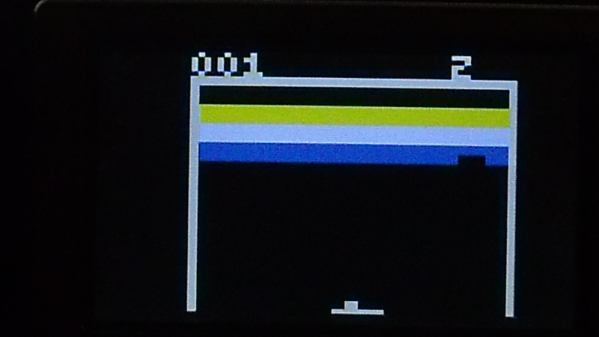
As a result of the compromises needed, NTSC analog signals are not the easiest to work with, especially when you’re trying to generate them with a microcontroller. This PIC-based breakout-style game manages to accomplish it handily, though, and with a minimal complement of external components. [Jacques] undertook this build as an homage to both the classic Breakout arcade game and the color standard that would drive the home version of the game. In addition to the PIC12F1572 and a crystal oscillator, there are only a few components needed to generate the chroma and luminance signals as well as horizontal and vertical sync. The game itself is fairly true to the original, although a bit twitchy and unforgiving judging by the gameplay video below. [Jacques] has put all the code and schematics up on GitHub for those who wish to revive the analog glory days.

Think NTSC is weird compared to PAL? You’re right, and it’s even weirder than you might know. [Matt] at Stand Up Maths talked about it a while back, and it turns out that a framerate of 29.97 fps actually makes sense when you think it through.

Continue reading “A PIC And A Few Passives Support Breakout In Glorious NTSC Color”

Eavesdropping On Cosmonauts With An SDR

Usually when we hear about someone making contact with astronauts in orbit, it’s an intentional contact between a ham on the ground and one of the licensed radio amateurs on the ISS. We don’t often see someone lucky enough to snag a conversation between ground controllers and a spacecraft en route to the ISS like this.

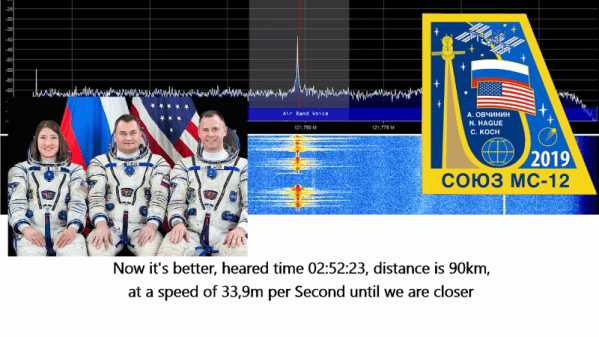
For [Tysonpower], this was all about being in the right place at the right time, as well as having the right equipment and the know-how to use it properly. Soyuz MS-12 launched from Baikonur on March 14 with cosmonaut [Aleksey Ovchinin] and NASA astronauts [Nick Hague] and [Kristina Koch] onboard, destined for the ISS after a six-hour flight. The lucky bit came when [Tysonpower] realized that the rendezvous would happen when the ISS was in a good position relative to his home in Cologne, which prompted him to set up his gear for a listening session. His AirSpy Mini SDR was connected to a home-brew quadrifilar helical (QFH) “eggbeater” antenna on his roof. What’s nice about this antenna is that it’s fixed rather than tracking, making it easy to get on the air with quickly. After digging around the aviation bands at about 121 MHz for a bit, [Tysonpower] managed to capture a few seconds of a conversation between [Ovchinin] and Moscow Flight Control Center. The commander reported his position and speed relative to the ISS a few minutes before docking. The conversation starts at about 1:12 in the video below.

We think it’s just cool that you can listen in on the conversations going on upstairs with a total of less than $50 worth of gear. Actually talking to the hams aboard the ISS is another matter, but not a lot more involved really.

Continue reading “Eavesdropping On Cosmonauts With An SDR”

LEDs Shine Through PCB On This Tiny Word Clock

Everyone seems to love word clocks. Maybe it’s the mystery of a blank surface lighting up to piece together the time in fuzzy format, or maybe it hearkens back to those “find-a-word” puzzles that idled away many an hour. Whatever it is, we see a lot of word clock builds, but there’s something especially about this diminutive PCB word clock that we find irresistible.

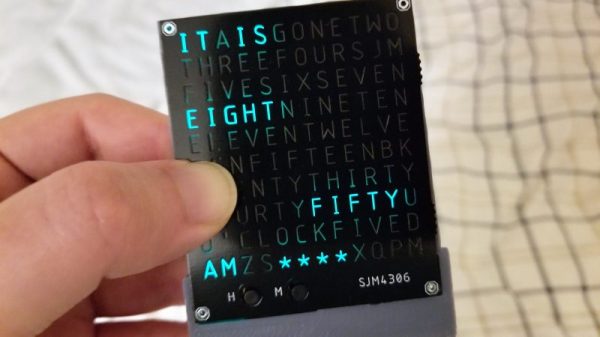
Like all fun projects, [sjm4306] found himself going through quite the design process with this one. The basic idea – using a PCB as the mask for the character array – is pretty clever. We’ve always found the laser-cut masks to be wanting, particularly in the characters with so-called counters, those enclosed spaces such as those in a capital A or Q that would be removed by a laser cutter. The character mask PCB [sjm4306] designed uses both the copper and a black solder mask to form the letters, which when lit by the array of SMD LEDs behind it glow a pleasing blue-green color against a dark background. Try as he might, though, the light from adjacent cells bled through, so he printed a stand that incorporates baffles for each LED. The clock looks great and even has some value-added modes, such as a falling characters display a la The Matrix, a Pong-like mode, and something that looks a bit like Tetris. Check out the video below for more details.

We’ve seen word clocks run afoul of the counter problem before, some that solved it by resorting to a stencil font, others that didn’t. We’re impressed by this solution, though, enough so that we hope [sjm4306] makes the PCB files available so we can build one.

Continue reading “LEDs Shine Through PCB On This Tiny Word Clock”

Extraterrestrial Excavation: Digging Holes On Other Worlds

We humans are good at a lot of things, but making holes in the ground has to be among our greatest achievements. We’ve gone from grubbing roots with a stick to feeding billions with immense plows pulled by powerful tractors, and from carving simple roads across the land to drilling tunnels under the English Channel. Everywhere we go, we move dirt and rock out of the way, remodeling the planet to suit our needs.

Other worlds are subject to our propensity for digging holes too, and in the 50-odd years that we’ve been visiting or sending robots as our proxies, we’ve made our marks on quite a few celestial bodies. So far, all our digging has been in the name of science, either to explore the physical and chemical properties of these far-flung worlds in situ, or to actually package up a little bit of the heavens for analysis back home. One day we’ll no doubt be digging for different reasons, but until then, here’s a look at the holes we’ve dug and how we dug them.

Continue reading “Extraterrestrial Excavation: Digging Holes On Other Worlds”