A 1940s Gangster-Mobile Gets An Electric Makeover

When referring to classic cars, there’s a good reason that “they don’t make ’em like that anymore.” Old cars represented the limits of what could be done in terms of materials and manufacturing methods coupled with the styles of the time and cheap fuel. The result was big, heavy cars that would cost a fortune in gas to keep on the road today.

Some people just don’t want to let those styles go, however, and send their beast off for some special modifications. This 1949 Mercury coupe with an electric drivetrain conversion is one way of keeping that retro look alive. Granted, the body of the car is not exactly showroom quality anymore, from the light patina of rust on its heavy steel body panels to the pimples cropping up under its abundant chrome. But that’s all part of the charm; this comes from conversion company Icon’s “Derelict” line, which takes old vehicles and guts them while leaving the outside largely untouched. This Mercury was given a fully electric, 298 kW drivetrain. The engine bay and trunk, together roomier than some Silicon Valley studio apartments, provided ample room for the 85 kWh Tesla battery pack and the dual electric motors, with room left over to craft enclosures for the battery controllers that look like a V8 engine. Custom electronic gauges and controls that look like originals adorn the chrome-bedazzled dash. The beast tops out at 120 mph (193 km/h) and has a 200 mile (322 km) range before it has to find a Tesla supercharger. Or a lemonade stand.

Say what you want about the old cars, but they had plenty of style. We appreciate the work that went into this conversion, which no doubt cost more than all the gas this thing has ever guzzled.

Thanks to [Qes] for the tip.
CNC Embroidery Machine Punches Out Designs A Stitch At A Time

It’s doubtful that the early pioneers of CNC would have been able to imagine the range of the applications the technology would be used for. Once limited to cutting metal, CNC machines can now lance through materials using lasers and high-pressure jets of water, squirt molten plastic to build up 3D objects, and apparently even use needle and thread to create embroidered designs.

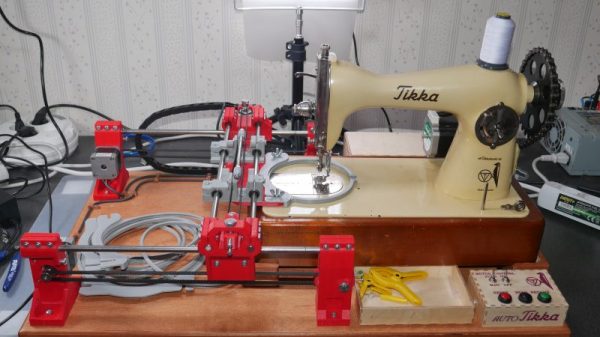
It may not seem like a typical CNC application, but [James Kolme]’s CNC embroidery machine sure looks familiar. Sitting in front of one of the prettiest sewing machines we’ve ever seen is a fairly typical X-Y gantry system. The stepper-controlled gantry moves an embroidery hoop under the needle of the sewing machine, which is actually the Z-axis of the machine. With the material properly positioned, a NEMA 23 stepper attached to the sewing machine through a sprocket and drive chain makes a stitch, slowly building up a design. Translating an embroidery pattern to G-code is done through Inkstitch, and extension to Inkscape. [James]’ write-up is great, and the video below shows it in action.

We’ve seen a CNC embroidery machine or two before, but our conspicuously non-embroidered hat is off to [James] on this one for its build quality and documentation. And the embroidered Jolly Wrencher doesn’t hurt either.

Continue reading “CNC Embroidery Machine Punches Out Designs A Stitch At A Time”

Delta Bot Plucks Out Tunes On A Mandolin

Is there no occupation safe from the scourge of robotic replacement? First it was the automobile assemblers, then fast food workers, and now it’s the — mandolin players?

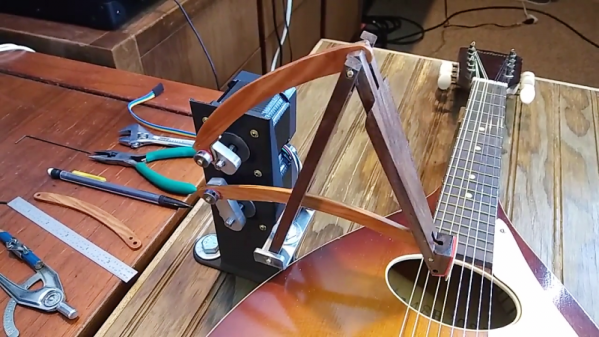
Probably not, unless [Clayton Darwin]’s mandolin playing pluck-bot has anything to say about it. The pick-wielding delta-ish robot can be seen in action in the video below, plucking out the iconic opening measures of that 70s prom-theme favorite, “Colour My World.” The robot consists of two stepper motors connected to a hinged wooden arm by two pushrods. We had to slow the video down to catch the motion, but it looks like [Clayton] has worked out the kinematics so that the pick can be positioned in front of any of the mandolin’s eight strings. A quick move of the lower stepper then flicks the pick across a string and plucks it. [Clayton] goes into some detail about how he built the motion-control part in an earlier video; he also proves that steppers are better musicians than we’ll ever be with a little “Axel F” break.

It’s only a beginning, of course, but the complexity of the kinematics just goes to show how simple playing an instrument isn’t. Unless, of course, you unleash an endless waterfall of marbles on the problem.

Continue reading “Delta Bot Plucks Out Tunes On A Mandolin”

Magnets And Printed Parts Make Quick-Disconnect Terminals

The Apple MagSafe power connector is long gone from their product line, but that doesn’t mean that magnetic connectors aren’t without their charms. It just takes the right application, and finding one might be easier with these homebrew magnetic connectors.

We’ll admit that the application that [Wesley Lee] found for his magnetic connectors is perhaps a little odd. He’s building something called Linobyte, a hybrid art and electronics project that pays homage to computing history with very high-style, interactive core memory modules. The connectors are for the sense wire that is weaved through the eight toroids on each module, to program it with a single byte. Each connector has a 3D-printed boot that holds a small, gold-plated neodymium magnet with the sense wire soldered to it. A socket holds another magnet to the underside of a PCB. The magnet in the boot sticks to the PCB and makes contact with pads, completing the circuit. We know what you’re thinking: heating a magnet past the Curie point is a great way to ruin it. [Wesley] admits that happens, but it just makes the connection a little weaker, which works for his application. The short video below shows how he puts them together.

We can think of a couple of ways these connectors would be useful, and we really like the look of the whole project. It’ll be interesting to see where it goes, but in the meantime, brushing up on how magnets work could be fun. Continue reading “Magnets And Printed Parts Make Quick-Disconnect Terminals”

Non-Nefarious Raspberry Pi Only Looks Like A Hack

We’re going to warn you right up front that this is not a hack. Or at least that’s how it turned out after [LiveOverflow] did some digital forensics on a mysterious device found lurking in a college library. The path he took to come to the conclusion that nothing untoward was going on was interesting and informative, though, as is the ultimate purpose of the unknown artifacts.

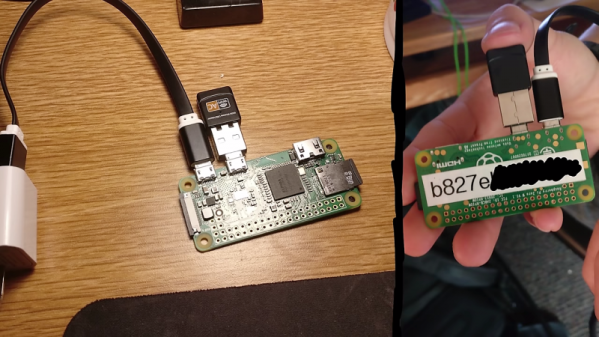
As [LiveOverflow] tells us in the video below, he came upon a Reddit thread – of which we can now find no trace – describing a bunch of odd-looking devices stashed behind garbage cans, vending machines, and desks in a college library. [LiveOverflow] recognized the posted pictures as Raspberry Pi Zeroes with USB WiFi dongles attached; curiosity piqued, he reached out to the OP and offered to help solve the mystery.

The video below tells the tale of the forensic fun that ensued, including some questionable practices like sticking the device’s SD card into the finder’s PC. What looked very “hackerish” to the finder turned out to be quite innocuous after [LiveOverflow] went down a remote-diagnosis rabbit hole to discern the purpose of these devices. We won’t spoil the reveal, but suffice it to say they’re part of a pretty clever system with an entirely non-nefarious purpose.

We thought this was a fun infosec romp, and instructive on a couple of levels, not least of which is keeping in mind how “civilians” might see gear like this in the wild. Hardware and software that we deal with every day might look threatening to the general public. Maybe the university should spring for some labels describing the gear next time.

Continue reading “Non-Nefarious Raspberry Pi Only Looks Like A Hack”

Mechanisms: Lead Screws And Ball Screws

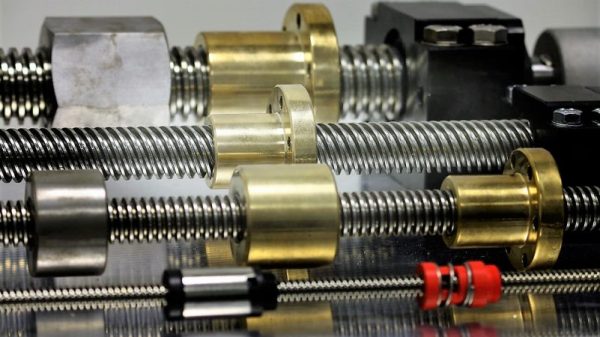
Translating rotary motion to linear motion is a basic part of mechatronic design. Take a look at the nearest 3D-printer or CNC router — at least the Cartesian variety — and you’ll see some mechanism that converts the rotation of the the motor shafts into the smooth linear motion needed for each axis.

Hobby-grade machines are as likely as not to use pulleys and timing belts to achieve this translation, and that generally meets the needs of the machine. But in some machines, the stretchiness of a belt won’t cut it, and the designer may turn to some variety of screw drive to do the job.

Continue reading “Mechanisms: Lead Screws And Ball Screws”

Unique Flat-Screen Display Put To Use In CRT Game Boy

The cathode-ray tube ruled the display world from the earliest days of TV until only comparatively recently, when flat-screen technology began to take over. CRTs just kept getting bigger over that time until they reached a limit beyond which the tubes got just too bulky to be practical.

But there was action at the low end of the CRT market, too. Tiny CRTs popped up in all sorts of products, from camcorders to the famous Sony Watchman. One nifty CRT from this group, a flat(tish) tube from a video intercom system, ended up in [bitluni]’s lab, where he’s in the process of turning it into a retro Game Boy clone with a CRT display. The display, which once showed the video from a door-mounted camera, was a gift from a viewer. Date codes on the display show it’s a surprisingly recent device; were monochrome TFT displays that hard to come by in 2007? Regardless, it’s a neat design, with the electron gun shooting upward toward a curved phosphor screen. With a little Google-assisted reverse engineering, [Bitluni] was able to track done the video connections needed to use his retro game console, which uses an ESP32 that outputs composite video. He harvested the intercom speaker for game audio, added a temporary Nintendo gamepad, and soon he was playing Tetris in glorious monochrome on the flat screen.

The video below is only the first in a series where the prototype will be stuffed into one nice tidy package. It certainly still needs some tweaking, but it’s off to a great start. We can’t wait to see the finished product.

Continue reading “Unique Flat-Screen Display Put To Use In CRT Game Boy”