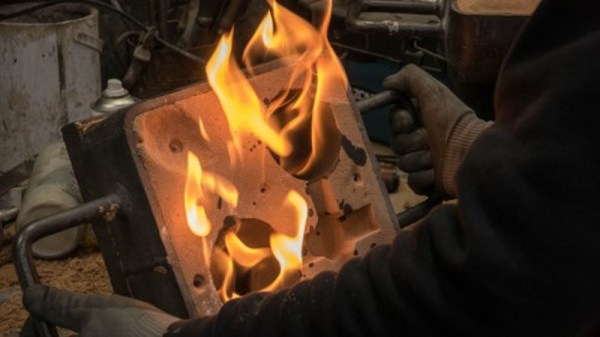
Late last year, artist [Steve Messam]’s project “Whistle” involved 16 steam engine whistles around Newcastle that would fire at different parts of the day over three months. The goal of the project was bring back the distinctive sound of the train whistles which used to be fixture of daily life, and to do so as authentically as possible. [Steve] has shared details on the construction and testing of the whistles, which as it turns out was a far more complex task than one might expect. The installation made use of modern technology like Raspberry Pi and cellular data networks, but when it came to manufacturing the whistles themselves the tried and true ways were best: casting in brass before machining on a lathe to finish.
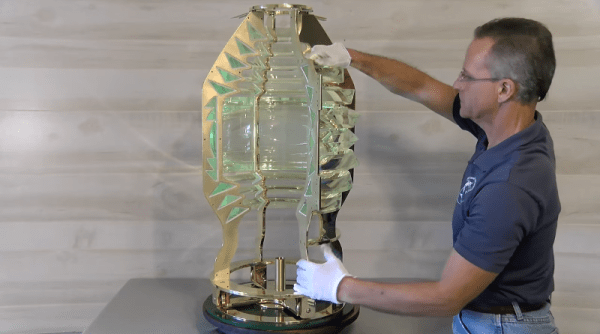
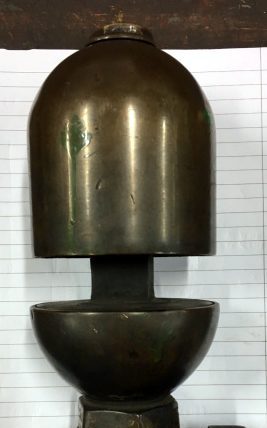 The original whistles are a peek into a different era. The bell type whistle has three major components: a large bell at the top, a cup at the base, and a central column through which steam is piped. These whistles were usually made by apprentices, as they required a range of engineering and manufacturing skills to produce correctly, but were not themselves a critical mechanical component.
In the original whistle shown here, pressurized steam comes out from within the bottom cup and exits through the thin gap (barely visible in the image, it’s very narrow) between the cup and the flat shelf-like section of the central column. That ring-shaped column of air is split by the lip of the bell above it, and the sound is created. When it comes to getting the right performance, everything matters. The pressure of the air, the size of the gap, the sharpness of the bell’s lip, the spacing between the bell and the cup, and the shape of the bell itself all play a role. As a result, while the basic design and operation of the whistles were well-understood, there was a lot of work to be done to reproduce whistles that not only operated reliably in all types of weather using compressed air instead of steam, but did so while still producing an authentic re-creation of the original sound. As [Steve] points out, “with any project that’s not been done before, you really can’t do too much testing.”
Embedded below is one such test. It’s slow-motion footage of what happens when the whistle fires after filling with rainwater. You may want to turn your speakers down for this one: locomotive whistles really were not known for their lack of volume.
Continue reading “To Make Reproduction Train Whistles, The Old Ways Are Best”
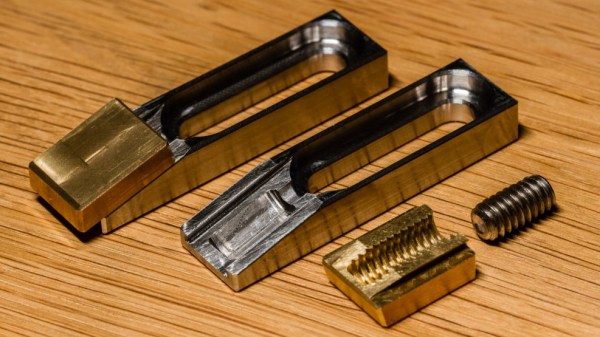
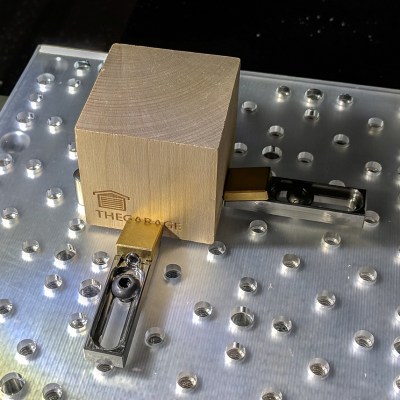 The usual way to secure a piece of stock to a fixturing table is to use top-down clamps, which hold the workpiece from the top and screw down into the table. However, this method limits how much of the stock can be accessed by the cutting tool, because the clamps are in the way. The most common way around this is to mount a vise to the table and clamp the workpiece in that. This leaves the top surface completely accessible. Unfortunately, [Kevin]’s benchtop Roland MDX-450 has a limited work area and he simply couldn’t spare the room. His solution was toe clamps, which screw down to the table and have little tabs that move inwards and downward. The tabs do the work of clamping and securing a piece of stock while maintaining a very low profile themselves.