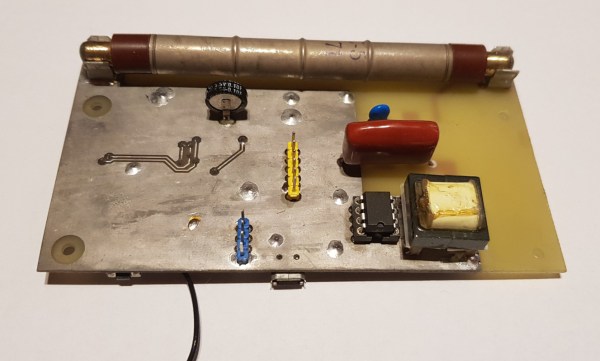
Hackaday Prize 2022: Soviet Geiger Counter Gets WiFi

[Marek] has an impressive collection of old Soviet-style Geiger counters. These are handy tools to have in some specific situations, but for most of us they would be curiosities. Even so, they need some help from the modern world to work well, and [Marek] has come up with some pretty creative ways of bringing them into the 21st century. This version, for example, adds WiFi capabilities.

This build is based on the STS-5 Geiger tube but the real heavy lifting is handled by an ESP8266 which also provides a wireless network connection. There are some limitations to using an ESP8266 to control a time-sensitive device like a Geiger tube, especially the lack of local storage, but [Marek] solves this problem by including a real-time clock and locally caching data until a network connection is re-established. Future plans for the device include adding temperature and atmospheric temperature sensors.

Eventually this Geiger counter will be installed in a watertight enclosure outside so [Marek] can keep an eye on the background radiation of his neighborhood. Previously he was doing this with another build, but that one only had access to the network over an Ethernet cable, so this one is quite an upgrade.


New OS For Commodore 64 Adds Modern Features

The Commodore 64 was a revolutionary computer for its day and age. After four decades, though, it gets harder and harder to use these computers for anything more than educational or hobby electronics projects. [Gregory Nacu] is fiercly determined to challenge this idea, though, and has gone to great extremes to make this hardware still relevant in the modern age by writing a completely new operating system for the Commodore machines.

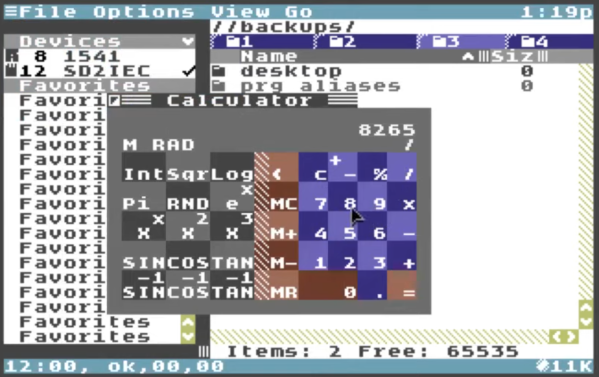
Known as C64OS, it squeezes everything it can out of the 8 bit processor and 64 kB of memory. The new OS includes switchable desktop workspaces, a windowing system, draggable icons, a Mac-style menu bar at the top, and drop-down menus for the icons (known as aliases in the demonstrations). The filesystem is largely revamped as well and enables a more modern directory system to be used. There are still some limitations like a screen resolution of 320×200 pixels and a fixed color palette which only allows for a handful of colors, but this OS might give Windows 3.1 a run for its money.

The project is still being actively developed but it has come a long way into a fairly usable state. It can be run on original hardware as well as long as you have a method of getting the image to the antique machine somehow. If not, the OS can likely run on any number of C64 emulators we’ve featured in the past.

Thanks to [Stephen] for the tip!

Continue reading “New OS For Commodore 64 Adds Modern Features”

Tiny Arcade Uses Tiny CRT

Restoring vintage electronics is a difficult hobby to tackle. Even the most practical builds often have to use some form of modern technology to work properly, or many different versions of the machine need to be disassembled to get a single working version. Either way, in the end someone will be deeply hurt by the destruction of anything antique, except perhaps with [Marco]’s recent tiny arcade with a unique CRT display.

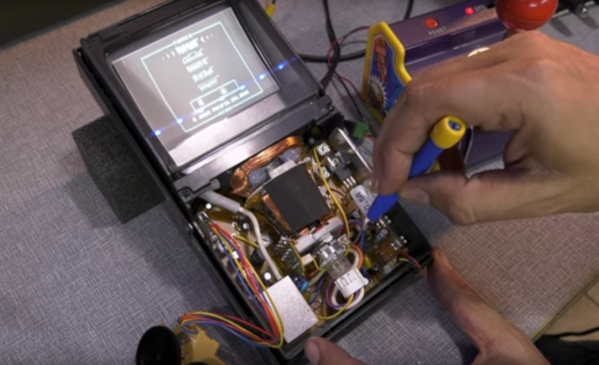
The CRT is a now-obsolete technology, but Arcade and MAME purists often seek them out because of the rounded screen and vintage feel these devices have when compared to modern LCD or LED displays. For a build this small, though, [Marco] couldn’t just use parts from an old TV set as there wouldn’t be clearance in the back of the cabinet. An outdated video conferencing system turned out to have just the part he needed, though. It has a CRT mounted perpendicularly to a curved screen in order to reduce the depth needed dramatically.

The final build uses a tiny Namco system meant to plug into the RCA jack on a standard TV, but put in a custom case that makes it look like an antique video game cabinet. It’s an interesting build that doesn’t destroy any valuable antique electronics, while still maintaining a classic arcade feel. If you’re building a larger arcade cabinet which will still satisfy the purists out there, make sure you’re using a CRT with the right kind of control system.

Continue reading “Tiny Arcade Uses Tiny CRT”

Probing CAN Bus For EV Battery Info

The widespread adoption of the CAN bus (and OBD-II) in automobiles was largely a way of standardizing the maintenance of increasingly complicated engines and their needs to meet modern emissions standards. While that might sound a little dry on the surface, the existence and standardization of this communications bus in essentially all passenger vehicles for three decades has led to some interesting side effects, like it’s usage in this project to display some extra information about an electric car’s battery.

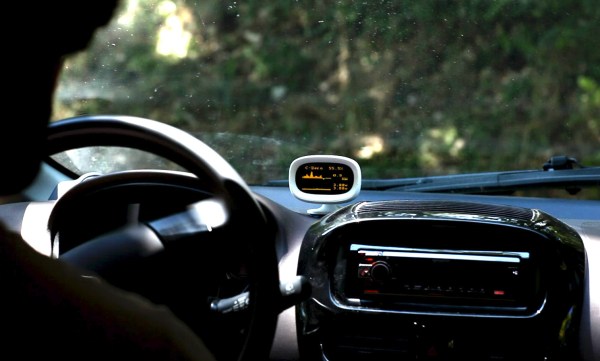
There’s not a ton of information about it, but it’s a great proof-of-concept of some of the things CAN opens up in vehicles. The build is based on a Citroën C-Zero (which is essentially just a re-badged Mitsubishi i-MiEV) and uses the information on the CAN bus to display specific information about the state of charge of the battery that isn’t otherwise shown on the car’s displays. It also includes a build of a new secondary display specifically for this purpose, and the build is sleek enough that it looks like a standard part of the car.

While there are certainly other (perhaps simpler) ways of interfacing with a CAN bus, this one uses off-the-shelf electronics like Arduino-compatible microcontrollers, is permanently installed, and has a custom case that we really like. If you’re just starting to sniff around your own vehicle’s CAN bus, there are some excellent tools available to check out.

Thanks to [James] for the tip!

Continue reading “Probing CAN Bus For EV Battery Info”

Mini Falcon 9 Uses NASA Software

[T-Zero Systems] has been working on his model Falcon 9 rocket for a while now. It’s an impressive model, complete with thrust vectoring, a microcontroller which follows a predetermined flight plan, a working launch pad, and even legs to attempt vertical landings. During his first tests of his model, though, there were some issues with the control system software that he wrote so he’s back with a new system that borrows software from the Space Shuttle.

The first problem to solve is gimbal lock, a problem that arises when two axes of rotation line up during flight, causing erratic motion. This is especially difficult because this model has no ability to control roll. Solving this using quaternion instead of Euler angles involves a lot of math, provided by libraries developed for use on the Space Shuttle, but with the extra efficiency improvements the new software runs at a much faster rate than it did previously. Unfortunately, the new software had a bug which prevented the parachute from opening, which wasn’t discovered until after launch.

There’s a lot going on in this build behind-the-scenes, too, like the test rocket motor used for testing the control system, which is actually two counter-rotating propellers that can be used to model the thrust of a motor without actually lighting anything on fire. There’s also a separate video describing a test method which validates new hardware with data from prior launches. And, if you want to take your model rocketry further in a different direction, it’s always possible to make your own fuel as well.

Continue reading “Mini Falcon 9 Uses NASA Software”

Atmospheric High-Voltage Motor Makes Useful Power

While it almost seems like an insane fever dream from an otherwise brilliant inventor, Nikola Tesla’s plan to harvest energy straight out of the atmosphere and essentially give it away is more reality than fiction. It’s usually prohibitively difficult get that energy out of the atmosphere for several obvious reasons, although it is still possible to do as [lasersaber] shows with his most recent atmospheric motor.

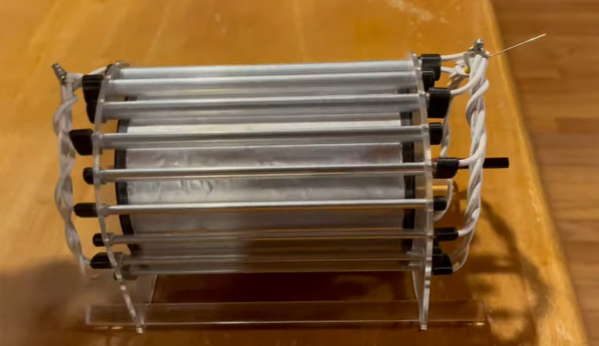
To help solve some of the logistical problems of harvesting electricity from the atmosphere, [lasersaber] is using a Van de Graaff generator as a stand-in for the high voltage gradient that can be found when suspending a long wire in the air. He has been experimenting with high-voltage motors like this for a while now and has refined his designs for corona discharge motors like these to be big enough and have enough torque to drive a drill bit. The motors have a conductive rotor with a series of discharge tubes on the stator, and exposing a metal point on the wiring (where the atmospheric wire would attach) to a sufficiently high voltage will cause rotation. In this case, it’s around 30,000 volts but with an extremely low current.

There are a number of videos documenting his latest build, including this follow-up video where he drills an arbitrarily large number of holes in various materials to demonstrate its effectiveness. Even though he is using a Van de Graaff generator in these builds, he does also show them working with a wire suspended by a drone as well for proof-of-concept. He’s also become somewhat of an expert on high-efficiency and low-power motors and has a number of other interesting builds based on these concepts.

Continue reading “Atmospheric High-Voltage Motor Makes Useful Power”

A ’70s TV With ’20s Parts

Keeping older technology working becomes exponentially difficult with age. Most of us have experienced capacitor plague, disintegrating wire insulation, planned obsolescence, or even the original company failing and not offering parts or service anymore. To keep an antique running often requires plenty of spare parts, or in the case of [Aaron]’s vintage ’70s Sony television set, plenty of modern technology made to look like it belongs in a machine from half a century ago.

The original flyback transformer on this TV was the original cause for the failure of this machine, and getting a new one would require essentially destroying a working set, so this was a perfect candidate for a resto-mod without upsetting any purists. To start, [Aaron] ordered a LCD with controls (and a remote) that would nearly fit the existing bezel, and then set about integrating the modern controls with the old analog dials on the TV. This meant using plenty of rotary encoders and programming a microcontroller to do the translating.

There are plenty of other fine details in this build, including audio integration, adding modern video and audio inputs like HDMI, and adding LEDs to backlight the original (and now working) UHF and VHF channel indicators. In his ’70s-themed display wall, this TV set looks perfectly natural. If your own display wall spotlights an even older era, take a look at some restorations of old radios instead.

Continue reading “A ’70s TV With ’20s Parts”