Super-small Robotic Joints Don’t Exist? They Do Now!

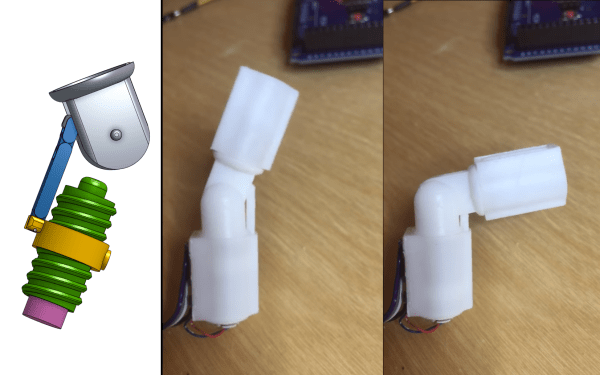
[Tim] needed very small, motorized joints for a robot. Unable to find anything to fit the bill, he designed his own tiny, robotic joints. Not only are these articulated and motorized, they are designed to be independent – each containing their own driver and microcontroller.

6mm geared motor next to LEGO [Source: Pololu]
None of the photos or video really give a good sense of just how small [Tim]’s design is. The motor (purple in the 3D render above, and pictured to the left) is a sub-micro planetary geared motor with a D shaped shaft. It is 6mm in diameter and 19mm long. One of these motors is almost entirely encapsulated within the screw it drives (green), forming a type of worm gear. As the motor turns the screw, a threaded ring moves up or down – which in turn moves the articulated shaft attached to the joint. A video is embedded below that shows the joint in action.

[Tim] originally tried 3D printing the pieces on his Lulzbot but it wasn’t up to the task. He’s currently using a Form 2 with white resin, which is able to make the tiny pieces just the way he needs them.

Continue reading “Super-small Robotic Joints Don’t Exist? They Do Now!” →

Careful Crafting Makes DIY 7-Segment Display Shine

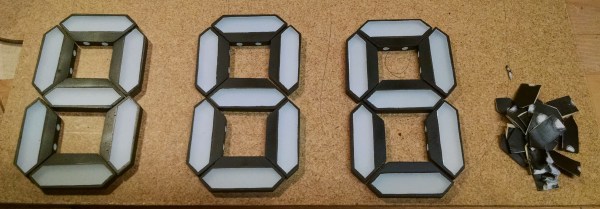
[MattB] decided to go the DIY route for some 7 segment displays that were several inches tall, but he had some particular requirements. He wanted precisely shaped elements that were as cleanly and evenly lit as possible, with no obvious points of illumination from LEDs and no visibly uneven edge lighting. To do this, he used the tools and materials he had on hand and carefully handcrafted each segment. The result is awfully close to his ideal!

Continue reading “Careful Crafting Makes DIY 7-Segment Display Shine” →

Safely Remove Drill Chuck; Receive Motor, Gearbox, And Clutch

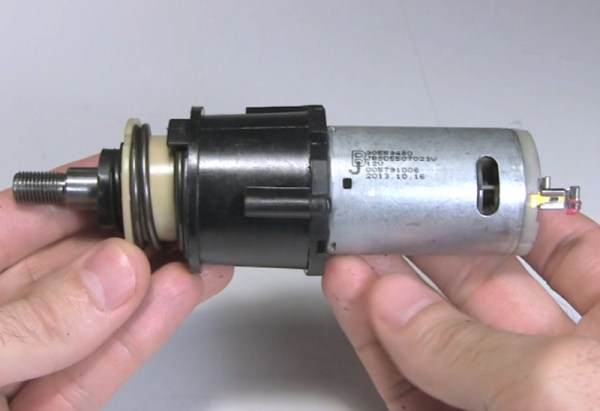
There’s a treasure trove of usefulness inside of an electric drill. [Steven Dufresne], Hackaday writer and the mad scientist behind Rimstar.org, kindly documented how to safely and reliably remove the chuck from a drill motor. You may think this is easy, but once in a while you’ll come across a drill determined to hold onto all its bits. We certainly were entertained by the lengths [Steven] went to in the video below to get a Black and Decker to give up its chuck.

An understanding of how the chuck and gearbox are connected, combined with the right tools and a bit of force, gets you a motor, gears and gearbox, and a clutch. There’s not much left in the drill after that, and you can put some or all of those components to new use — like using them for the drive system of a BB-8 Droid.

Many projects (like this walking scooter) make use of cordless drills as motor sources. Being able to skip the chuck in order to interface directly to the shaft is useful for those projects where the drill is at least a semi-permanent part of the build. Ask your friends, neighbors, and at work. Cheap cordless drills and screw guns have been around for a long time. It’s usually the batteries that go and many people have the drills lying around and will be happy to part with them knowing you’re going to do something awesome with them.

Continue reading “Safely Remove Drill Chuck; Receive Motor, Gearbox, And Clutch” →

Amazing Meccano Pinball Machine Fully Functional Before Meeting Its Fate

[Brian Leach] of the South East London Meccano Club has put an impressive amount of ingenuity into making his pinball machine almost entirely out of Meccano parts. He started in 2013 and we saw an earlier version of the table back in 2014, but it has finally been completed. It has all the trappings of proper pinball: score counter, score multiplier with timeout, standing targets, kickouts, pot bumpers, drop targets, and (of course) flippers and plunger.

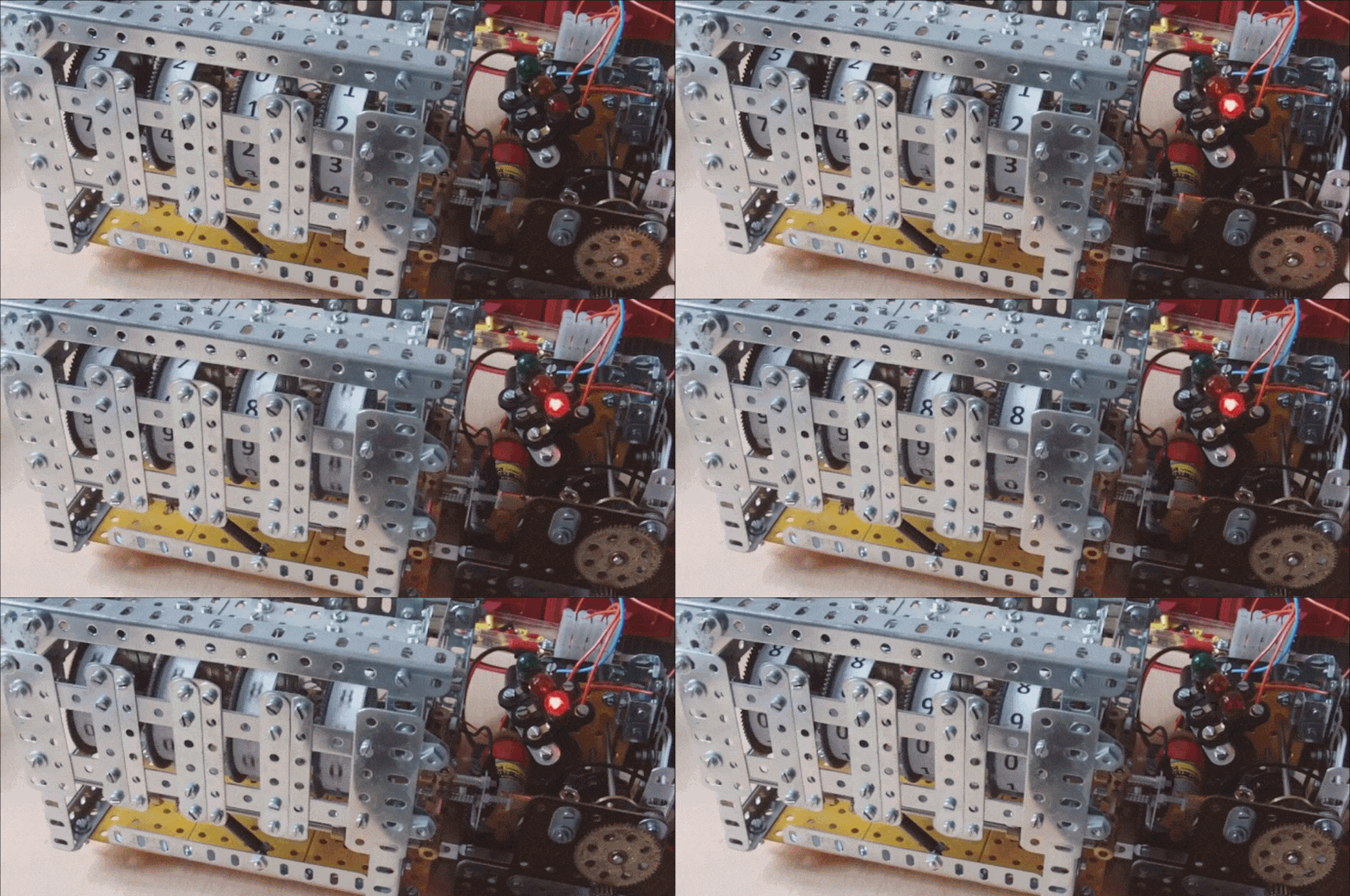
The video (embedded below) is very well produced with excellent closeups of the different mechanisms as [Brian] gives a concise tour of the machine. Some elements are relatively straightforward, others required workarounds to get the right operation, but it’s all beautifully done. For example, look at the score counter below. Meccano electromagnets are too weak to drive the numbers directly, so a motor turns all numbers continuously with a friction drive and electromagnets are used to stop the rotation at specific points. Reset consists of letting the numbers spin freely to 9999 then doing a last little push for a clean rollover to zero.

meccano-pinball-anim-wide

Continue reading “Amazing Meccano Pinball Machine Fully Functional Before Meeting Its Fate” →

Raspberry Pi Chiptune Player Rocks A Sound Chip From The 80’s

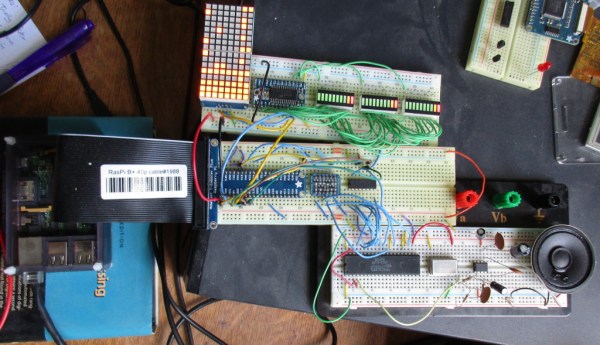
Sometimes it’s worth doing something in an inefficient way. For example, it might be worth it in order to learn something new, or just to use a particular part. [Deater] did just that with the Raspberry Pi AY-3-8910 Chiptune Player (with LED visualizers!)

The venerable General Instrument AY-3-8910 series sound chips were common in older hardware like home computers and game consoles as well as sound cards for the Apple II family. They were capable of generating three channels of square waves with various effects. Developers eventually squeezed every little bit of performance out with clever hacks. The Raspberry Pi has more than enough power to do all this in software, but as [Deater] puts it, it’s far more interesting to use an actual AY-3-8910 from the 80’s. Some LED bar graphs and matrices round out the whole system.

All the code for the Raspberry Pi AY-3-8910 chiptune player can be found on [deater]’s github repository for the project. A video of the player banging out some sounds is embedded after the break.

Continue reading “Raspberry Pi Chiptune Player Rocks A Sound Chip From The 80’s” →

“Starry Night” Dress Shines On The Experience Of Multiple Builds

[Dave Hrynkiw] wrote up some practical and useful detail around embedding electronics into clothing. It centers around his daughter’s “Starry Night” high school graduation dress, which is the culmination of a lot of experimentation in finding the best way to do things. His daughter accented the dress with LEDs to produce a twinkling starfield effect, and a laser-cut RGB pendant to match.

While [Dave] is the president of Solarbotics and pitches some products in the process of writing it all up, the post is full of genuinely useful tips that were all learned though practical use and experimentation. Imagine how awesome it must be growing up a child of a “local technology-hacking company” founder — akin to growing up as Willy Wonka’s progeny.

What advice does [Dave] have for making electronics an awesome part of garments? For example, the fact that regular hookup wire isn’t very well suited to embedding into clothing due to the need for high flexibility. There is also the concept of sequestering electronics into a separate Technology Layer — a must for anything that will be used more than once. The idea is to “build your technology so it can be isolated from the fashion aspect as much as possible. It makes building and maintenance of both the fashion and technology aspects much simpler.”

Slapping some LEDs and a battery pack into clothing might do the trick if all you care about is some bling, but if you want something that actually highlights and complements clothing while also being able to stand up to repeated use, this is a great read. A simple lighting effect that complements a design isn’t difficult, and there’s no need to reinvent the wheel or make the same mistakes others have encountered. Video is embedded below.

Continue reading ““Starry Night” Dress Shines On The Experience Of Multiple Builds” →

Dirt Cheap VR Gun With Tracking For $15 Of Added Hardware

Virtual reality doesn’t feel very real if your head is the only thing receiving the virtual treatment. For truly immersive experiences you must be able to use your body, and even interact with virtual props, in an intuitive way. For instance, in a first-person shooter you want to be able to hold the gun and use it just as you would in real reality. That’s exactly what [matthewhallberg] managed to do for just a few bucks.

This project is an attempt to develop a VR shooting demo and the associated hardware on a budget, complete with tracking so that the gun can be aimed independent of the user’s view. [matthewhallberg] calls it The Oculus Cardboard Project, named for the combined approach of using a Google Cardboard headset for the VR part, and camera-based object tracking for the gun portion. The game was made in Unity 3D with the Vuforia augmented reality plugin. Not counting a smartphone and Google Cardboard headset, the added parts clocked in at only about $15.

ESP8266 on FiducialUsing corrugated cardboard and a printout, [matthewhallberg] created a handheld paddle-like device with buttons that acts as both controller and large fiducial marker for the smartphone camera. Inside the handle is a battery and an ESP8266 microcontroller. The buttons on the paddle allow for “walk forward” as well as “shoot” triggers. The paddle represents the gun, and when you move it around, the smartphone’s camera tracks the orientation so it’s possible to move and point the gun independent of your point of view. You can see it in action in the video below.

Tracking a handheld paddle with a fiducial marker isn’t a brand new idea; We were able to find this project for example which also very cleverly simulates a trigger input by making a trigger physically alter the paddle shape when you squeeze it. The fiducial is altered by the squeeze, and the camera sees the change and registers it as an input. However, [matthewhallberg]’s approach of using hardware buttons does allow for a wider variety of reliable inputs (move and shoot instead of just move, for example). If you’re interesting in trying it out, the project page has all the required details and source code.

This isn’t [matthewhallberg]’s first attempt and getting the most out of an economical Google Cardboard setup. He used some of the ideas and parts from his earlier DIY Virtual Reality Snowboard project.

Continue reading “Dirt Cheap VR Gun With Tracking For $15 Of Added Hardware” →