People With Dementia Can DRESS Smarter

People with dementia have trouble with some of the things we take for granted, including dressing themselves. It can be a remarkably difficult task involving skills like balance, pattern recognition inside of other patterns, ordering, gross motor skill, and dexterity to name a few. Just because something is common, doesn’t mean it is easy. The good folks at NYU Rory Meyers College of Nursing, Arizona State University, and MGH Institute of Health Professions talked with a caregiver focus group to find a way for patients to regain their privacy and replace frustration with independence.

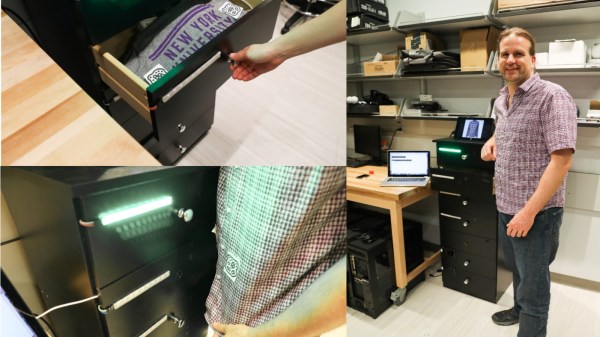
Although this is in the context of medical assistance, this represents one of the ways we can offload cognition or judgment to computers. The system works by detecting movement when someone approaches the dresser with five drawers. Vocal directions and green lights on the top drawer light up when it is time to open the drawer and don the clothing inside. Once the system detects the article is being worn appropriately, the next drawer’s light comes one. A camera seeks a matrix code on each piece of clothing, and if it times out, a caregiver is notified. There is no need for an internet connection, nor should one be given.

Currently, the system has a good track record with identifying the clothing, but it is not proficient at detecting when it is worn correctly, which could lead to frustrating false alarms. Matrix codes seemed like a logical choice since they could adhere to any article of clothing and get washed repeatedly but there has to be a more reliable way. Perhaps IR reflective threads could be sewn into clothing with varying stitch lengths, so the inside and outside patterns are inverted to detect when clothing is inside-out. Perhaps a combination of IR reflective and absorbing material could make large codes without being visible to the human eye. How would you make a machine-washable, machine-readable visual code?

Helping people with dementia is not easy but we are not afraid to start, like this music player. If matrix codes and barcodes get you moving, check out this hacked scrap-store barcode scanner.

Thank you, [Qes] for the tip.

Gentle Electric Eel

It’s no shock that electric eels get a bad rap for being scary creatures. They are slithery fleshy water snakes who can call down lightning. Biologists and engineers at the University of California had something else in mind when they designed their electric eel. Instead of hunting fish, this one swims harmlessly alongside them.

Traditional remotely operated vehicles have relied on hard shells and spinning propellers. To marine life, this is noisy and unnatural. A silent swimmer doesn’t raise any eyebrows, not that fish have eyebrows. The most innovative feature is the artificial muscles, and although the details are scarce, they seem to use a medium on the inside to conduct a charge, and on the outside, the saltwater environment conducts an opposite charge which causes a contraction in the membrane between to the inside and outside. Some swimming action can be seen below the break, and maybe one of our astute readers can shed some light on this underwater adventurer’s bill of materials.

One of our favorite submarines is the 2017 Hackaday Prize winner, The Open Source Underwater Glider. For a more artistic twist on submersibles, the Curv II is one of the most elegant we have seen.

Continue reading “Gentle Electric Eel”

Flash Memory: Caveat Emptor

We all love new tech. Some of us love getting the bleeding edge, barely-on-the-market devices and some enjoy getting tech thirty years after the fact to revel in nostalgia. The similarity is that we assume we know what we’re buying and only the latter category expects used parts. But, what if the prior category is getting used parts in a new case? The University of Alabama in Huntsville has a tool for protecting us from unscrupulous manufacturers installing old flash memory.

Flash memory usually lasts longer than the devices where it is installed, so there is a market for used chips which are still “good enough” to pass for new. Of course, this is highly unethical. You would not expect to find a used transmission in your brand new car so why should your brand new tablet contain someone’s discarded memory?

The principles of flash memory are well explained by comparing them to an ordinary transistor, of which we are happy to educate you. Wear-and-tear on flash memory starts right away and the erase time gets longer and longer. By measuring how long it takes to erase, it is possible to accurately determine the age of chip in question.

Pushing the limits of flash memory’s life-span can tell a lot about how to avoid operation disruption or you can build a flash drive from parts you know are used.

Pimp My Scope

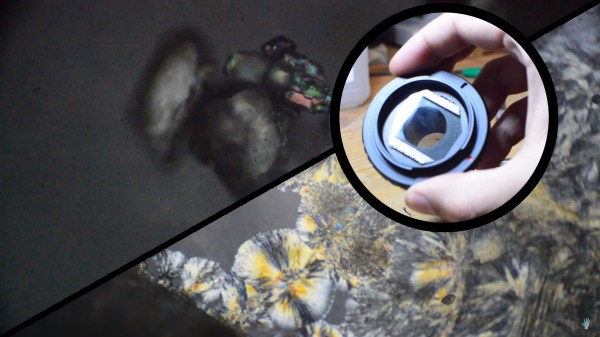
Most of us have heard some form of the adage, “You can buy cheaper, but you’ll never pay less.” It means that cheaper products ultimately do not stand up to the needs of their superior counterparts. Hackers love to prove this aphorism wrong by applying inexpensive upgrades to inexpensive tools to fill up a feature-rich tool bag. Take [The Thought Emporium] who has upgraded an entry-level microscope into one capable of polarized and dark-field microscopy. You can also see the video after the break.

Functionally, polarized images can reveal hidden features of things like striations in crystals or stress lines in hot glue threads. Dark-field microscopy is like replacing the normally glaring white background with a black background, and we here at Hackaday approve of that décor choice. Polarizing filters sheets are not expensive and installation can be quick, depending on your scope. Adding a dark-field filter could cost as much as a dime.

Like most mods, the greatest investment will be your time. That investment will pay back immediately by familiarizing you with your tools and their workings. In the long-run, you will have a tool with greater power.

Simple mods like the light source can be valuable, but upgrades are not limited to optical scopes, an electron microscope was brought back to life with Arduino

Continue reading “Pimp My Scope”

Impossibly Huge Depth Of Focus In Microscope Photographs

Sometimes, less is more. Sometimes, more is more. There is a type of person who believes that if enough photos of the same subject are taken, one of them will shine above the rest as a gleaming example of what is possible with a phone camera and a steady hand. Other people know how to frame a picture before hitting the shutter button. In some cases, the best method may be snapping a handful of photos to get one good one, not by chance, but by design.

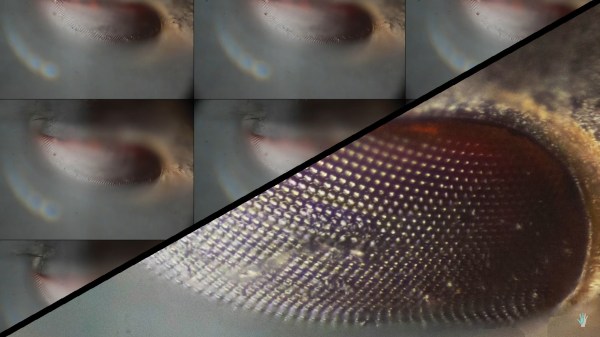
[The Thought Emporium]’s video, also below the break, is about getting crisp pictures from a DSLR camera and a microscope using focus stacking, sometimes called image stacking. The premise is to take a series of photos that each have a different part of the subject in focus. In a microscope, this range will be microscopic but in a park, that could be several meters. When the images are combined, he uses Adobe products, the areas in focus are saved while the out-of-focus areas are discarded and the result is a single photo with an impossible depth of focus. We can’t help but remember those light-field cameras which didn’t rely on moving lenses to focus but took many photos, each at a different focal range.

[The Thought Emporium] has shown us his photography passion before, as well as his affinity for taking the cells out of plants and unusual cuts from the butcher and even taking a noble stab at beating lactose intolerance.

Continue reading “Impossibly Huge Depth Of Focus In Microscope Photographs”

Step The Halbach From My Magnets

[Klaus Halbach] gets his name attached to these clever arrangements of permanent magnets but the effect was discovered by [John C. Mallinson]. Mallinson array sounds good too, but what’s in a name? A Halbach array consists of permanent magnets with their poles rotated relative to each other. Depending on how they’re rotated, you can create some useful patterns in the overall magnetic field.

Over at the K&J Magnetics blog, they dig into the effects and power of these arrays in the linear form and the circular form. The Halbach effect may not be a common topic over dinner, but the arrays are appearing in some of the best tech including maglev trains, hoverboards (that don’t ride on rubber wheels), and the particle accelerators they were designed for.

Once aligned, these arrays sculpt a magnetic field. The field can be one-sided, neutralized at one point, and metal filings are used to demonstrate the shape of these fields in a quick video. In the video after the break, a powerful magnetic field is built but when a rare earth magnet is placed in the center, rather than blasting into one of the nearby magnets, it wobbles lazily.

Be careful when working with powerful magnets, they can pinch and crush, but go ahead and build your own levitating flyer or if you came for hoverboards, check out this hoverboard built with gardening tools.


Continue reading “Step The Halbach From My Magnets”

Decellularization: Apples To Earlobes

Our bodies are not like LEGO blocks or computers because we cannot swap out our parts in the living room while watching television. Organ transplants and cosmetic surgery are currently our options for upgrades, repairs, and augments, but post-transplant therapy can be a lifelong commitment because of rejection. Elective surgery costs more than a NIB Millenium Falcon LEGO set. Laboratories have been improving the processes and associated treatments for decades but experimental labs and even home laboratories are getting in on the action as some creative minds take the stage. These folks aren’t performing surgeries, but they are expanding what is possible to for people to do and learn without a medical license.

One promising gateway to human building blocks is the decellularization and recellularization of organic material. Commercial scaffolds exist but they are expensive, so the average tinkerer isn’t going to be buying a few to play with over a holiday weekend.

Let’s explore what all this means. When something is decellularized, it means that the cells are removed, but the structure holding the cells in place remains. Recellularizing is the process where new cells are grown in that area. Decellularizing is like stripping a Hilton hotel down to the girders. The remaining structures are the ECM or the Extra Cellular Matrix, usually referred to as scaffolding. The structure has a shape but no functionality, like a stripped hotel. The scaffolding can be repopulated with new cells in the same way that our gutted hotel can be rebuilt as a factory, office building, or a hospital.

Continue reading “Decellularization: Apples To Earlobes”