Blinging Up A Scope: Scale Your Divisions In Style

When a hacker owns an oscilloscope, it’s more than a possession. Weary nights are spent staring at the display, frantically twiddling the dials to coax out vital information. Over time, a bond is formed – and only the best will do for your scope. So why settle for the stock plastic dials when you could go for gold? Well in case you hadn’t noticed, we’re partial to a bit of over-engineering here at Hackaday, and [AvE] has upgraded his Rigol scope by adding metal knobs.

Employing his usual talent in the shop, [AvE] first turns the basic knob shapes from the stock, before drilling them and milling the outer texture pattern at an angle. Voilà: six custom knobs for 100% more torque and traction control. No matter how trivial the project, it’s always good to watch him at work. This [AvE] video doesn’t come with the usual fruity language warning; instead this build is set to the swelling tones of Beethoven. “Less Talk – More Action!” says the title, but we have to say that we miss his quips. That said, he still manages to deliver his signature humour through action alone.

For some slightly more functional oscilloscope upgrades, you can read about adding a hybrid touchscreen interface, or hacking a Rigol scope’s software to unlock greater bandwidth, storage depth and more.

Continue reading “Blinging Up A Scope: Scale Your Divisions In Style”

A Guide To Audio Amps For Radio Builders

For hams who build their own radios, mastering the black art of radio frequency electronics is a necessary first step to getting on the air. But if voice transmissions are a goal, some level of mastery of the audio frequency side of the equation is needed as well. If your signal is clipped and distorted, the ham on the other side will have trouble hearing you, and if your receive audio is poor, good luck digging a weak signal out of the weeds.

Hams often give short shrift to the audio in their homebrew transceivers, and [Vasily Ivanenko] wants to change that with this comprehensive guide to audio amplifiers for the ham. He knows whereof he speaks; one of his other hobbies is jazz guitar and amplifiers, and it really shows in the variety of amps he discusses and the theory behind them. He describes a number of amps that perform well and are easy to build. Most of them are based on discrete transistors — many, many transistors — but he does provide some op amp designs and even a design for the venerable LM386, which he generally decries as the easy way out unless it’s optimized. He also goes into a great deal of detail on building AF oscillators and good filters with low harmonics for testing amps. We especially like the tip about using the FFT function of an oscilloscope and a signal generator to estimate total harmonic distortion.

The whole article is really worth a read, and applying some of these tips will help everyone do a better job designing audio amps, not just the hams. And if building amps from discrete transistors has you baffled, start with the basics: [Jenny]’s excellent Biasing That Transistor series.

[via Dangerous Prototypes]

Bike-Driven Scarf Knitter Is An Accessory To Warmth

Despite all our technological achievements, humans still spend a lot of time waiting around for trains. Add a stiff winter breeze to the injury of commuting, and you’ve got a classic recipe for misery. [George Barratt-Jones] decided to inject some warmth into this scene by inviting people to knit a free scarf for themselves by riding a bike.

All a person has to do is ride the Cyclo-Knitter for five minutes and marvel at their handiwork. By the time the scarf is finished, they’ve cycled past being cold, and they have something to hold in the warmth. Cyclo-Knitter is essentially an Addi Express knitting machine being belt-driven by a stationary bike. Power is transferred from the bike through large, handmade wooden gears using old bike tire inner tubes as belts. [George] built a wooden tower to hold the machine and give the growing scarf a protected space to dangle.

We love the utility of this project as much as the joy it inspires in everyone who tries it. Check out their scarves and their reactions after the break. We haven’t seen people this happy to see something they weren’t expecting since that billboard that kills Zika mosquitoes.

Continue reading “Bike-Driven Scarf Knitter Is An Accessory To Warmth”

Rubber Duck Debugging The Digital Way

Anyone who slings code for a living knows the feeling all too well: your code is running fine and dandy one minute, and the next minute is throwing exceptions. You’d swear on a stack of O’Reilly books that you didn’t change anything, but your program stubbornly refuses to agree. Stumped, you turn to the only one who understands you and pour your heart out to a little yellow rubber duck.

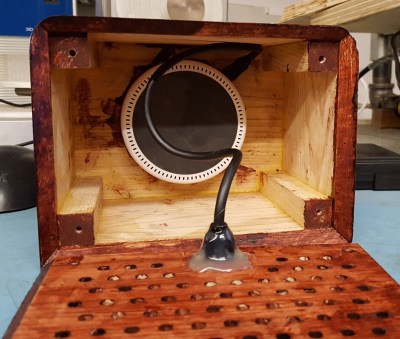
When it comes to debugging tools, this digital replacement for the duck on your desk might be even more helpful. Rubber duck decoding, where actually explaining aloud to an inanimate object how you think the code should run, really works. It’s basically a way to get you to see the mistake you made by explaining it to yourself; the duck or whatever – personally, I use a stuffed pig– is just along for the ride. [platisd] took the idea a step further and made his debugging buddy, which he dubs the “Dialectic Ball,” in the form of a Magic 8-Ball fortune teller. A 3D-printed shell has an ATtiny84, an accelerometer, and an LCD screen. To use it, you state your problem, shake it, and read the random suggestion that pops up. The list has some obvious suggestions, like adding diagnostic print statements or refactoring. Some tips are more personal, like talking to your local guru or getting a cup of coffee to get things going again. The list can be customized for your way of thinking. If nothing else, it’ll be a conversation piece on your desk.

If you’re more interested in prognostication than debugging, we have no shortage of Magic 8-Ball builds to choose from. Here’s one in a heart, one that fits in a business card, and even one that drops F-bombs.

Continue reading “Rubber Duck Debugging The Digital Way”

Donut vending machine without microcontroller

No Microcontroller In This Vending Machine, D’oh!

You might think that a microcontroller would be needed to handle a vending machine’s logic. For one thing, only the correct change should activate them and the wrong change should be returned.  If the correct change was detected then a button press should deliver the right food to the dispenser. But if you like puzzles then you might try to think of a way to do with without a microcontroller. After all, the whole circuit can be thought of as a few motors, a power source, and a collection of switches, including the right sized coin.

That’s the way [Little Puffin] approached this donut dispensing vending machine. What’s really fun is to watch the video below and wonder how the logic will all come together as you see each part being put in place. For example, it’s not until near the end that you see how the coin which is a part of the circuit is removed from the circuit for the next purchase (we won’t spoil it for you). Coins which are too small are promptly returned to the customer. To handle coins which are the right size but are too heavy, one enhancement could be to make them fall through a spring-moderated trap door and be returned as well. We’re not sure how to handle coins which are the right size but too light though.

Continue reading “No Microcontroller In This Vending Machine, D’oh!”

Magnetic Spheres Line Up For Rotary Encoder Duty

When it comes to rotary encoders, there are plenty of options. Most of them involve putting a credit card number into an online vendor’s website, though, and that’s sometimes just not in the cards. In that case building your own, like this encoder using magnetic spheres, is a pretty cool way to go too.

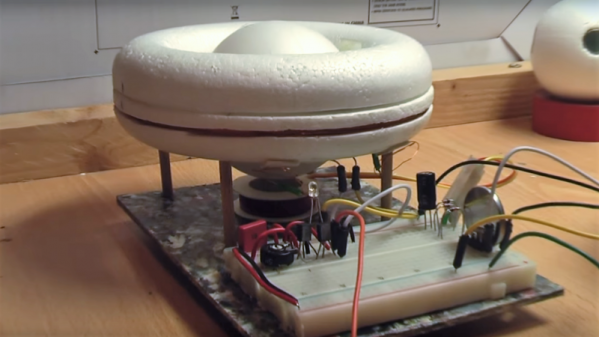
If he’d had less time to spare, we imagine [Antonio Ospite] would have gone for a commercial solution rather than building an encoder from scratch. Then again, he says his application had noise considerations, so maybe this was the best solution overall. He had some latching Hall effect sensors lying around, but lacked the ring magnet that is usually used with such sensors in magnetic encoders. But luckily, he had a mess of magnetic spheres, each 5 mm in diameter. Lined up in a circle around a knob made from a CD spindle, the spheres oriented themselves with alternating poles, which is just what the Hall sensors want to see. The sensors were arranged so the pulses are 90° apart, and can resolve 4.29° steps. Check out the video below to watch it work.

Small, cheap and effective are always good things. But magnets aren’t the only thing behind homebrew rotary encoders. A couple of microswitches might do in a pinch, or maybe even scrapped hard drives would suffice.

Continue reading “Magnetic Spheres Line Up For Rotary Encoder Duty”

Buck Converter Efficiency

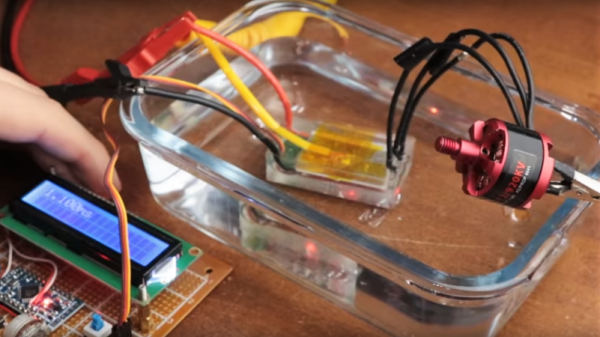
We always appreciate when someone takes the time to build something and then demonstrates what different design choices impact using the real hardware. Sure, you can work out the math and do simulations, but there’s something about having real hardware that makes it tangible. [Julian Ilett] recently posted two videos that fit this description. He built a buck converter and made measurements about its efficiency using different configurations.

The test setup is simple. He monitors the drive PWM with a scope and has power meters on the input and output. That makes it easy to measure the efficiency since it is just the ratio of the power output to input. You can see the two videos, below.

Continue reading “Buck Converter Efficiency”